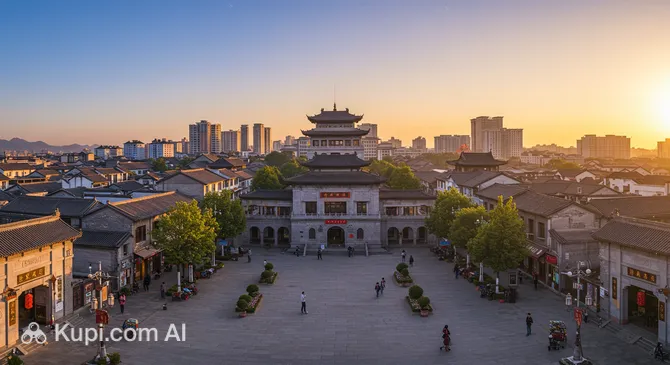
Located in the eastern part of Anhui Province, Tianchang is a dynamically developing county-level city that harmoniously combines industrial rhythm with the deep cultural heritage of China. As an important administrative and trade hub, this city attracts those who want to see the authentic life of a Chinese province away from the well-trodden tourist paths.
Tianchang. Illustration.
Source: Kupi.com AI
Geographically, Tianchang is located in close proximity to the great Yangtze River, which historically determined its status as a center for trade and agriculture. With a population of about 602,840 people, the city maintains a cozy atmosphere despite active urbanization. You can get acquainted with the rich history of Tianchang through its architectural monuments, some of which have been preserved since the 8th century.
Among the main features are ancient temples and pagodas neighboring modern residential neighborhoods. A visit to this city is an excellent choice for travelers seeking to explore the economic growth and daily life of modern Eastern China in its natural manifestation.
Weather Overview
Tianchang is characterized by a subtropical monsoon climate typical of the country's eastern region. Summers here are usually hot and humid, especially in July and August, when average temperatures reach 28–31°C. Heavy rainfall is possible during this period, so an umbrella will be a mandatory accessory in your luggage.
Winters in the city are cool, with average temperatures in January around 3–7°C; occasionally, snowfalls occur, creating picturesque landscapes. To better plan your visit, we recommend checking detailed information about the city weather in advance. The most comfortable times to visit are considered spring and autumn, when mild and predominantly dry weather sets in.
Average monthly temperature
Average monthly precipitation
Interesting Facts
Tianchang hides many amazing stories and features rooted in deep antiquity. Here are a few facts to help you get to know this city better:
The city's name translates as "Heavenly Longevity"—this name was given to the county in 748 AD as a wish for the eternal prosperity of Chinese culture.
Jinggang Pagoda, erected during the Song Dynasty (960–1279 AD), is one of the key historical sites and a recognized masterpiece of regional architecture.
Tianchang received official county-level city status in 1993, marking the beginning of a period of intensive urbanization and significant investment.
For many centuries, the city has maintained its administrative importance, remaining an important bridge for trade in Anhui Province due to its proximity to the Yangtze River.
How to Get There
The transport accessibility of Tianchang is due to its favorable geographic location near major regional centers. The main flow of travelers arrives here by intercity bus from Chuzhou or Nanjing. You can find more details on how to get to the city in specialized transport guides.
Tianchang does not have its own airport, so the most convenient option for air travelers is to arrive at Nanjing Lukou International Airport (NKG). From there, you can reach the city center by taxi or bus in about 2–3 hours, depending on traffic conditions and peak hour queues.
Railway communication is primarily carried out through the neighboring city of Chuzhou, located about 50–60 km away. Buses run regularly from Chuzhou to Tianchang, with a travel time of about an hour and a half. This is the optimal route for those using China's high-speed rail network.
Despite its industrial profile, Tianchang carefully preserves its historical treasures. The main symbol of the city is the majestic Jinggang Pagoda, dating back to the Song Dynasty. This graceful multi-tiered structure attracts lovers of classical Chinese architecture with its austere forms and ancient energy preserved through the centuries.
Another important spiritual center is the Huaiyuan Temple, founded during the Tang Dynasty. This place allows you to touch centuries-old traditions and feel peace in the heart of a busy county. A walk through the temple grounds gives tourists a rare opportunity to see authentic rituals and architectural details characteristic of old China.
For those interested in fortification art, a visit to the Old City Wall at the West Gate is a must. This is one of the surviving fortifications, serving as a symbol of the city and a clear example of the fortress architecture of the past. Today, the wall area is a popular place for walking, where historical heritage meets the daily life of citizens.
Local Cuisine
A gastronomic journey through Tianchang is an introduction to the traditions of Anhui cuisine, known for its emphasis on fresh natural ingredients. Due to the proximity to water, the local menu is often based on dishes made from river fish and shrimp caught in the Yangtze River. Try the local roasted duck and braised vegetables—these dishes feature a balanced taste and a light aroma of sauces.
The beverage culture here is represented by the famous green tea of the Anhui region, such as Huangshan Maofeng. Rice wines are also popular in local establishments. Restaurants are mainly concentrated in the central part of the county and are cozy family-run establishments serving authentic dishes at very affordable prices.
The best place to have lunch in Tianchang is where the locals do—in small restaurants without unnecessary tourist pretension. There are few specific "star" establishments here, but it is in simple street cafes that you can experience the real taste of traditional Hui cuisine, which masterfully combines the gifts of the forests and rivers of this rich region.
Travel Tips
When planning a trip to Tianchang, it is useful to prepare in advance for the specifics of life in a Chinese county. These practical tips will help you make your journey as comfortable and interesting as possible.
Clothing and Essentials: Choose clothing according to the season. In summer, light clothes and an umbrella are necessary due to high humidity; in winter, a warm jacket is needed, as the proximity of the river makes the cold more piercing. Be sure to bring comfortable shoes for walking through historical quarters.
Transport: Within the city, it is most convenient to get around by taxi using the Didi app. Buses are a budget option, but they can be crowded during peak hours.
Finances: The main methods of payment are WeChat Pay or Alipay. Cash is useful at markets, but international cards rarely work, so have a supply of yuan.
Health: On dry days, dust levels can be elevated, so having a protective mask won't hurt. Pharmacies are common in the city center.
Communication: English is almost non-existent in Tianchang. Download an offline translator in advance and carry a hotel card with the address in Chinese.
Local Etiquette: Chinese people are very hospitable but value restraint. Greet people with a slight nod, and maintain silence and an appropriate dress code (covered shoulders and knees) when visiting temples.
What to Avoid: Do not plan trips to the Yangtze River during the peak of the monsoon season (July-August) due to the risk of flooding. Also, avoid the outskirts of industrial zones after dark due to poor lighting.
Additional Tip: Try the local green tea in one of the small teahouses—it's the best way to feel the atmosphere of Anhui Province.
May your acquaintance with Tianchang bring you only positive emotions and allow you to take a new look at multifaceted China!
Entertainment & Nightlife
Tianchang is a city with a measured pace of life, so you should not expect a boisterous nightlife in the sense of major metropolises. Local entertainment is centered around the main squares and parks, where people gather in the evenings for walks and traditional outdoor dancing. This creates a very warm and friendly atmosphere typical of the Chinese province.
For those looking for modern nightclubs or large-scale entertainment centers, the best solution is a trip to neighboring Chuzhou or Nanjing. In Tianchang itself, it is worth paying attention to evening street cafes and small markets where you can not only have a snack but also observe city life. Most establishments close quite early, as the city is oriented toward a working rhythm.
Daytime leisure can be diversified by visiting local parks or walking along the shopping streets in the center of the district. The city is completely safe for evening walks, and calling a taxi through a mobile app is easy at any time of the day, allowing for a comfortable return to your hotel after dinner in one of the local restaurants.
Parks & Museums
Although Tianchang is actively developing as an industrial center, cozy green corners for relaxation can be found in the city. City parks located in the central part of the district serve as the main recreation zones. Here, residents engage in traditional gymnastics or simply relax in the shade of trees, which allows you to feel the measured rhythm of life in a modern Chinese province.
The city's museum activities are closely intertwined with its historical monuments. The main exhibitions dedicated to the region's past are often organized near the Jinggang Pagoda, where you can see household items and archaeological finds from different eras. This gives tourists an opportunity to better understand Tianchang's development path from an ancient county to a modern industrial hub.
The city's surroundings are also attractive for their agricultural landscapes. A walk beyond the dense urban areas will reveal views of endless fields and canals that change their appearance depending on the season. This combination of urbanization and traditional agrarian lifestyle is a characteristic feature of this region of Anhui.
Getting Around
Public transport in Tianchang relies on a network of bus routes connecting the central districts with industrial zones and the outskirts of the county. The fare is low, and payment can most often be made using a QR code in a mobile app or in cash. Buses run quite frequently, however, they can be crowded with workers from local enterprises during peak hours.
A popular alternative to buses is electric scooters and bicycles, used by a significant portion of the population. This is a convenient way to move quickly over short distances, avoiding traffic jams on the main roads. Tourists should be careful, as the movement of two-wheeled vehicles in the city is very intense and takes some getting used to.
Taxis and ride-hailing services (such as Didi) are available and inexpensive in Tianchang. This is the most comfortable way for travelers to get around, especially when needing to reach remote attractions or railway stations in neighboring cities. There is no metro in the city, but thanks to the compact size of the district, any trip within it rarely takes more than 30–40 minutes.
Accommodation
Accommodation options in Tianchang are primarily oriented toward business travelers and those visiting the city for work purposes. Mid-range hotels (2–3 stars) and guesthouses offering a basic set of amenities predominate here. The average cost of living varies between 100–300 yuan per night, making the city a very budget-friendly destination.
The most convenient area to find housing is the center of the county, where the main infrastructure, markets, and transport stops are concentrated. Since the city is not a mass tourist center, luxury five-star hotels are practically absent here, and travelers often head to neighboring metropolises for a luxury stay.
When planning a trip, it is recommended to book accommodation in advance through major services such as Trip.com. It is important to consider that not all budget hotels in small Chinese cities have a license to accommodate foreign citizens, so you should carefully study the guest admission rules or contact the hotel administration directly before booking.
Nearby Cities
Tianchang serves as an excellent starting point for exploring Eastern China, as it is surrounded by cities with a rich history and culture. One of the most interesting trips is a visit to ancient Yangzhou, famous for its classical gardens and picturesque lakes. You can get there by car or bus in less than an hour.
Just 73 kilometers away is the majestic Nanjing—the former capital of China, where a huge number of imperial monuments and modern shopping centers are concentrated. It is also worth paying attention to neighboring Gaoyou, which attracts travelers with its unique historical heritage and proximity to the lake.
Exploring nearby cities such as Zhenjiang or Gulou will allow you to see the multifaceted nature of the province and compare the quiet life of industrial Tianchang with the dynamics of large historical centers. Each of these destinations is ideal for a day visit and will provide many new impressions.
Shopping & Souvenirs
Shopping in Tianchang is primarily an opportunity to purchase locally produced goods and fresh produce at favorable prices. The main commercial activity is concentrated on the central streets and markets of the county. The shopping stalls near the old city wall are particularly popular, where you can find everything from clothing and household goods to authentic handicrafts.
There are few large international shopping centers in the city, but local shops and department stores are plentiful. As souvenirs of the trip, it is worth bringing back local green tea or bamboo and ceramic products that reflect the traditions of Anhui Province. Such purchases will be a soulful reminder of your visit to this original corner of China.
Shops usually operate from early morning until 21:00–22:00. To pay for purchases, it is most convenient to use mobile payment systems like WeChat Pay or Alipay, which are accepted everywhere. Don't hesitate to look into small shops in the alleys—that's often where the most interesting and inexpensive goods aimed at locals are hidden.