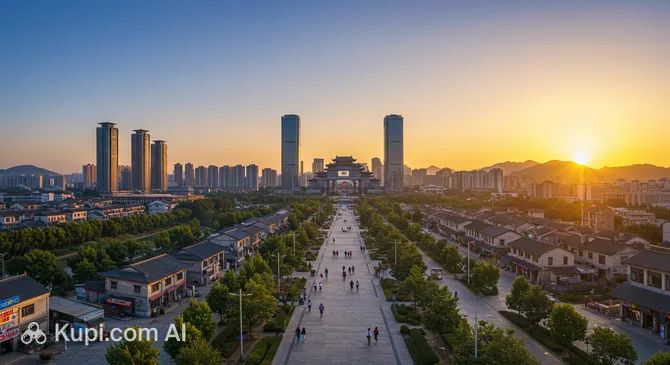
Located in the heart of Jiangsu Province, Jurong is a harmonious blend of industrial development and China's traditional agricultural lifestyle. As part of the Zhenjiang prefecture-level city, this destination does not seek to overwhelm tourists with the glitz of skyscrapers, offering instead a peaceful atmosphere and a chance to witness the everyday life of a modern Chinese county.
Geographically, the city covers an area of about 1,385 square kilometers, where flat landscapes transition smoothly into picturesque hills. With a population of over 617,000, Jurong remains relatively compact and cozy. If you are interested in the heritage of the region, it is worth learning more about the city's history, which is inextricably linked to the development of the agricultural sector and the economy of the Yangtze River basin.
Jurong. Illustration.
Source: Kupi.com AI
One of Jurong's main "calling cards" is floriculture: the region is famous for its tulip fields, which turn into a vibrant carpet in the spring. The city is ideal for those who want to take a break in their journey between metropolises and enjoy the authentic rhythm of life in East China. We invite you to discover this hospitable corner where production traditions meet natural charm.
Weather Overview
The climate in Jurong belongs to the subtropical monsoon type, which defines a clear change of seasons. Travelers should prepare for hot and humid summers, when the thermometer in July and August often rises to +32°C. Winters here are cool and dry, with the average temperature in January being around +4°C, though night frosts are not uncommon.
Precipitation in the region is abundant, especially during the spring and summer periods. The peak of the rains occurs in June and July, which is characteristic of the Yangtze River basin. If you want to know more about what kind of weather awaits you in the city in a specific month, we recommend studying the detailed city's climate. The most comfortable times for a visit are considered to be April, May, and October, when the temperature is mild and pleasant for walking.
Average monthly temperature
Average monthly precipitation
Interesting Facts
Flower capital of the region: Jurong is widely known in Jiangsu Province for its massive cultivation of tulips; in spring, gardeners from all over the country buy their bulbs.
Demographic profile: The median age of residents in the city's central districts is about 40.9 years, reflecting the stable and mature nature of the local community.
Geographic precision: The city is located almost exactly on the 32nd parallel north, which provides it with a clearly defined change of seasons and favorable conditions for agriculture.
Economic status: Jurong holds an honorable 15th place in terms of population among all counties and county-level cities in the developed Jiangsu Province.
Density of life: Despite the general agricultural focus, the population density in the central blocks reaches an impressive 7,350 people per square kilometer.
How to Get There
The transport accessibility of Jurong makes it a convenient stop during a trip through East China. The city is located in close proximity to major transport arteries, making it easy to combine a visit here with trips to neighboring metropolises. You can find detailed information about routes in the section describing how to get to the city.
The nearest major air hub is Nanjing Lukou International Airport (NKG), located approximately 80 kilometers away. From there, Jurong can be reached by taxi or intercity buses, with travel times ranging from 2 to 3 hours depending on traffic. Although the city does not have its own airport, its proximity to Nanjing solves the air travel issue.
Railway communication is another reliable way to reach Jurong. Although high-speed trains stop more frequently in neighboring Zhenjiang (which is about 40–60 km away), the local station serves regional trains. It is convenient for travelers to take buses from Zhenjiang or Nanjing, which run regularly and are the most budget-friendly option.
Although Jurong is primarily known as an industrial and agricultural hub, it offers travelers interesting local spots that reflect the spirit of Jiangsu Province. The main seasonal attraction is undoubtedly the vast agricultural fields. In spring, they are blanketed in blooming tulips, attracting photography enthusiasts and those who enjoy quiet walks in the fresh air.
Public life is concentrated in the very center of the city. Here, you will find spacious town squares and markets where you can observe the locals and feel the true flavor of county-level China. These places are not overcrowded with tourists, allowing guests to enjoy an authentic atmosphere without the usual hustle and bustle of major metropolises.
For business travelers, the Jurong Economic Development Zone may be of interest. It is a modern cluster demonstrating the industrial power of the region. Despite the absence of world-renowned monuments, a stroll through the central shopping streets and a visit to local parks will leave a pleasant impression of a well-maintained and hospitable city.
Local Cuisine
The gastronomic profile of Jurong is inextricably linked to the culinary traditions of Jiangsu Province, known for their delicate flavors and emphasis on the freshness of ingredients. The local menu is based on dishes made from rice, river fish, pork, and seasonal vegetables. A hallmark of the local cuisine is the Huaiyang style, famous for its stewing techniques and the fine slicing of ingredients.
One of the most popular local treats is su-jin miao—delicate rice dumplings with various fillings. You should also definitely try the famous Yangzhou fried rice and the aromatic salted duck, which is considered a delicacy throughout the region. A meal in Jurong is often accompanied by a cup of fresh green tea harvested from nearby plantations or traditional rice wine.
The food culture here is simple and democratic. The best places to try authentic food are small family restaurants and bustling street stalls in the city center. Prices will pleasantly surprise tourists: a hearty lunch at a local establishment can cost as little as 10–30 yuan. The lack of pretentious restaurants is more than compensated for by sincere hospitality and the chance to taste the "real" flavor of everyday China.
Travel Tips
A trip to Jurong will give you a unique experience of meeting the "real" China, and these practical tips will help make your trip comfortable and safe.
Clothing and Essentials: Choose your wardrobe according to the season—summers are hot and humid, while winters can be quite chilly. Be sure to bring comfortable walking shoes and an adapter for Chinese power outlets (types A/C/I).
Transport: Install the DiDi app for hailing taxis and Baidu Maps for orientation. Public buses are the most budget-friendly option, but be prepared for queues during peak hours.
Finance: Mobile payments dominate in China. Set up Alipay or WeChat Pay before your trip. ATMs in the city center accept international cards, but you should always have some cash in yuan for small purchases.
Health and Safety: The city is very safe, but keep an eye on your personal belongings in crowded places like markets. Pharmacies are common, but medicine names will be in Chinese, so carry a basic first-aid kit with you.
Communication: English is not widely spoken. Download an offline translator and save your hotel address in Chinese characters to show to a taxi driver.
Local Etiquette: Greeting with a slight bow or a nod of the head is standard. Be polite and patient; locals are usually very friendly toward foreign guests, though they may show curiosity about you.
What to Avoid: Do not plan important business during "Golden Week" (holidays in early October and Chinese New Year), as transport will be overloaded. Also, try to avoid walking in poorly lit industrial areas on the outskirts at night.
Best Time to Visit: Visit in April or May to catch the famous tulip blooming—it is the most beautiful time of year in Jurong.
May your introduction to this hospitable city be filled only with pleasant discoveries and bright impressions!
Entertainment & Nightlife
Nightlife in Jurong is quiet and primarily oriented toward local residents. Here, you won't find world-famous mega-clubs, but you can immerse yourself in the atmosphere of traditional Chinese entertainment. The main evening leisure activity for locals is KTV (karaoke bars), where groups of friends spend time in private, cozy rooms.
For those who prefer evening walks, the shopping centers with their spacious food courts and cinemas become the main points of attraction. Additionally, as dusk falls, night street food markets come to life, where under neon signs you can sample various local snacks and observe the city's evening buzz.
If you crave more vibrant and large-scale entertainment, locals often suggest heading to nearby metropolises. Thanks to excellent transport links, the bars and concert venues of Nanjing or Zhenjiang remain quite accessible for those seeking an energetic night out. In Jurong itself, evening is a time for family dinners, leisurely tea drinking, and strolls through illuminated city parks.
Parks & Museums
The green zones of Jurong are, first and foremost, spaces for the daily relaxation of residents and agricultural landscapes. In the city center, there are small municipal parks that are ideal for watching residents perform morning exercises or taking a leisurely evening stroll among blooming alleys. Although there is less large-scale urban landscaping here than in major tourist centers, cozy squares create a pleasant atmosphere for relaxation.
The surrounding hills and agro-parks play a special role in the city's "green" appearance. In spring, the main natural gallery becomes the tulip fields, which transform the countryside into a real open-air botanical garden. Residents often use these areas and nearby elevations for hiking and picnics, enjoying panoramic views of the county.
Regarding cultural institutions, Jurong does not yet have major historical museums of a world-class level. Local exhibitions are most often applied in nature and dedicated to the region's achievements in the economy and agriculture. Travelers wishing to immerse themselves in deep history are advised to combine a visit to Jurong with trips to the museums of neighboring Nanjing, while the county itself is best revealed through its natural and rural landscapes.
Getting Around
The public transport system in Jurong is represented by an extensive network of buses and fixed-route taxis. They connect central districts with industrial zones and nearby villages. It is worth considering that during morning and evening rush hours (roughly from 7:00 to 9:00 and 17:00 to 19:00), buses can be very crowded, so it is better to plan your trips for the middle of the day.
In the city itself, alternative methods of transportation are very popular. Due to the compactness of the central part, many key points are within a 15–20 minute walk. Locals actively use bicycles and electric scooters, which can be found at every turn. For tourists, this is a great opportunity to quickly and conveniently explore the surroundings.
Taxis and ride-hailing services (such as the DiDi app) are the most comfortable option for long-distance trips or traveling to the airport. A trip within the city limits is inexpensive—usually costing between 5 and 20 yuan. There is no metro in Jurong, so for navigating bus routes, we recommend downloading Baidu Maps or Amap in advance, as English on signs is rare.
Accommodation
The choice of accommodation in Jurong is mainly geared towards business travelers and those visiting the region for agricultural purposes. Mid-range hotels (2–3 star level) and guesthouses predominate here. Most accommodation options are concentrated in the central part of the city, providing convenient access to shops, markets, and local transport.
The price range in the city is very affordable: a standard room in a decent hotel costs an average of 150–300 yuan per night. For those planning a longer stay, renting apartments is a popular option. During the spring tulip blooming periods, the demand for accommodation may increase, so it is recommended to book rooms in advance using popular services like Ctrip.
If you are looking for luxury five-star hotels or boutique resorts, you should consider staying in nearby major cities such as Nanjing and visiting Jurong as a day trip. Nonetheless, local hotels offer the basic comfort, cleanliness, and hospitality characteristic of provincial China.
Nearby Cities
Thanks to its location, Jurong serves as an excellent starting point for exploring the attraction-rich province of Jiangsu. Several major cultural and historical centers are just a few dozen kilometers away, easily reachable by bus or car in an hour or an hour and a half.
The most popular destination is ancient Nanjing, the former capital of China. Here, travelers will find majestic imperial tombs, old city walls, and modern museums. It is also worth visiting Zhenjiang, which is famous for its picturesque hilltop temples and renowned aromatic vinegar. For a quieter introduction to the region, the cozy Yangzhou with its classical gardens or the industrial-agricultural Danyang are excellent choices.
Short trips to neighboring cities will allow you to diversify your itinerary and see the contrast between peaceful Jurong and dynamic metropolises. We recommend setting aside time to visit at least one of these destinations to fully appreciate the scale and diversity of the Yangtze region's heritage.
Shopping & Souvenirs
Shopping in Jurong is primarily an opportunity to purchase high-quality locally produced goods and fresh farm products. The city is not overloaded with luxury boutiques, but instead offers many lively shopping streets and markets in the central zone. Main shopping centers and electronics stores are concentrated around the main square and near the economic development zone.
The main souvenir to bring back from Jurong is tulip bulbs, if your visit falls in the spring. The region is also famous for its tea blends and local rice-based sweets. In the central markets, you can find affordable clothing, accessories, and electronics at prices significantly lower than in large metropolises, making a shopping trip here very practical.
Shops usually operate from morning until late evening, and the most convenient payment methods are mobile apps like WeChat Pay and Alipay, which are accepted almost everywhere. Cash is also in use, but international payment cards may only be accepted at major retail outlets. Don't forget to stop by the local food market to experience the true energy of the city's commercial life.