Suzhou is a city where nature and culture are inextricably linked, offering a landscape where meticulously curated gardens coexist with museums that preserve the region's rich artistic heritage. Beyond the most famous sites, the city is dotted with green oases and historical repositories that allow visitors to deepen their understanding of its identity as a center of refinement and scholarship.
Among the celebrated green spaces, the Lingering Garden (Liu Yuan) is often cited alongside the Humble Administrator's Garden as one of China's four greatest gardens. Renowned for its artistic layout, it packs a surprising variety of architectural styles and landscapes into a compact space. Visitors are often captivated by the 700-meter-long covered walkway that connects the garden's sections, allowing for beautiful views rain or shine. The garden is also famous for the Cloud-Capped Peak, a magnificent limestone rock from Lake Tai that stands as a testament to the traditional appreciation of natural scholars' rocks.
Another horticultural masterpiece is the Lion Grove Garden (Shizilin), which offers a distinctly different experience. Known as the "Kingdom of Rockeries," this garden is famous for its labyrinthine formations of Taihu rocks that resemble lions in various postures. It is a playful yet profound space originally built by a Zen Buddhist monk. Tourists enjoy navigating the stone mazes, which provide a sense of adventure and exploration rarely found in more sedate classical gardens.
For a breath of fresh air away from the walled enclosures, Jinji Lake offers a vast, modern natural area in the Suzhou Industrial Park. It stands in stark contrast to the old town, featuring wide promenades, the giant Ferris wheel, and open green lawns perfect for picnics. It is a favorite spot for locals to watch the sunset and enjoy the "Peach Blossom Island" located within the lake, blending contemporary leisure with scenic beauty.
Delving into the city's cultural fabric, the Suzhou Silk Museum is an essential stop given the city's historical status as the silk capital of China. The museum chronicles the history of silk production spanning thousands of years, from ancient looms to intricate brocades. Visitors can see live silkworms and watch master weavers demonstrate traditional techniques, providing a tangible connection to the trade that once brought Suzhou immense wealth and fame along the Silk Road.
The Suzhou Museum of Opera and Theatre, also known as the Kunqu Opera Museum, is located in the historic Qianxi Hall. This venue is dedicated to Kunqu, one of the oldest forms of Chinese opera and a UNESCO Intangible Cultural Heritage. The museum itself is an architectural gem, featuring an exquisite ancient stage with a domed ceiling designed to amplify sound naturally. It serves as a quiet sanctuary where you can learn about the elaborate costumes, instruments, and musical history of the region.
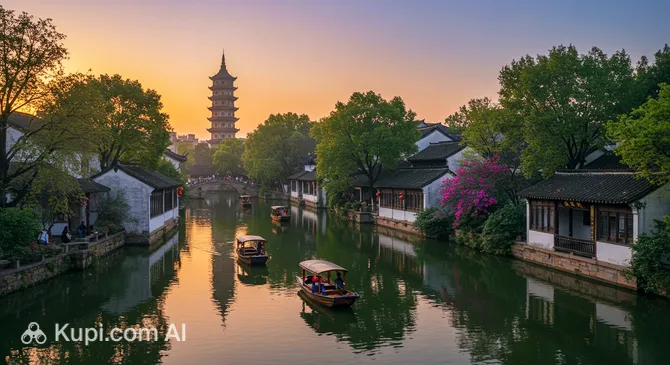
In terms of historical landmarks, the Panmen Gate is a unique architectural feat and the only existing ancient city gate in China that has both land and water entrances. Part of the Panmen Scenic Area, it allows visitors to walk atop the old city walls and view the Ruiguang Pagoda. The site perfectly illustrates the city's strategic reliance on its canal system for both defense and transport. Nearby, the Hanshan Temple is immortalized in Chinese poetry and remains a pilgrimage site for those seeking to hear its famous bell, which is rung on New Year's Eve to dispel worries.
For a truly authentic experience, seek out the Canglang Pavilion (Surging Wave Pavilion). As the oldest existing garden in Suzhou, dating back to the Northern Song Dynasty, it is less crowded than its more famous counterparts. Unlike other gardens that are enclosed by high walls, this pavilion opens up to the canal outside, borrowing the scenery of the water to create a harmonious blend of internal and external views.