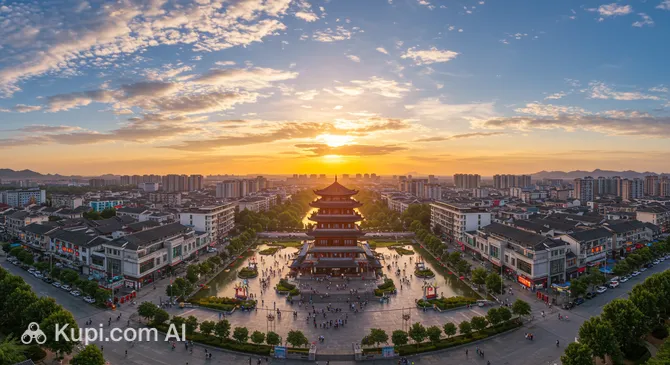
Mingguang is a peaceful county-level city located in the northeastern part of China's picturesque Anhui Province, China. Serving as an important administrative center, the city harmoniously combines the rhythm of modern life with traditional Chinese hospitality. Its geographical location on the border with Jiangsu Province and proximity to the Huai River give it a special charm, making it an important hub in the regional transport network.
Mingguang. Illustration.
Source: Kupi.com AI
The city's population is about 655,000 people, creating the atmosphere of a lively but not overcrowded metropolis. Mingguang is predominantly inhabited by the Han people, and the city itself, formerly known as Jiashan, carefully preserves the pages of its centuries-old history of Mingguang. For the traveler, this place reveals itself as an authentic corner of the Middle Kingdom, where one can see the everyday life of provincial China without embellishment.
Although the city is not a typical tourist magnet, it attracts visitors with its sincerity. Here, you can stroll along cozy embankments, visit bustling local markets, or simply enjoy the silence in one of the city parks. Mingguang invites those looking for a relaxing holiday who want to get acquainted with the real, non-tourist China, its traditions, and its measured way of life.
Weather Overview
The climate of Mingguang is humid continental in character, typical of the Huai River basin region. All four seasons are clearly defined here, each bringing its own colors to the city's appearance. Travelers should keep in mind that the weather in the city can be quite changeable, especially during the transitional periods of spring and autumn.
Summer in Mingguang is hot and humid: in July and August, the thermometer often rises above +30°C, and tropical rains bring a significant part of the annual precipitation. Winters, on the contrary, are quite dry and cold—in January, the average temperature is about +2.5°C, but frosts occur frequently. Expect a warm, sun-filled summer with occasional thunderstorms and bracing, clear winter days when the city settles into tranquility.
The most favorable times for a visit are considered April–May and September–October. During these months, the temperature is comfortable (averaging +17°C...+22°C), and precipitation is minimal, which is ideal for long walks along the embankments and exploring the surroundings without the summer heat or winter chill.
Average monthly temperature
Average monthly precipitation
Interesting Facts
Historical Name: For a long time, the city was known as Jiashan County before receiving its current name.
Natural Border: The Huai River, one of China's most important waterways, serves as a natural boundary separating Mingguang from neighboring Jiangsu Province to the northeast.
Administrative Structure: Modern Mingguang includes 4 subdistricts and 12 towns, highlighting its role as an important regional center.
Ethnic Composition: The vast majority of residents (over 650,000 people) are members of the Han ethnicity, making the city's cultural environment very homogeneous and traditional.
Geographical Junction: The city is located at the junction of the major provinces of Anhui and Jiangsu, which historically made it an important transit point for trade and travel.
How to Get There
The transport accessibility of Mingguang is ensured by its favorable location in the eastern part of the country. The main flow of travelers arrives here through the major transport hubs of Anhui Province. The city is well connected by bus and rail to the administrative center of Zhoukou and the provincial capital, Hefei.
Mingguang does not have its own airport, so air travelers usually use the nearest large air hubs in Hefei or Nanjing. From these cities, Mingguang can be reached by high-speed trains or intercity buses. Travel time by train from the nearest large centers is usually between 1 and 3 hours, making the trip quite comfortable.
Mingguang Railway Station handles trains following important directions, including lines connecting the region with Beijing and Shanghai. This makes the city a convenient point for those traveling through China by rail. More detailed information on routes and tickets can be found on the specialized page describing how to get there in this region.
Station
Passenger traffic
Distance
Huai'an East Railway Station
3
105 km
Nanjing railway station
12
134 km
Nanjing South railway station
11
146 km
Xuzhou railway station
9
150 km
Yangzhou East Railway Station
4
153 km
For those who prefer road transport, important highways such as the G3 and G104 pass through the city. A car trip from neighboring cities in Jiangsu Province will take about 1.5–2 hours, though potential traffic congestion during peak hours at the entrances to large settlements should be taken into account.
Main Attractions
Unlike major metropolises, Mingguang does not strive to impress tourists with grandiose monuments of world significance. Its main charm lies in its authentic atmosphere and the opportunity to see the life of an ordinary Chinese city from the inside. The center of social life is the main City Square, where locals gather in the evenings for dancing or leisurely walks under the lantern light.
The embankments along the Huai River deserve special attention. This is the city's natural border, which shapes its unique landscape. A walk along the water allows you to enjoy the tranquility and observe how the river influences the daily life of the townspeople. During the warm season, the riverbanks become a favorite spot for relaxation and picnics.
For those interested in modern architecture and infrastructure, it is worth looking into the administrative center of Mingguang. Here, you will find modern buildings surrounded by well-kept alleys. Despite the absence of famous landmarks, the city leaves a pleasant impression with its cleanliness, order, and the friendliness of local residents, who are always ready to show the way to a rare foreign guest.
Local Cuisine
The gastronomic identity of Mingguang is closely linked to the traditions of Anhui cuisine (Huicai), which is among the eight great culinary schools of China. The main emphasis here is on the freshness of ingredients and the mastery of stewing. Thanks to its proximity to the Huai River, dishes made from river fish, shrimp, and snails, prepared with aromatic spices and soy sauce, hold a place of honor on the local menu.
One of the signature dishes worth trying is stewed duck made according to a local recipe, as well as various vegetable stews using seasonal products grown on surrounding farms. Street food also plays an important role in the city's life: at the morning and evening markets, be sure to try freshly prepared noodles, steamed jiaozi dumplings, and crispy flatbreads with herbs.
As for drinks, locals prefer the famous green tea for which Anhui Province is renowned. Tea drinking here is not just a way to quench thirst but an important part of social culture. In restaurants, you can also find local rice wine, which is traditionally served with hot and hearty dishes. The atmosphere in Mingguang's establishments is simple and sincere, and the food always delights with its authenticity and rich flavor.
Travel Tips
A trip to Mingguang will give you a unique experience of getting to know the authentic China. To make your trip as comfortable and interesting as possible, we have prepared some practical tips.
Clothing and Essentials: Pack your suitcase according to the season. Summers in Mingguang are hot and very humid, so choose light, natural fabrics. Winters can be quite frosty, so a warm jacket is a must. Don't forget comfortable shoes for walking and a universal power adapter.
Transport: The main way to get around is by buses and taxis. If you plan to go to neighboring cities, check the train schedules at the station in advance. For moving around the city itself, bicycles are very convenient.
Finance: The official currency is the Chinese Yuan. Be sure to carry cash with you, as foreign bank cards are not accepted everywhere. The most reliable way to pay is through the Alipay or WeChat Pay apps, if you have them set up.
Health and Safety: The city is generally very safe, and the crime rate is minimal. Nevertheless, standard precautions are always wise. Pharmacies can be found in the center, but it's better to bring specific medications with you.
Communication: English is practically not spoken here. Be sure to install an offline translator on your smartphone and save your hotel address in Chinese to show it to the taxi driver.
Local Etiquette: Greet people with a slight nod of the head. In communication, Chinese people value politeness and restraint. Loud behavior in public places may be perceived negatively.
What to Avoid: You should not discuss sensitive political topics or photograph government facilities without permission. Also, try not to drink tap water—use only bottled water.
Extra Tip: Visit the local morning markets—it's the best way to feel the real rhythm of life in Mingguang and try the freshest delicacies.
May your acquaintance with this cozy corner of Anhui Province be filled with bright discoveries and warm encounters. Have a pleasant journey!
Entertainment & Nightlife
Entertainment in Mingguang is predominantly local and quiet in nature. You won't find world-famous noisy nightclubs here, but the city offers a great opportunity to dive into typical Chinese evening leisure. The most popular form of entertainment among residents is KTV bars (karaoke), which can be found in the central part of the city. These are excellent places to spend time with company and listen to the locals sing.
Evening life is concentrated around the central squares and small cafes. After sunset, the streets come alive thanks to street food vendors and improvised open-air dance floors, where residents of all ages gather for group exercise and dancing. This tradition creates a wonderfully warm and friendly atmosphere in which even a tourist will feel like a welcome guest.
If you are looking for larger-scale entertainment, such as modern cinemas or large shopping and entertainment centers, locals usually head to nearby major cities like Hefei or Bengbu. However, for those who appreciate cozy gatherings in small restaurants and leisurely walks along illuminated embankments, Mingguang provides everything needed for a pleasant end to the day.
Parks & Museums
The green zones of Mingguang serve as true oases of tranquility for its residents and guests. The main place for outdoor recreation is the city parks located along the banks of the Huai River. These areas are equipped with walking paths, cozy traditional-style gazebos, and sports grounds. Here, you can see elderly people practicing Tai Chi and children flying kites.
Although there are no major world-class state museums in Mingguang itself, local exhibition halls and folk art centers may be of interest to culture lovers. These venues often host exhibitions dedicated to the history of the region and the achievements of local craftsmen. This is a great opportunity to learn more about the crafts characteristic of Anhui Province, such as calligraphy or wood carving.
For those willing to venture a little further beyond the central urban area, views of vast agricultural landscapes open up, which are themselves a kind of "open-air museum" showcasing the traditional way of life in a Chinese village. The combination of well-kept city squares and the natural beauty of the riverbank makes walking around Mingguang a pleasant and relaxing activity.
Getting Around
The public transport system in Mingguang is mainly represented by an extensive network of bus routes. Buses run between the city center, the station, and remote subdistricts, providing reliable connections for local residents. Intervals are usually 10–20 minutes, and the fare is extremely low, making this mode of transport the most economical way to get around.
For faster and more comfortable trips around the city, you can always use taxi services. Cars are easy to find on the streets or call via popular apps, though it's worth noting that in smaller cities like Mingguang, the choice of services may be more limited than in metropolises. Payment in taxis is most often by the meter, and it is advisable to have the destination address written in Chinese characters.
Electric scooters and bicycles are extremely popular among Mingguang residents, allowing for quick maneuvering through traffic. For tourists, renting a bicycle can be an excellent alternative to public transport for exploring central districts and embankments. Overall, the city is quite compact, and many interesting places in the center can easily be reached on foot while enjoying the local atmosphere.
Accommodation
The hotel infrastructure in Mingguang is primarily oriented toward business travelers and locals, so mid-range hotels and cozy guesthouses predominate here. In the city center, you can find several Chinese hotel chains that offer a standard set of services, cleanliness, and comfort at very affordable prices.
For those looking for more budget-friendly options, there are many small hotels and short-term rental apartments located in the areas adjacent to the railway station and central markets. It is worth noting that in such places, staff may not speak English, so having a mobile translator will be a great advantage during check-in.
If you plan to visit Mingguang during China's national holidays, it is recommended to book accommodation in advance, as the demand for quality rooms in the city center increases significantly. At other times of the year, finding a suitable accommodation option upon arrival is usually not difficult, but pre-booking through popular Chinese services will help save time and money.
Nearby Cities
Mingguang is an excellent starting point for exploring the eastern part of Anhui Province and the border areas of Jiangsu. Thanks to the developed railway communication and road network, travelers can easily take day trips to interesting neighboring cities, each of which has its own unique character.
Just 77 kilometers away is the large city of Bengbu, which offers broader opportunities for shopping and getting to know modern Chinese urban culture. You should also pay attention to the city of Suqian, known for its parks and historical connections. For a more peaceful holiday, Zhangliangcun or the cozy Tianchang, where you can enjoy views of provincial architecture, are suitable.
Exploring the surroundings of Mingguang will allow you to see the diversity of the Huaihe region's landscapes—from endless agricultural lands to dynamically developing industrial and cultural centers. Each of these destinations will add new colors to your journey through East China.
Shopping & Souvenirs
Shopping in Mingguang is primarily about experiencing the flavor of local markets and shopping streets. There are no massive luxury malls here, but the central areas of the city offer a wide selection of goods for daily life. The main commercial activity is concentrated on the streets in the city center, where clothing stores, electronics shops, and small boutiques with household goods are located.
Special attention should be paid to the food markets. These are ideal places for those who want to purchase authentic products from the Anhui region. Here you can find the famous local green tea, dried mushrooms, medicinal herbs, and a variety of spices. Market vendors are usually very friendly, and although a language barrier may exist, the process of choosing and buying goods always turns into an exciting adventure.
As souvenirs from Mingguang, it is worth bringing back folk crafts or high-quality tea in gift packaging. Shops typically operate from early morning until late evening (roughly from 9:00 AM to 9:00 PM). Regarding payment, larger stores accept cards, but in markets and small shops, it is better to have cash Yuan or use mobile payment systems like Alipay and WeChat Pay, which are widespread everywhere.