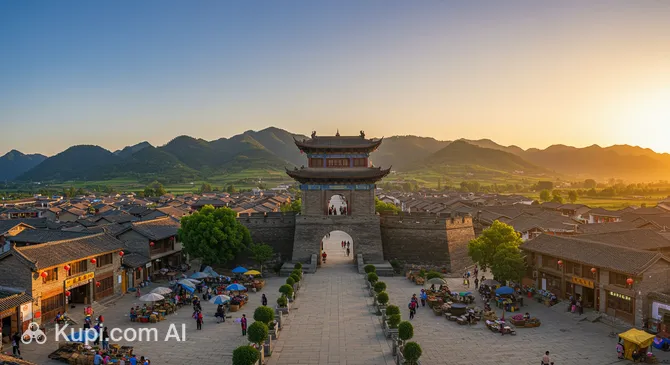
Located in the heart of Hebei Province, Xuanhua is a unique blend of living history and the daily rhythm of modern China. This district of Zhangjiakou, with a population of about 410,000, once played a strategic role in the empire's defense. Known as the "Gateway to Beijing," the city was one of the nine most important border garrisons and served as a key outpost of the Great Wall during the Ming Dynasty.
Xuanhua. Illustration.
Source: Kupi.com AI
Geographically, Xuanhua is situated on a plain surrounded by rugged northern landscapes, which largely defined its austere and majestic architecture. The rich history of Xuanhua is reflected in its well-preserved ancient walls, towers, and temples, which remain the architectural landmarks of the district today. There is no metropolitan hustle here; the atmosphere is permeated with the tranquility and dignity of an ancient postal city.
Tourists are drawn by the opportunity to see authentic China without the glossy decorations: strolling through narrow streets with gray tiled roofs, climbing monumental towers, or exploring fortifications. A visit here is an invitation to a journey through time, where every stone remembers the steps of imperial messengers and the ringing of ancient pagoda bells.
Weather Overview
The climate in Xuanhua is distinctly continental, typical of Northern China. Winters here are cold and dry: in January, the average temperature drops to -8.7°C, and at night it can reach -15°C. Summer, on the other hand, brings pleasant warmth and sometimes heat—in July, the average maximum is around 28°C, making this period popular for visits.
Precipitation falls mainly in the summer months, with July and August being the rainiest. In spring, be prepared for windy weather; due to the proximity of the steppe plains, dust storms occasionally occur in the region. The current weather in Xuanhua is always available online, which will help you choose the right wardrobe before your trip.
For comfortable walks along the historical walls and towers, the best time is late spring (May) or early autumn (September). During these periods, the temperature is mild and humidity remains at a comfortable level, allowing you to spend the whole day outdoors without exhausting heat or piercing cold.
Average monthly temperature
Average monthly precipitation
Interesting Facts
Xuanhua was designed as an ideal military and postal city of the Ming era; its fortress walls have a precisely measured length of six li and thirteen steps.
Zhenshuo Tower has the status of a "living witness" to history—it has stood in its place for over 560 years, preserving original structural elements from 1440.
The city was a vital link on the "Northern Silk Road"; it was here that trade caravans heading north and west were formed.
In 1900, while fleeing Beijing, the famous Empress Cixi stayed at the He Family Mansion, making this house a significant historical site.
Xuanhua has preserved a density of construction within its walls that is rare for modern Chinese cities: administrative buildings, temples, and imperial-era stables still stand side by side here.
How to Get There
Xuanhua is an important transport hub in Hebei Province, making it easily accessible for travelers coming from Beijing and neighboring regions. The most convenient way to plan your route is to research the main ways of how to get to Xuanhua, including rail and air connections.
The nearest airport is Zhangjiakou Ningyuan Airport (IATA: ZJK), also known as Nanshan Airport. It serves a number of domestic flights and is located about an hour's drive from Xuanhua. From the airport, you can reach your destination by taxi or by booking a transfer through your hotel. The route follows modern highways, though peak-hour traffic should be considered when entering the city.
Railway transport remains the most popular and reliable method of travel. Thanks to the development of the high-speed rail network, the journey from Beijing to Zhangjiakou takes about 3–4 hours, after which you can quickly transfer to a local bus or taxi to Xuanhua. The district is also connected to the regional rail network, providing links to other cities in Hebei Province.
Station
Passenger traffic
Distance
Zhangjiakou railway station
6
25 km
Pingguoyuan station
11
119 km
Qinghe railway station
10
121 km
Beijing North railway station
16
129 km
Beijing West railway station
25
130 km
For those who prefer driving, the modern G7 Beijing–Ürümqi Expressway passes through the region. Driving time from the capital is about 3 hours, though tourists should be aware of the heavy freight traffic typical of this industrial and agricultural hub.
Main Attractions
The main pride and architectural core of Xuanhua is its ancient Ming Dynasty city. Its centerpiece is an ensemble of three majestic towers located on a single axis. Zhenshuo Tower (the Drum Tower), built in 1440, is considered one of the most beautiful and significant. By climbing it, you can not only appreciate the craftsmanship of ancient builders but also admire the panorama of residential quarters that have preserved their historical layout.
Equally impressive is the Qingyuan Tower, known for its elegant forms and cultural significance. This entire complex is recognized as a national cultural heritage site. For those who appreciate an old-world atmosphere, the narrow streets of the Baozili quarter are a must-visit. Here, you can see traditional houses with gray tiles and feel the spirit of the past that still lives in the daily details of local life.
Military history enthusiasts should head to the surrounding forts of the Great Wall. Of particular interest is the ancient postal town of Jiming-yi (Chicken Crow)—the largest and most completely preserved postal station in old China. Its high walls, temples, and even ancient opera stages create the feeling of being on a historical movie set.
Among other attractions, the He Family Mansion stands out, having served as a temporary residence for Empress Cixi. This site offers a glimpse into the private lives of wealthy citizens and the refined interiors of the imperial period. In Dajingmen Square, you can see the "Camel Caravan" sculpture, a reminder of Xuanhua's important role on the Northern Silk Road.
Local Cuisine
The culinary scene in Xuanhua is steeped in the traditions of Northern China, where hearty dishes made from wheat, lamb, and local vegetables play the lead roles. The food here is simple, "home-style," and incredibly fragrant. Walking through the city center, you will inevitably come across small shops with steam rising from them: this is where they make the famous baozi—fluffy steamed buns with various fillings.
Be sure to try the local hot soups and hand-pulled noodles, which are considered the staple of the diet in this region. Thanks to developed agriculture, restaurant menus always feature plenty of fresh seasonal fruits and vegetables. A characteristic feature of the local table is the use of thick sauces and spices that are warming in cool weather.
Food culture in Xuanhua is concentrated in street cafes and traditional eateries located around the main historical towers. It is customary to eat simply and quickly here, while enjoying the view of the ancient walls. For drinks, locals prefer various types of tea, and in cold weather, strong locally produced grain spirits. This is honest and hospitable cuisine that best reveals the character of the country's northern regions.
Travel Tips
A trip to Xuanhua will give you a wealth of impressions if you prepare in advance for the specifics of this northern region. We have gathered some practical tips to help make your journey as comfortable as possible.
Clothing and Equipment: Consider the continental climate; bring warm clothes for winter trips and light but modest clothing for summer. Comfortable shoes are a must for walking on the cobblestones of the old city.
Transport: Within the district, it is most convenient to get around by taxi or on foot. For longer trips, use the buses connecting Xuanhua with the center of Zhangjiakou.
Finances: The main currency is the yuan. It is recommended to have cash on hand for small shops, although hotels and large outlets accept cards and mobile payments (Alipay, WeChat Pay).
Safety: The city is safe, but try to avoid walking in industrial outskirts at night due to heavy truck traffic. Face masks can be useful in windy weather due to dust.
Communication: English is not widely spoken here. Download an offline translator and learn a few basic phrases in Chinese—this will be very helpful in communicating with locals.
Local Etiquette: Be polite and respect the privacy of residents in the ancient quarters. When entering temples, maintain silence and follow a moderate dress code.
What to Avoid: Do not plan your visit to the towers for late evening—they have almost no lighting, and you will not see the full beauty of the architecture.
Additional Tip: Try to climb the walls and towers during the day; the ticket price is nominal (about 10 yuan), and the views are stunning.
Xuanhua reveals itself to those who do not rush and know how to notice beauty in the details. Enjoy your journey deep into Chinese history!
Entertainment & Nightlife
Xuanhua is a place for those seeking a quiet and contemplative holiday rather than noisy parties. Nightlife here is practically non-existent in the traditional European sense; the district lacks large nightclubs or loud bars. Instead, evening entertainment focuses on leisurely walks through the historical center.
The area around the Wenchang Pavilion and the Baozili streets is considered the most atmospheric spot for an evening promenade. At twilight, when traditional Chinese lanterns are lit, the ancient towers and walls take on a mysterious and majestic appearance. This is the perfect time for photography and immersing yourself in the silence of the old city, free from tourist crowds.
For more active entertainment, such as modern cinemas, large shopping malls, and chain restaurants, locals usually head to the center of neighboring Zhangjiakou, a 30–40 minute trip. In Xuanhua itself, the focus is on daytime cultural discoveries, visiting museums inside the towers, and exploring architectural heritage, which is the main attraction for visitors.
Parks & Museums
Xuanhua itself is often called an "open-air museum" because the concentration of historical monuments per square kilometer is staggering. Instead of classic museum halls, history is presented here through majestic towers, each housing its own exhibits. Inside the Drum Tower and Qingyuan Tower, you can find small exhibitions telling the story of garrison life during the Ming Dynasty and the city's role in border defense.
There are few traditional park zones in Xuanhua; however, the squares around historical sites, such as Dajingmen, serve as the main leisure spots for residents. Greenery is concentrated along the ancient city walls, where walking paths are laid out. These areas allow you to combine a light walk in the fresh air with an exploration of the monumental fortifications of the past.
For those seeking larger parks or themed museums, it is recommended to visit neighboring districts of Zhangjiakou. Nevertheless, it is in Xuanhua that you can feel the unbreakable link between historical architecture and modern urban space, where ancient temples and pavilions are still part of the everyday landscape.
Getting Around
The public transport system in Xuanhua is highly functional and adapted to the needs of residents and visitors. Internal movement is based on bus routes that connect the historical center with the outskirts and neighboring districts. Buses run regularly, and fares are extremely low, making them an excellent choice for budget-conscious tourists.
For quick and comfortable trips over short distances, taxis are ideal. A car can easily be hailed on the street or called via a mobile app. Since Xuanhua is a compact district, a taxi ride between the main attractions is inexpensive. There is no metro in the area, but thanks to the developed road network, this does not cause significant inconvenience.
Nevertheless, the best way to explore the heart of Xuanhua remains walking. The ancient city with its narrow streets and monumental towers is best revealed to those who are ready to explore on foot. If you need to reach remote industrial zones or the railway station, it is worth using taxi services or renting a car, keeping in mind the heavy traffic on major highways during peak hours.
Accommodation
The choice of accommodation in Xuanhua is primarily geared toward those who value proximity to the historical center and an authentic atmosphere. Most hotels are middle-class establishments and small guesthouses located within walking distance of the ancient towers and city walls. This location allows tourists to start sightseeing right from their hotel doorstep.
For travelers seeking a higher level of service or luxury chain hotels, it is worth considering staying in neighboring Zhangjiakou. There is a wider range of accommodation there, including modern hotel complexes, from which Xuanhua can be easily reached by taxi or public transport as a day trip.
It is recommended to book accommodation in advance, especially if your visit coincides with national Chinese holidays. The price range in Xuanhua is quite reasonable, making it an excellent choice for budget travelers and history buffs wishing to spend a few days surrounded by Ming and Qing era architecture.
Nearby Cities
Xuanhua is an excellent starting point for those who want to explore northern Hebei Province more deeply. Proximity to major transport hubs makes it easy to plan interesting day trips, discovering both modern metropolises and quiet historical corners.
Just 25 kilometers away is Zhangjiakou—a dynamically developing city that offers more modern infrastructure, amusement parks, and large shopping centers. For those interested in ancient mythology and the origins of Chinese civilization, a trip to Zhuolu, located just half an hour away, is an excellent choice. Also worth noting is the small town of Shenjiatun, which has preserved the charm of provincial China.
Exploring the surroundings of Xuanhua will allow you to see the region's contrasts: from industrial landscapes to majestic sections of the Great Wall and cozy suburban settlements. Each of these directions will add new colors to your journey through Northern China.
Shopping & Souvenirs
Shopping in Xuanhua is primarily about finding unique local goods and souvenirs steeped in the region's history. Unlike the modern shopping districts of major metropolises, trade here is concentrated in small shops and markets located within the boundaries of the ancient city. The main shopping activity unfolds on the streets leading to the primary towers, where you can find everything from everyday goods to antique trinkets.
From the city, it is worth bringing back traditional souvenirs reminiscent of its military and trade past. Miniature replicas of the Zhenshuo and Qingyuan towers are popular, as are products by local craftsmen. Additionally, Xuanhua is famous for its agricultural products—you can buy high-quality local tea and dried fruits here, which make excellent gifts for loved ones.
For more conventional modern shopping in large malls with well-known brands, tourists usually head to Zhangjiakou. However, the markets of Xuanhua offer a more authentic experience of interacting with the locals. Most shops are open from early morning until late evening, and payment is most often made through popular Chinese mobile apps, although small shops still readily accept cash yuan.