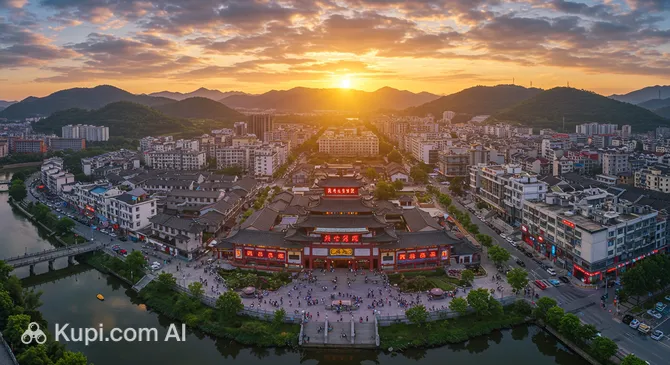
Yushan is a stunning corner of Jiangxi Province where ancient traditions harmoniously intertwine with the majestic nature of China. The town, whose name translates to "Jade Mountain," possesses a unique atmosphere of tranquility, attracting travelers with its misty peaks and rich cultural heritage.
Yushan. Illustration.
Source: Kupi.com AI
Geographically, Yushan is situated in the picturesque surroundings of the Huaiyu and Sanqingshan ranges. With a population of over 2 million, this county seat serves as an important regional transport hub while retaining the charm of provincial life. The local climate is subtropical monsoon, ensuring lush green forests and full-flowing rivers throughout most of the year.
The rich pages of the city's history date back to the 7th century, during the Tang Dynasty. Today, Yushan is known as the main gateway to the famous Sanqingshan National Park and an important center of tea culture. A visit to this region will provide unforgettable experiences, from hiking mountain trails to exploring the philosophical legacy of Neo-Confucianism and tasting rare tea varieties.
Weather Overview
The climate of Yushan is characterized as subtropical monsoon, which brings distinct seasonal changes to the region. Summers here are hot and humid, especially from June to August, when temperatures can rise to +35°C and tropical downpours become frequent. Winters, by contrast, are quite mild and cool: in December and January, the average temperature ranges from +3°C to +10°C, and snow falls very rarely.
The most favorable times for a visit are spring and autumn, when the weather in the city is most comfortable. From March to May and September to November, Yushan's nature appears in all its glory, and the moderate temperatures are ideal for long mountain hikes and outdoor sightseeing.
Average monthly temperature
Average monthly precipitation
Interesting Facts
The name of the town "Yushan" translates to "Jade Mountain." According to legend, the mythical Emperor Shun left a piece of pure jade here during his travels.
During the Song Dynasty, the region became a center of philosophical thought thanks to the famous philosopher Zhu Xi, who taught in the Huaiyu Mountains.
The local white tea from the Sanqingshan Mountains was so highly valued in antiquity that it was mentioned in poetic works of the Tang Dynasty.
Yushan became an important transport hub as early as the 1930s, when one of the region's first major railways passed through it.
Archaeologists have discovered traces of Neolithic settlements in the county, proving the incredible antiquity of human habitation in these lands.
How to Get There
The primary way to reach Yushan is via the extensive railway network. The town is a major transport hub thanks to the historic railway connecting Zhejiang and Jiangxi provinces. Travelers can find detailed information on how to get to the region from the country's largest metropolises.
For those who prefer air travel, the nearest option is Jingdezhen Airport (IATA: JDZ), located about 60 kilometers away. Alternatively, you can use Nanchang Airport, from which a high-speed train ride takes about an hour and a half. From the airports, the city center is easily accessible by transfer or intercity bus.
Yushan South (Yushan-Nan) Railway Station receives high-speed trains from Shanghai, Nanjing, and Hangzhou. The trip from Shanghai takes only a few hours, making the city accessible even for short weekend trips. Special tourist buses regularly depart from the station for trips within the county and to the mountain parks.
Station
Passenger traffic
Distance
Shangrao railway station
6
49 km
Quzhou railway station
7
53 km
Huangshan Railway Station
3
101 km
Sidu Railway Station
2
119 km
Jingdezhen Railway Station
4
122 km
Main Attractions
The main attractions of Yushan are inextricably linked to its unique natural landscape and spiritual heritage. One of the most impressive locations is Sanqingshan National Park, a UNESCO World Heritage site. Tourists come here to see bizarre granite peaks, ancient pines, and historic Taoist temples that seem to float in the clouds.
The Huaiyu Mountains, which gave the town its name, offer excellent opportunities for trekking and ecotourism. These ranges are shrouded in legends and have served as a source of inspiration for poets for centuries. While walking along the slopes, you can find secluded pagodas and small monasteries where a traditional way of life is still preserved.
For those interested in culture, the historic center of Yushan is a must-visit. Traces of the Tang and Song eras remain here, and the banks of the local river are adorned with picturesque bridges and hills. It is an ideal place for evening strolls, allowing you to feel the harmony between urban architecture and the natural environment.
Local Cuisine
The gastronomic scene in Yushan is inextricably linked to the tea traditions of Jiangxi Province. The pride of the region is the famous white tea from the Sanqingshan Mountains, known for its delicate aroma and healing properties. Attending a local tea ceremony is an essential ritual that allows you to feel the true spirit of the "Jade Mountain."
The local cuisine is characterized by the spiciness typical of this region and the use of fresh seasonal products. Be sure to try the braised meat with bamboo shoots, prepared here according to ancient recipes, as well as river fish dishes caught in clear mountain streams. Rice prepared with fermented vegetables is also popular, giving it a unique sour and spicy flavor.
The food culture in Yushan is very accessible: authentic dishes can be found in both sophisticated hotel restaurants and small family-run shops. To accompany a meal, locals often choose traditional rice wine. To fully enjoy the gastronomy, it is worth heading for a tasting directly at the tea plantations, where dishes are prepared from the freshest ingredients.
Travel Tips
To ensure your trip to Yushan goes as smoothly as possible and leaves only pleasant impressions, please review our practical recommendations.
Clothing and Essentials: For mountain hikes, be sure to bring comfortable shoes with non-slip soles. The weather at the peaks can be changeable, so pack a windbreaker or raincoat. For visiting temples, it is better to choose modest, closed clothing.
Transport: High-speed trains are the most convenient way to travel; tickets should be booked in advance via official apps. Within the city, use buses or taxis.
Finances: Cashless payments via QR codes dominate in China, but it is useful for tourists to carry cash yuan, as international cards are not accepted everywhere.
Health and Safety: Yushan is a safe city, but in the mountains, you should stick to official trails. It is recommended to carry insect repellent and sunscreen.
Communication: English is not very common, so download an offline translator and maps. Learning a few basic phrases in Chinese is always appreciated by the locals.
Local Etiquette: It is customary to remove your shoes when entering temples or private homes. Show respect for tea traditions: the ceremony here is considered an important ritual, not just a meal.
What to Avoid: Do not try to go off the marked trails in the national park—it can be life-threatening and harmful to the fragile ecosystem.
Extra Tip: Try to reach Sanqingshan at sunrise—it is the most magical time when the mist just begins to clear among the peaks.
Plan your route in advance, and Yushan will reveal itself as one of the most harmonious and beautiful places in China!
Entertainment & Nightlife
Entertainment in Yushan is geared toward outdoor enthusiasts and those seeking peace away from bustling metropolises. The primary focus here is on nature: popular activities include trekking routes of various difficulty levels, cycling trips along tea plantations, and scenic picnics on the shores of local reservoirs.
The town's nightlife is quite calm and lacks the hustle and bustle of major tourist centers. Instead of booming clubs, it is customary to spend evenings enjoying traditional tea ceremonies or attending folklore shows at cultural centers, where performers introduce guests to the region's heritage. After dark, the town is transformed by beautiful lighting on bridges and historic buildings, creating a romantic atmosphere for walks.
Sports events, such as mountain marathons and outdoor festivals, regularly attract an energetic crowd to Yushan. During the day, it is also worth visiting local amusement parks or small theaters where you can see productions based on ancient legends of the Jade Mountain.
Parks & Museums
The main open-air "museum" in Yushan is rightfully considered to be Sanqingshan National Park. This place combines the natural majesty of granite cliffs with the deep spirituality of Taoist shrines. A walk along its trails is like a journey through the pages of ancient paintings, where every cloud and every peak has its own name and legend.
In the city itself and its immediate surroundings, it is worth visiting museums dedicated to history and tea culture. The exhibitions tell the story of the heyday of the Tang and Song dynasties, displaying ancient tea-harvesting tools and jade products for which the region has long been famous. Such places provide a better understanding of why Yushan became an important cultural center on trade routes.
For a relaxing break, the county's river parks are ideal. The riverbanks are well-equipped for walking, decorated with statues and traditional pavilions. Here you can see how local residents spend their free time and take beautiful photos of bridges against the backdrop of sunset hills.
Getting Around
The transport system in Yushan is well-adapted to the needs of travelers, largely due to the city's status as a major railway hub. The backbone of urban transport consists of buses and electric buses that connect the stations with central districts and popular tourist locations. Fares are inexpensive, usually ranging from 2 to 5 yuan, and the routes are intuitive.
For fast travel around the city, it is convenient to use taxis or the popular Didi app. Prices for trips are quite reasonable, and it is often the most comfortable way to get to your hotel with luggage. Special tourist shuttles regularly run from Yushan South station to the foot of the Sanqingshan mountains, with schedules coordinated with train arrivals.
An alternative to public transport is bicycles, which can be rented at many hotels. This is a great way to explore the surrounding tea fields and small villages at your own pace. Private drivers are also available for travel to remote mountain areas and can organize individual transfers.
Accommodation
The choice of accommodation in Yushan allows travelers with various preferences to stay in comfort. The most popular options are mid-range and chain hotels, such as Holiday Inn, located in the central part of the city near the railway station. This is a convenient location for those planning to use public transport actively.
For those visiting specifically for the mountains, hotels and resort complexes located directly at the foot of or within Sanqingshan National Park are an excellent choice. Here you can find everything from luxury resorts with panoramic views to cozy guesthouses styled after traditional Chinese architecture. Staying in these areas allows you to start your ascent early in the morning before the main groups of tourists arrive.
Budget travelers can consider hostels and family guesthouses located near the tea plantations. Accommodation prices in Yushan remain quite affordable, though during peak seasons (spring during the blossoming period and during national holidays), it is recommended to book rooms in advance through popular online services.
Nearby Cities
Yushan serves as an excellent starting point for exploring the picturesque surroundings of Jiangxi and neighboring Zhejiang provinces. Just 28 kilometers away is the city of Jiangshan, known for its unique natural landscapes and historical monuments. Another interesting destination is Kaihua, where you can enjoy the tranquility of parks and traditional architecture.
If you are looking for a larger hub, head to Shangrao. This administrative center offers many cultural sites and temples and is just an hour's drive away. History buffs will also find Dexing attractive, while those who appreciate ancient architecture and cozy streets will enjoy Quzhou. Traveling through these cities allows for a deeper experience of East China's local flavor.
The variety of routes around the city makes it an ideal place for those who love active exploration and want to see not only the famous mountains but also the life of the real Chinese province.
Shopping & Souvenirs
Shopping in Yushan is primarily an opportunity to purchase authentic goods for which this region is famous. The main souvenir is undoubtedly the local white tea. It is best to buy it in specialized shops at the tea plantations or at the central markets near the railway station, where the selection is widest and the product is always fresh.
In addition to tea, the region is known for its jade and stone products. Yushan craftsmen have honed the art of carving for centuries, creating exquisite jewelry, figurines, and seals. Also, thanks to the proximity to the famous porcelain center of Jingdezhen, you can find high-quality ceramics and tea sets in local shops at very attractive prices.
The city's shopping centers offer a standard range of goods, but for tourists, the small markets and souvenir shops in the historic center are of the greatest interest. Shops usually stay open from morning until late evening, and many places accept popular mobile payment apps, though it's better to carry some cash (yuan) for small shops in the mountains.