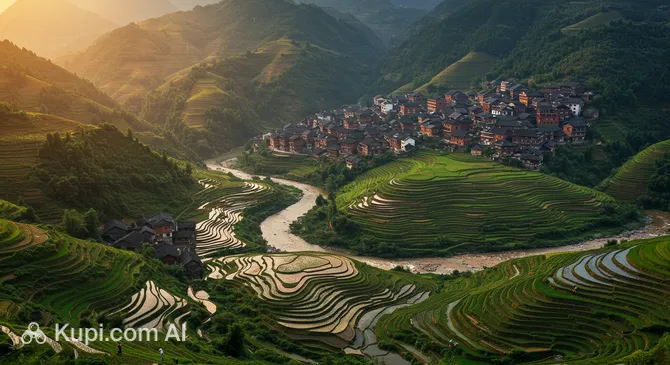
Songyang County, tucked away among the emerald mountains of Zhejiang Province, is rightfully called "the last hidden gem of Jiangnan." This corner of China has preserved the atmosphere of old times, offering travelers authentic villages and endless tea plantations rather than urban landscapes. Around 668,000 people live in Songyang, yet life here flows at a measured rural pace, far from the noise of megacities.
Songyang County. Illustration.
Source: Kupi.com AI
The county's geographical position in a mountainous region in the southeast of the country has defined its unique appearance. It is a land of misty forests and traditional architecture. If you are interested in the history of this region, you will find that many settlements here have maintained their appearance since the Ming and Qing dynasties, making the county a true open-air reserve.
The main magnets for tourists are the ancient Songyang Old Street and picturesque villages such as Yangjiatang, which look as if they have stepped out of ancient Chinese paintings. Visiting this place is an invitation to contemplation and an opportunity to touch the living heritage of the Middle Kingdom in its most pristine form.
Weather Overview
The climate in Songyang is subtropical monsoon, which means a clear change of seasons and an abundance of greenery year-round. Winters here are mild and relatively dry, with average temperatures ranging from +5°C to +10°C in January. Summer brings heat and high humidity: in July and August, the thermometer often stays at the +28...+32°C mark. To better plan your trip, check the detailed weather in Songyang before your flight.
Special attention should be paid to the rainy season, which falls between May and September. June sees the peak of precipitation — up to 380 mm — which may affect the accessibility of some mountain trails. However, it is at this time that the tea plantations and forests look their most lush and vibrant. Expect warm summers with occasional thunderstorms and cool, sunny winters when the county is shrouded in picturesque mists.
Average monthly temperature
Average monthly precipitation
Interesting Facts
"The Hidden Gem": Songyang is often called "the last hidden gem of Jiangnan" due to the unique preservation of hundreds of ancient villages that escaped large-scale modern development.
Sea of Tea: The Damushan Tea Garden is China's largest zone for cycling tourism located directly on plantations, covering an area of more than 5,000 hectares.
Golden Architecture: Yangjiatang Village is often called the "Golden Village" because of the special hue of its house walls, which take on a bright golden glow at sunset.
Open-Air Museum: Songyang Old Street is considered one of the most vibrant historical streets in the region, where blacksmiths, tinsmiths, and traditional medicine pharmacists still work today.
Wild Nature: The county is home to the Luoliao Wildwood reserve, which contains sections of wild forest virtually untouched by human activity.
How to Get There
Traveling to Songyang is a journey to tranquility through the scenic mountain roads of Zhejiang Province. The county does not have its own airport, so the region's transport accessibility largely depends on the nearby major city of Lishui. If you are planning a trip, it is worth studying the detailed routes to Songyang in advance, as there are no direct flights here.
The nearest major air hubs are in the cities of Wenzhou and Hangzhou. From these airports, it is most convenient to transfer to a high-speed train (Gaotie) going to Lishui station. The travel time from Hangzhou is about one and a half to two hours. Upon arrival in Lishui, you can take a regular bus (the trip takes about an hour) or book a taxi for a more comfortable transfer directly to your hotel door in the county.
The railway is the fastest and most modern way to travel in this part of China. Although railway infrastructure within Songyang County itself is limited, Lishui station receives trains from Shanghai, Ningbo, and other major metropolises. Inside the county, public transport is represented by infrequent bus routes, so tourists often choose car rentals or private drivers to explore remote villages.
Station
Passenger traffic
Distance
Quzhou railway station
7
79 km
Yiwu railway station
6
117 km
Wenzhou South railway station
7
120 km
Shangrao railway station
6
145 km
Sidu Railway Station
2
164 km
Main Attractions
The main attractions of Songyang are centered around natural majesty and historical heritage. One of the most popular spots is the Damunshan Riding Tea Garden — a colossal tea garden where you can go cycling right among the endless rows of tea bushes. This is a unique ecotourism project combining sport and the aesthetic pleasure of rural landscapes.
Fans of panoramic views should head to the Shuangtong Mountain scenic area. There are observation decks offering breathtaking views of the mountain ranges and valleys. For those who prefer wild nature, the Luoliao Wildwood nature reserve, which has preserved the region's pristine flora and fauna, will be a real discovery.
The architectural heart of the county is Songyang Old Street. A stroll along this ancient street allows you to enjoy the atmosphere of the Ming and Qing dynasties for free: ancient pharmacies, workshops, and residential houses have been preserved here. No less interesting are the "frozen in time" villages such as Yangjiatang and Chenjiapu, where the traditional way of life is harmoniously integrated into the mountain landscape.
Local Cuisine
The cuisine of Songyang is a vivid reflection of Zhejiang culinary traditions with a local "mountain" character. The main feature of gastronomy here is the use of the freshest local products: bamboo shoots, wild mushrooms, mountain herbs, and river fish. Dishes are characterized by their lightness and a desire to emphasize the natural taste of ingredients, making a local meal not only delicious but also healthy.
Tea holds a special place in the food culture. Songyang is famous for its oolong and green tea, which are not only drunk here but also used as a seasoning for dishes — for example, in meat marinades or when smoking fish. Signature dishes to try include stewed pork with bamboo and aromatic rice cakes prepared according to village recipes.
The gastronomic scene is concentrated around Songyang Old Street, where numerous family-run taverns and cozy tea houses are open. A homely atmosphere prevails here: owners often cook food themselves using products grown on neighboring farms. Street food is represented by various rice snacks and seasonal fruits that can be bought directly at local markets.
Travel Tips
A trip to Songyang promises to be an unforgettable adventure in the heart of rural China. To ensure your journey goes as smoothly as possible and brings only pleasant impressions, check out these practical tips.
Clothing and Essentials: Choose layered clothing, as the weather in the mountains is changeable. Be sure to bring comfortable shoes with good grip for walking on cobbled streets and mountain trails. A type A/C/I power adapter will be useful, though many newer hotels have universal sockets.
Transport: Within the county, it's best to get around by taxi via the Didi app or by renting a bicycle. It is most convenient to travel between cities by bus from Lishui.
Finance: The primary payment methods are WeChat Pay or Alipay. International cards are rarely accepted, so keep a supply of cash yuan for small purchases in villages. There is no tipping culture in China.
Health and Safety: The area is very safe, but be careful on forest trails in rainy weather. Pharmacies are concentrated in the county center, and serious medical care is available in neighboring Lishui.
Communication: English is not widely spoken here. Download an offline translator and maps (such as Baidu Maps or Amap). It is useful to carry a hotel business card with the address in Chinese.
Local Etiquette: Local residents are friendly but conservative. Greet people with a slight nod. When visiting temples and private homes, be quiet and show respect for the villagers' privacy.
What to Avoid: Do not go hiking on remote mountain trails alone late in the evening — lighting outside the villages is practically non-existent. Try not to photograph people without their explicit consent.
Best Time: Plan your visit for spring or autumn when temperatures are comfortable and nature is painted in its most vibrant colors.
By following these simple recommendations, you can fully immerse yourself in the atmosphere of the "hidden gem" and enjoy every moment of your trip!
Entertainment & Nightlife
Entertainment in Songyang is geared towards nature lovers and those seeking a quiet getaway. During the day, guests of the county prefer active ecotourism: hiking the trails of Shuangtong Mountain, cycling through the Damushan tea plantations, or exploring the Luoliao Wildwood nature reserves. It is an ideal place for those seeking solitude who want to trade city noise for birdsong and the rustle of leaves.
As for nightlife, it is practically non-existent in Songyang in the conventional sense of clubs and bars. After sunset, life here quiets down, and the main evening activities are leisurely walks along the illuminated Songyang Old Street or traditional tea ceremonies in local guesthouses. The audience here values silence and authenticity, so the dress code in establishments is as relaxed as possible.
For those who miss the dynamics of cinemas or large shopping centers, locals recommend heading to the neighboring city of Lishui, which is about an hour's drive away. Evenings in the county itself are best spent tasting local oolong in one of the family tea houses, enjoying the cool mountain air and the starry sky.
Parks & Museums
The natural parks of Songyang are the county's main wealth. Vast forest areas, such as Luoliao Wildwood, offer tourists the chance to walk through real wild forests where the air is considered some of the cleanest in the province. Another significant natural area is Shuangtong Mountain, equipped with convenient hiking trails and observation decks offering panoramic views of misty valleys and tea plantations.
The museum life of the county is unique in that the historical settlements themselves act as "living museums." For example, Songyang Old Street is a true open-air gallery where you can observe traditional crafts in their natural environment. Shicang Village is also an important cultural site, demonstrating the Qing dynasty architectural style and the Hakka way of life that has been preserved for centuries.
The high level of greenery — more than half of the county's area is covered by forests and plantations — makes any stay in Songyang feel like a holiday in a giant garden. The absence of large industrial centers guarantees excellent ecology, which is particularly appreciated by travelers from megacities coming here for "forest therapy" and peaceful walks in the fresh air.
Getting Around
The public transport system in Songyang is quite simple and oriented toward connecting the administrative center with key attractions and the neighboring city of Lishui. The main mode of transport here is buses. Regular services take passengers to popular villages and tea plantations, though it's worth noting that intervals in rural areas can be quite long.
For tourists, the most convenient payment method is through mobile apps like Alipay, which support QR codes for fare payment. Cash is not accepted everywhere, so it's worth setting up digital wallets in advance. Intercity bus tickets can be purchased at bus station ticket offices. There are practically no traffic jams in the county itself, and the population density is low, making trips peaceful and predictable.
As an alternative to buses, many travelers choose taxis (called via the Didi app) or bike rentals. Bicycle rental is especially popular around the Damushan tea gardens, where ideal conditions for two-wheeled rides have been created. In the central part of the county and tourist villages, it is best to move around on foot — this allows you to fully enjoy the ancient architecture and mountain views.
Accommodation
In Songyang, you won't find huge chain hotels or skyscrapers. The hotel stock consists mainly of authentic guesthouses and mini-hotels, known as "minsu" in China. Many are located in restored ancient buildings, allowing guests to fully immerse themselves in the rural atmosphere. Popular options include farmhouses near tea plantations and cozy apartments near the old street.
For those seeking maximum connection with nature, consider staying in the villages of Chenjiapu or Yangjiatang. Small designer boutique hotels focused on ecotourism are opening here. Accommodation prices in the county remain quite affordable, although during peak tourist seasons (especially during the tea harvest or spring holidays), costs can rise and vacancies can quickly disappear.
The main booking tip is to do it in advance using Chinese or international services. Most high-quality accommodation options are concentrated around Songyang Old Street, which is convenient for logistics, or directly in the Damushan tea gardens for those who want to wake up to views of green hills. The price range varies from budget rooms to quite expensive designer villas with panoramic windows.
Nearby Cities
Songyang serves as an excellent starting point for exploring the picturesque surroundings of Zhejiang Province, where every neighboring county hides its own natural treasures. The most accessible destination for a trip is the city of Lishui, located just 43 kilometers away. It is a major transport and cultural center where you can find modern shopping malls, parks, and more developed infrastructure while maintaining a connection to the region's mountain landscapes.
For those interested in traditional crafts, a visit to Longquan is a must. This city is world-famous for its celadon porcelain and the production of legendary swords. The journey there takes just over an hour, and you can see workshops where the art of working with ceramics and metal has been honed for centuries. It is also worth noting Jinhua, a major historical city known for its famous ham and ancient temples.
The region around Songyang is literally permeated with the spirit of antiquity and natural beauty. Whether it's a short trip to the small village of Chuanliaocun or a visit to the cultural center of Quzhou, each of these destinations will allow you to deeper understand the diversity and richness of eastern China.
Shopping & Souvenirs
Shopping in Songyang is intimate and exceptionally authentic. You won't find huge shopping malls with global brands here, but the county is famous for its unique handmade goods. The main place for shopping is the historical Songyang Old Street, where small shops sell products from local blacksmiths, bamboo crafts, and traditional pottery.
The main souvenir to bring back from this trip is, undoubtedly, local tea. It is best to buy it in specialized shops at the Damushan plantations or from farmers in mountain villages. In addition to the tea itself, you can purchase beautiful tea sets and accessories for ceremonies. Ecologically clean products such as dried mushrooms, mountain herbs, and local honey are also popular.
Shops and stalls usually operate from morning until late evening, though they may close earlier in rural areas. In most places, the apps popular in China, WeChat Pay and Alipay, are accepted, but it is better to have some cash yuan when visiting remote villages. Tax Free is practically non-existent in local shops, as most outlets are small family businesses.