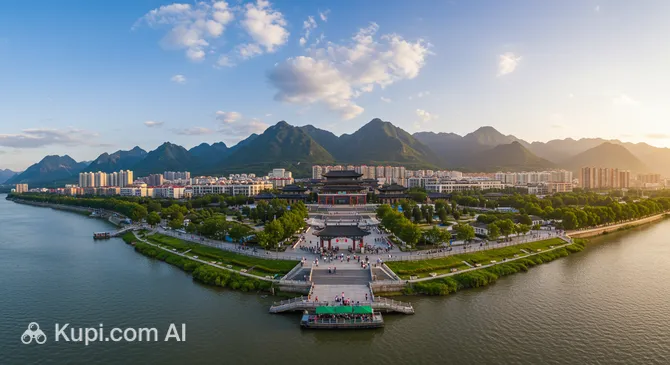
Yueqing is a dynamically developing county-level city on the coast of the East China Sea, part of the Wenzhou prefecture in Zhejiang Province. The city holds the unique status of being the "Electric Capital of China," serving as a global hub for electrical equipment manufacturing. Despite its industrial character, it maintains deep roots: the history of Yueqing dates back to 374 AD, and in 2006, UN experts recognized it as a "Millennium Ancient County."
Yueqing. Illustration.
Source: Kupi.com AI
Geographically, the city is situated in a picturesque location where mountains meet the sea, creating a distinct local flavor. With a population exceeding 1.3 million people, Yueqing is a blend of bustling business activity and a traditional way of life. Here, the Liushi industrial district sits alongside the natural beauty of the bay, and modern shopping centers coexist with authentic coastal villages.
For travelers, the city is primarily interesting as the gateway to the famous Yandang Mountains, known for their unique volcanic landscapes, and as a place to witness the "kitchen" of global electrical engineering production. We recommend visiting this city for those who want to see the real, energetic, industrial China that combines economic power with centuries-old heritage.
Weather Overview
The weather in Yueqing is defined by its subtropical monsoon climate, characterized by distinct seasonality and high humidity. To better prepare for your trip, you can check the current weather in Yueqing on our dedicated page. Summers here are typically long, hot, and humid: in July and August, average temperatures reach 28–31°C, often accompanied by heavy rainfall.
Winters in the region are mild and relatively dry. In January, the coldest month, temperatures range from 4°C to 12°C. Despite the absence of severe frost, the high humidity can make the air feel colder than the thermometer indicates. Spring and autumn are considered the most comfortable periods to visit, with pleasant warmth and temperatures ranging from 15°C to 25°C.
An important feature of the climate is the monsoon season and the influence of typhoons, which can bring gale-force winds and heavy downpours during the summer and early autumn months. The city's coastal location also contributes to frequent fogs. If you are planning a visit to the industrial zone or a trip to the mountains, keep in mind that air quality and visibility can change depending on wind direction and industrial activity levels.
Average monthly temperature
Average monthly precipitation
Interesting Facts
In 2006, UN experts granted Yueqing the status of a "Millennium Ancient County" in recognition of its continuous history dating back to 374 AD.
The city bears the unofficial title of the "Electric Capital of China" due to its incredible concentration of enterprises manufacturing low-voltage electrical equipment.
The city received its modern name, Yueqing, in 908 AD during the Five Dynasties and Ten Kingdoms period, keeping it virtually unchanged for over a thousand years.
Despite its status as a county-level city, the population of Yueqing is comparable to that of major European capitals, exceeding 1.3 million people.
The city is uniquely situated at the foot of the Yandang Mountains, which are included in the UNESCO World Geological Heritage list.
How to Get There
Yueqing enjoys well-developed transport links with China's major cities, making it accessible for both business and tourism. To plan your route as efficiently as possible, we recommend reviewing detailed information on how to get to the city by various means of transport.
The nearest major air hub is Wenzhou Longwan International Airport (WNZ), located approximately 40–50 km from Yueqing. You can get from the airport to the city center by taxi or intercity bus, with a travel time of 1 to 1.5 hours depending on traffic. The airport handles flights from most Chinese metropolises and some international destinations.
Rail travel is the most convenient way to get around the region. Yueqing Railway Station is located on a high-speed line connecting major cities along the East Coast. A high-speed train journey from Shanghai takes about 3–4 hours, while neighboring Ningbo can be reached in just 2 hours. Important expressways, such as the G15, also pass through the city, making it convenient to arrive by car or bus.
Although Yueqing is primarily known as a major industrial center, its surroundings and urban environment offer several interesting locations. The main natural treasure of the region is the Yandang Mountains, located north of the city center. This area is famous for its ancient volcanic relics, bizarre rock formations, and waterfalls, making it an ideal destination for hiking enthusiasts and nature photographers.
Within the city itself, life is concentrated around central squares and large commercial hubs. The Liushi district is worth visiting as a unique urban phenomenon: it is the "heart" of low-voltage electrical equipment production, home to thousands of enterprises. Walking through the local markets and showrooms allows you to feel the scale of Chinese industry, which is an unusual tourist experience in its own right.
For those seeking a more relaxed atmosphere, head to the coast of Yueqing Bay. Local coastal villages, such as Qingjiang, offer quiet walking areas and a chance to observe the lives of local fishermen. There are no grand sights here, but these are the places where the authentic atmosphere of coastal Zhejiang is felt best.
Local Cuisine
The gastronomic scene in Yueqing is closely tied to the culinary traditions of Zhejiang Province and its proximity to the East China Sea. Seafood is rightfully considered the main delicacy of the region. The town of Qingjiang, part of the county, is widely known as the "Home of Oysters." Local oysters are famous for their freshness and delicate taste; they are served raw, baked with garlic, or added to hearty noodle soups.
The general character of the local cuisine can be described as simple but of very high quality and nutritious. In addition to oysters, be sure to try the fried fish, various crustaceans, and shellfish prepared with minimal spices to highlight the natural flavor of the products. In industrial areas like Liushi, small eateries offering quick and inexpensive lunches for workers are popular, where you can always find fresh noodles and dim sum.
The food culture in Yueqing involves both visiting modern restaurants in shopping malls and relaxing in authentic family-run establishments in coastal areas. For drinks, people here prefer the famous green tea from Zhejiang's plantations, as well as traditional Chinese rice wine. Street food at evening markets is another way to experience local flavors in a casual setting.
Travel Tips
A trip to Yueqing will be an interesting experience of immersion into modern Chinese industrial life. To ensure your journey is comfortable and productive, we have prepared several practical recommendations.
Clothing and Gear: Choose your wardrobe based on the season—summers are very hot and humid, requiring light clothing made of natural fabrics, while winters can be quite chilly. Be sure to bring comfortable shoes, as you will be walking a lot, especially if you plan to visit the Yandang Mountains. Don't forget a universal power adapter.
Transport: The most convenient way to get around is the Didi app. Public buses can be overcrowded during peak hours. For trips to neighboring cities, use high-speed trains, for which tickets should be booked in advance via official services.
Finance: Mobile payment systems WeChat Pay and Alipay dominate in China. We recommend linking an international card to one of these apps. Keep some cash in yuan for small markets. International cards are only accepted at large hotels.
Communication: The primary language is Mandarin Chinese. English is not widely spoken here, so download an offline translator in advance and save the addresses of your destinations and hotel in Chinese characters.
Connectivity: To access your usual services, you may need a VPN. A local SIM card can be purchased at Wenzhou Airport or at mobile operator offices in the city center with your passport.
Local Etiquette: Yueqing residents are accustomed to a business rhythm. Be polite; a greeting is usually limited to a slight nod or a handshake. Tipping is not expected in restaurants.
Health and Safety: The city is generally safe, but air quality in industrial zones may not be ideal—on windy days, sensitive individuals might need a protective mask. Drink only bottled water.
What to Avoid: Do not visit remote factory outskirts alone late at night due to poor lighting and heavy truck traffic. Also, try not to photograph industrial sites if you see signs prohibiting it.
Following these simple rules will help you focus on exploring the city and get the most out of your trip to this energetic region.
Entertainment & Nightlife
The entertainment scene in Yueqing is primarily geared toward local residents and business travelers, so classic tourist nightlife is moderately developed. The main leisure hubs are the modern shopping malls in the city center, where cinemas, gaming zones, and numerous restaurants stay open late. In the evenings, youth and families gather here, creating a lively yet calm atmosphere.
For those seeking traditional evening entertainment, karaoke bars (KTV) are popular and form an important part of the local social culture. If you are looking for large-scale nightclubs or concept bars, keep in mind that locals often travel to neighboring Wenzhou for such entertainment, which is about an hour's drive away.
In the evenings, street markets and food courts also become active in Yueqing, especially in the Liushi area. This is a great opportunity to try local food and observe the rhythm of life in an industrial city after the workday. The central districts are quite safe for night walks, and for late-night travel, it is best to use mobile ride-hailing apps.
Parks & Museums
Since Yueqing is a major industrial hub, there are few classic museums in the traditional sense. However, the urban environment is being actively improved, and local green zones and small parks have been created within the eight central street committees. These places serve as islands of tranquility amidst the dense industrial landscape, where locals rest, practice gymnastics, or play board games.
The city's main "natural gallery" is Yandang Mountain. It is not just a park, but a massive geological site that serves as an open-air museum for residents and tourists alike. Here you can study volcanic rocks millions of years old and enjoy views that have inspired Chinese poets and artists for centuries.
For those who want to dive deeper into the region's culture, it is worth looking at small exhibition halls in administrative centers dedicated to the history of local industry. This provides a unique opportunity to trace Yueqing's journey from an ancient county to a global electrical engineering center. For larger-scale cultural leisure and visits to major historical museums, residents often travel to neighboring Wenzhou.
Getting Around
The transport system of Yueqing is designed to ensure the efficient movement of huge numbers of people between industrial zones and residential quarters. The core of urban transport consists of bus routes that connect the 8 street committees and 9 outlying towns. The bus network is quite extensive; however, during peak hours when shifts change at numerous factories, transport can be very crowded.
The city does not yet have a subway system, so taxis and car-hailing services via the Didi app (the Chinese equivalent of Uber) serve as alternatives to buses. This is the most convenient and fastest way for a tourist to get around, as taxi prices are quite moderate and the app helps avoid the language barrier. In the city center, electric scooters and bicycles are also popular, used by residents for short-distance trips.
For travel outside the county, the Yueqing Railway Station is the key hub. High-speed trains allow you to reach Shanghai, Hangzhou, or Ningbo in just a few hours. Fares on public transport are most often paid via mobile apps or transport cards, so travelers are recommended to set up electronic payment methods on their smartphones in advance.
Accommodation
The hotel infrastructure in Yueqing is primarily focused on business tourism, which defines the character of local accommodations. Many 3-star and 4-star business-class hotels are concentrated in the city center and the Liushi industrial district. These establishments offer comfortable living conditions, conference rooms, and quality service at quite affordable prices typical of industrial regions.
For budget travelers, there are numerous local hostels and mini-hotels, often located near shopping centers and transport hubs. It is worth noting that there are few luxury resort hotels in Yueqing itself, as the city is not a classic tourist center. If you are looking for premium accommodation with a view of nature, consider options closer to the Yandang Mountains.
When planning your trip, it is recommended to book accommodation in advance, especially during major industry exhibitions and holidays when demand from the business community spikes. Primary booking methods include popular international services and Chinese platforms. Foreign tourists will need a passport with a valid visa to register at hotels.
Nearby Cities
Yueqing serves as an excellent starting point for exploring the eastern coast of Zhejiang Province. Thanks to the developed network of high-speed trains and highways, many interesting cities in the region are accessible for day trips, offering tourists a variety of experiences—from touring metropolises to strolling through historical sites.
The most obvious destination is Wenzhou, located just 31 km away. It is a major cultural and economic center where you can walk along Jiangxinyu Island with its ancient pagodas or enjoy shopping in modern districts. It is also worth visiting Ruian and Wenling, which are famous for their historical architecture and picturesque coastal landscapes.
For those interested in the industrial potential of the region, the neighboring Liushi, which virtually merges with Yueqing, is a must-visit. It is a unique "factory-city" where you can see the scale of Chinese manufacturing from the inside. Exploring the surroundings will allow you to better understand the multifaceted nature of this region of China.
Each of these destinations has its own unique character, turning a stay in Yueqing into an exciting journey through modern China.
Shopping & Souvenirs
Shopping in Yueqing has a very specific character, reflecting the city's status as a global industrial hub. The main "attraction" for buyers here is the wholesale and retail electrical equipment markets, particularly in the Liushi district. These are true labyrinths filled with a vast variety of technology—from tiny switches to complex industrial systems. For specialists and entrepreneurs, this place is a must-visit.
For regular tourists, traditional shopping opportunities are concentrated in large shopping centers located in the central part of the city. Here you will find both well-known international brands and popular Chinese labels for clothing, cosmetics, and electronics. The malls also house supermarkets where you can buy everyday goods and food products.
If you are looking for souvenirs, pay attention to local non-technical products: Yueqing is famous for its high-quality tea and dried seafood, which make excellent gifts. In local markets in the villages, you can find authentic products and handmade goods. In most stores and shopping centers, payments are accepted via mobile systems like WeChat Pay and Alipay, though it is better to have some cash for small purchases at markets.