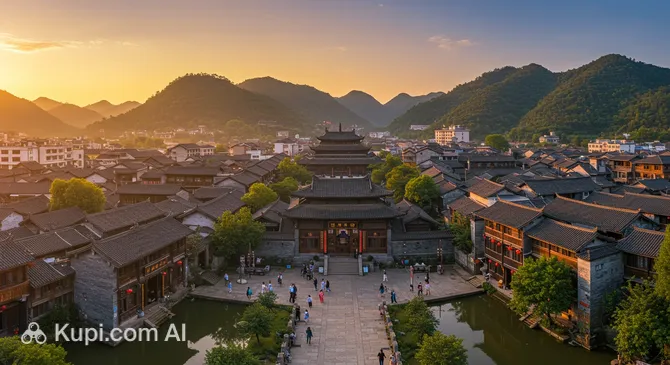
Dongyang is a dynamically developing industrial center in the heart of Zhejiang Province, part of China's economic constellation. The city is part of the massive Yangtze River Delta agglomeration and is closely linked to its neighboring trade giant, Yiwu. Dongyang. Illustration.
Source: Kupi.com AI
Despite its reputation as a major industrial hub, Dongyang retains its unique character, blending modern neighborhoods with the traditional craftsmanship for which the region has been famous for centuries.
Geographically, the city covers an area of over 1,700 km², and its population, according to recent data, has exceeded one million people. The history of this region is inextricably linked to the development of trade and craftsmanship: Dongyang is world-renowned as the "capital of woodcarving." The climate here is subtropical monsoon, providing the city with lush greenery in its parks and humid, warm summers.
For the traveler, Dongyang is primarily interesting as a unique example of "business tourism." Here, you can see colossal furniture markets and textile clusters that resemble entire cities in their own right. If you are looking for an authentic industrial China striving for the future, Dongyang will be an excellent point on your itinerary through Zhejiang Province.
Weather Overview
The climate in Dongyang is classified as subtropical monsoon, which is typical for the entire Zhejiang Province. This means the city clearly experiences all four seasons: from hot, humid summers to cool and relatively dry winters. Weather in Dongyang largely dictates the rhythm of the city's life and its business activity.
The summer months, especially July and August, can be quite exhausting with temperatures reaching +30–35°C and high humidity. Heavy precipitation is frequent during this time. Winter arrives in December–January and is characterized by average temperatures around +2–7°C, occasionally dropping to light frosts. Snow is a rare occurrence here; light rain is more common.
The best time to visit is considered to be spring (March–May) and autumn (September–November), when the weather is comfortably warm without extreme heat. It is worth noting that due to the high concentration of industrial enterprises in the agglomeration, haze may be observed during periods of calm winds, so travelers with sensitive health are advised to monitor air quality indices.
Average monthly temperature
Average monthly precipitation
Interesting Facts
Giant City: Despite its status as a county-level city, Dongyang, together with neighboring Yiwu, forms a continuous urban area with a population of nearly 3 million people.
Woodcarving: Dongyang woodcarving ("Dongyang mudiao") is one of the four main types of carving in China and is recognized as an object of national intangible cultural heritage.
Rapid Growth: Back in 1950, the city's population was just over 3,000 people; today, it is a metropolis with a population of a million, grown on the wave of industrialization.
Film Industry Hub: Dongyang administers the town of Hengdian, home to the world's largest outdoor film studio — known as "China's Hollywood."
Special Time: The city operates on a single China Standard Time (UTC+8), which should be kept in mind when planning meetings, as daylight can start very early here.
How to Get There
Dongyang enjoys excellent transport connectivity with key cities in East China. Although the city is industrially oriented, getting here is easy thanks to its proximity to major transport hubs in Zhejiang Province. The journey to Dongyang for most tourists begins through neighboring metropolises or regional airports.
The main air hub within the city limits is Dongyang Hengdian Airport (IATA: HEW). It is located about 18 km from the center and primarily serves regional flights, providing convenient access to the famous film studio and the city's business districts. Also, many travelers use Yiwu International Airport, which is only 20–30 km from Dongyang, allowing for a taxi ride to the destination in 40–60 minutes.
Rail travel is one of the most convenient ways to get around. While Dongyang's own high-speed rail network is still developing, the main flow of passengers arrives at Yiwu Railway Station. From there, shuttle buses and taxis regularly run to Dongyang, with travel times ranging from 20 to 40 minutes. High-speed trains from Hangzhou and Shanghai reach the region in just 1.5–3 hours.
Dongyang is primarily a city of business and production, so there aren't many classic "world-class" tourist attractions here. The main interest for visitors lies in the large-scale infrastructure projects and markets. A walk should begin in central districts like Jiangbei Street, where the city's modern life is concentrated, featuring office centers, shopping galleries, and cozy urban spaces for relaxation.
The main "magnet" for visitors is the specialized markets. Dongyang is famous for its furniture production, and visiting the enormous showrooms—displaying pieces made from precious woods with the finest carvings—feels like an excursion through a museum of applied arts. These markets attract not only entrepreneurs but also those who want to witness the skill of local cabinetmakers firsthand.
Many travelers use Dongyang as a convenient base for visiting nearby attractions, including the famous Hengdian World Studios, located within the city's administrative boundaries. The combination of business activity and proximity to the cultural hubs of the province makes a stay in this industrial center meaningful and interesting in its own way.
Local Cuisine
Dongyang's gastronomy features the classic flavors of Zhejiang Province, where fresh ingredients and a delicate balance of seasonings are highly valued. The city's main pride is the local black vinegar (Dongyang vinegar). Its deep aroma and unique taste make it an indispensable component in marinades and sauces, and a bottle of this vinegar makes an excellent culinary souvenir.
Among the dishes you must try are Dongyang-style roasted duck and various soups with young bamboo shoots. Since the region is rich in rivers, local restaurant menus always feature fresh fish and seafood, prepared with minimal heat treatment to preserve the flavor. Don't forget to order shaoza—local fried dumplings that are a popular street food.
The food culture in the city is very well developed, ranging from affordable food courts in shopping malls to authentic eateries in the markets. In the evenings, locals like to gather in family-style restaurants serving large portions of rice and sweet and sour pork. As for drinks, the famous Longjing green tea or local rice wine, which has a mild warming effect, is the perfect accompaniment to a meal.
Travel Tips
A trip to Dongyang requires some preparation to ensure your stay in this industrial center is as comfortable as possible. We have prepared several tips to help you adapt quickly to the local rhythm of life.
Digital Services: Be sure to install and set up Alipay or WeChat Pay before your trip. Cash is accepted reluctantly, and international bank cards only work at very large hotels. For navigation, use Baidu Maps or Gaode, as Google services are restricted in China.
Connectivity: Buy a local SIM card at the airport or an official service center. Wi-Fi is available in many cafes, but access often requires a Chinese phone number to receive an SMS code.
Clothing and Environment: In summer, bring light clothing made of natural fabrics, as the humidity is very high. During dry periods, air quality may decrease due to factory operations, so having a protective mask in your bag is a good idea.
Transport: During rush hours, the city experiences traffic jams. Plan your taxi trips in advance or choose accommodation within walking distance of your points of interest.
Language Barrier: English is not widely spoken. Prepare cards with the names of your hotel and key locations in Chinese characters to show to taxi drivers.
Drinking Water: Drink only bottled water. Tap water in China is not suitable for drinking, even after boiling.
Etiquette: In business communication, it is customary to exchange business cards (give and receive them with both hands). Be prepared for the markets to be quite noisy—this is part of the local trading culture.
What to Avoid: Try to avoid visiting remote industrial quarters after dark—there is little lighting and almost no pedestrian infrastructure.
Dongyang is a city of workers, and a respectful attitude toward the local pace of life will open many doors for you. Have a pleasant trip!
Entertainment & Nightlife
Nightlife in Dongyang reflects its status as a business and industrial center: you won't find noisy mega-clubs here, but you can always spend the evening in traditional Chinese style. The main entertainment for locals and visitors remains karaoke centers (KTV). These are massive complexes with private rooms, professional sound, and excellent service that operate late into the night and serve as hubs of social activity.
For those who prefer a quieter evening, consider the numerous tea houses in the city center, especially around Jiangbei Street. In the evening, a cozy atmosphere is created here, perfect for leisurely conversation. Additionally, modern cinemas and bowling alleys operate in large shopping malls, which are popular among the younger generation.
If you're looking for a more active nightlife with bars and dance floors, it's best to head to neighboring Yiwu, which is just a 20-minute drive away. The nightlife there is more cosmopolitan and diverse. Within Dongyang itself, evening strolls along the illuminated river embankments are considered a safe and pleasant way to end the day, and many street cafes offer a chance to try local delicacies in an informal setting.
Parks & Museums
Dongyang, being a major industrial hub, does not have an extensive network of parks, but there are pleasant green areas for relaxation in the city. The main walking spots are concentrated along the riverbanks and in the Jiangbei district. Small municipal parks with shady alleys and benches are found here, where locals practice gymnastics or play board games. These spaces serve as the "lungs" of the city, providing a break from the hustle and bustle of the commercial quarters.
The city's museum scene is closely tied to its craft heritage. The primary interest lies in the exhibition halls of major woodcarving factories, which essentially serve as museums of applied art. Here, you can see masterpieces by local craftsmen—ranging from miniature figurines to massive carved panels depicting historical scenes. This is a unique opportunity to get acquainted with the tradition that has made Dongyang famous throughout China.
While there are fewer cultural institutions here than in major tourist centers like Hangzhou, those that exist are characterized by their narrow specialization and authenticity. Visiting local exhibitions and small private galleries in commercial areas will help you better understand the character of this hardworking city and see how ancient carving skills are adapted to modern interiors and architecture.
Getting Around
The transport system in Dongyang is mainly represented by an extensive network of bus routes and taxis. Municipal buses connect all key sub-districts and industrial zones, though it can be difficult for tourists to navigate the routes without knowing the language. Nevertheless, it is the most budget-friendly way to get around, and modern shuttles regularly run between Dongyang and the transport hub in Yiwu.
The most convenient and popular way for foreigners to move around the city is by taxi. We recommend using the Didi app (the Chinese equivalent of Uber), which has an English interface and allows you to link an international card. This eliminates the need to explain the address to the driver and avoids issues with change. Trips within the center usually take between 10 and 30 minutes, but be prepared for heavy traffic during rush hours—from 7:00 to 9:00 AM and from 5:00 to 7:00 PM.
Dongyang does not have a metro system, so many locals prefer electric bikes and scooters. You can find bike rental points in the city center, which is a great alternative for short trips in good weather. Payment for public transport is most often done via QR codes in the Alipay or WeChat apps, which has become the standard for all of modern China.
Accommodation
Accommodation in Dongyang is primarily geared toward business travelers and specialists visiting local factories and markets. Most hotels are concentrated in the central Jiangbei district, where you can find modern buildings with a good level of service. Mid-range Chinese hotel chains such as Hanting or Ji Hotel predominate here, offering comfortable rooms at reasonable prices.
For those planning a long-term business stay, renting apartments in new residential complexes is a popular option. This allows for more independence and is often cheaper than a long hotel stay. While there are few luxury five-star hotels from international brands in the city itself, quality four-star options with conference rooms and restaurants are well-represented.
When planning a trip, keep in mind that during major trade fairs and exhibitions in neighboring Yiwu, the demand for accommodation in Dongyang increases sharply. In such periods, it is recommended to book rooms in advance, at least 2-3 weeks before the visit. Most bookings are made through popular Asian platforms or directly through the websites of Chinese hotel chains.
Nearby Cities
Dongyang serves as an excellent starting point for exploring the central part of Zhejiang Province, offering travelers access to the region's unique cultural and commercial sites. Just 16 kilometers away is the city of Yiwu, world-famous for its colossal small-commodity market. A trip there takes less than half an hour and allows you to immerse yourself in the atmosphere of global trade.
For those seeking natural tranquility and traditional architecture, a trip to Pan'an is a great option. This area is famous for its picturesque mountains, clean rivers, and ecological parks. Also worth noting is the city of Jinhua, the administrative center of the region, where you can visit historical temples and experience local culture more deeply.
Proximity to high-speed railway lines allows for a day trip even to the provincial capital, Hangzhou, to see the legendary West Lake. Exploring the surroundings of Dongyang will reveal the many facets of China: from futuristic markets to serene mountain landscapes.
Shopping & Souvenirs
Shopping is why many people come to Dongyang. The city is a true paradise for interior design enthusiasts and collectors of unique items. Above all, Dongyang is famous for its furniture markets. Here, you can find both modern designer solutions and traditional rosewood furniture adorned with hand carvings. The scale of these trading platforms is staggering, and the quality of local craftsmanship is considered a benchmark in China.
Central shopping areas, such as the Jiangbei street district, offer a more familiar shopping format. Here you will find modern shopping centers with clothing, electronics, and cosmetics stores. These complexes often host seasonal sales, and you can relax in the food courts after an intensive shopping trip. For tourists, Dongyang is interesting for its mix of global brands and local manufacturers.
As souvenirs from Dongyang, it is worth bringing back wood products—from small carved boxes to elegant fans. Also, don't forget about gastronomic purchases: local vinegar and sets of the famous Longjing tea make excellent gifts. Shops usually operate from 9:00 AM to 9:00 PM, and for payment, it is best to use mobile apps like Alipay or WeChat Pay, as cash and international cards are not accepted everywhere.