Support

Christiansborg Palace

About

Christiansborg Palace (Danish: Christiansborg Slot) is a majestic building and one of the main architectural symbols of Copenhagen. Located in the heart of the city on the small island of Slotsholmen, it is a unique site for all of Denmark. It is the only complex in the world that houses all three branches of state power under one roof: the legislative (the Folketing parliament), the executive (the Prime Minister's Office), and the judicial (the Supreme Court).
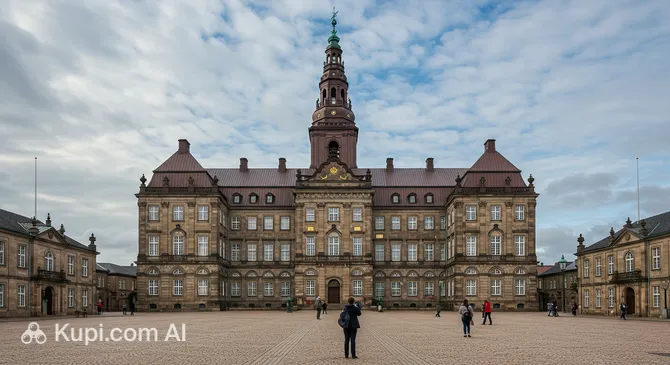
Christiansborg Palace. Illustration.
Source: Kupi.com AI

Traveler photos:

The current building, designed in the Neo-Baroque style using granite and copper, looks powerful and authoritative, perfectly reflecting its high status. The palace is surrounded by canals and connected to the main part of the city by eight bridges. Its history spans over 800 years, and the modern Christiansborg is the third major structure on this site, having survived several devastating fires. Nevertheless, it was rebuilt each time, maintaining its significance for the Danish nation.

Initially, Christiansborg served as the primary residence for Danish kings starting in 1740, but after a fire at the end of the 18th century and the subsequent move of the royal family to Amalienborg, it gradually became the center of the country's political life. Today, part of the palace is still used by the royal family for official receptions and ceremonial events. For tourists, the luxurious halls, royal stables, and even the ruins of Bishop Absalon's medieval castle, discovered during construction, are open to the public.

Contacts

For the most up-to-date information on opening hours, ticket prices, and available tours at Christiansborg Palace, we recommend contacting the administration directly. You can reach out to the palace representatives using the official visitor contact details.

How to contactContact
AddressPrins Jørgens Gård 1, 1218 København, Denmark
Phone number+45 33 92 64 92
Websitekongeligeslotte.dk

What to Do

A visit to Christiansborg Palace is a unique opportunity to immerse yourself in the rich history and culture of Denmark. The main focus for tourists is the Royal Reception Rooms, which are still used today by the royal family for official functions such as gala dinners and receptions for ambassadors. Here, you can see magnificent interiors, including the Throne Room and the Great Hall with its famous tapestries depicting a thousand years of the country's history. Of particular note is the series of ten canvases by court painter Nicolai Abildgaard, illustrating key moments in Danish history.

Beyond the luxurious rooms, Christiansborg invites you to explore other parts of this versatile complex. You can descend into the palace underground, which houses the ruins of Bishop Absalon's castle—the very first structure on this site. The Royal Stables are also open to visitors, where you can see graceful white horses and antique carriages, alongside the Royal Kitchen. This historical complex is not only a tourist attraction but also a functioning center of the country's political life, making it a must-visit location in Copenhagen for anyone interested in history and architecture.

Getting There

Getting to Christiansborg Palace is easy, as it is located in the very heart of Copenhagen, on the island of Slotsholmen. Thanks to its central location, it is within easy walking distance of many key city attractions, such as the Strøget pedestrian street or Nyhavn (New Harbour). A walk across one of the eight bridges connecting the island to the rest of the city is a pleasant experience in itself. Traveling by car is not recommended, as parking in this area is extremely limited.

The most convenient way to reach the palace is by using Denmark's efficient public transport system. The nearest metro station, Gammel Strand (lines M3 and M4), is located just a few minutes' walk from the palace. Slightly further away is the major transport hub Kongens Nytorv, which also offers a quick walk to the site. Additionally, numerous buses stop right by Christiansborg. Look for the Christiansborg (Vindebrogade) stop, served by routes such as 1A, 2A, and 26.

For those who want to see the city from the water, the harbor bus (Havnebus) is an excellent option. Routes 991 and 992 stop at the Royal Library (Det Kongelige Bibliotek), from where the palace is just a leisurely 5–10 minute walk. This method is not only convenient but also offers picturesque views of the harbor. Of course, don't forget the bicycle—Copenhagen's most popular mode of transport—which allows you to reach Christiansborg quickly and enjoyably, making you feel like a local.

Nearest city: Copenhagen

History & Facts

The history of Christiansborg Palace is a true saga spanning over 800 years. It began in 1167 when Bishop Absalon's fortress-castle was founded on this site, considered the core of modern Copenhagen. However, the appearance that forms the basis of the modern palace began to take shape much later. Between 1733 and 1740, a magnificent Baroque building was erected based on the design of architect Elias Häusser, and in 1737, the French master Louis-Auguste le Clerc was invited to oversee the sculpture and stonework.

The fate of Christiansborg has been inextricably linked with fire. The palace survived two catastrophic fires that radically changed its appearance. The first major fire occurred in 1794, after which the building was painstakingly restored by architect Christian Hansen between 1800 and 1820, giving it stricter Neoclassical features. But in 1884, flames engulfed the palace once again. This time, the restoration was led by Thorvald Jørgensen, who recreated Christiansborg in the Neo-Baroque style between 1907 and 1922, returning the monumentality and grandeur we see today.

The most significant turning point in the palace's history occurred in 1849. Following the adoption of the constitution, when Denmark became a parliamentary monarchy, Christiansborg was officially handed over to the Danish Parliament—the Folketing. Since then, it has been more than just a historical monument; it is the heart of the country's political life, symbolizing the transition from absolutism to democracy and uniting the past and present of the Danish nation under one roof.

Time Needed

To fully enjoy your visit to Christiansborg Palace, you should set aside 3 to 4 hours, which is roughly half a day. This will allow you to explore all the main parts of this multifaceted complex without rushing, as it includes not only the reception rooms but also other interesting exhibits. Visitors are often offered a combined ticket, providing access to the Royal Reception Rooms, the Royal Kitchen, the Royal Stables, and the ancient ruins beneath the palace.

If your time is limited, you can plan a shorter route. For example, a tour of the majestic Royal Reception Rooms, including the famous Great Hall with its tapestries, takes about 1.5–2 hours. Delving into history requires extra time: a visit to the ruins of Absalon's Castle beneath the palace usually lasts 30–45 minutes, and you should allow another hour for the Royal Kitchen and Stables. For those who just want to enjoy a panorama of the city, it is possible to climb the palace tower for free, which takes no more than 30 minutes, including any potential wait. Thus, you can plan either a quick 1-2 hour visit or a deeper exploration that takes up most of the day.

Working Hours

Christiansborg Palace is open to visitors year-round, though opening hours may vary depending on the season. During the summer period, roughly from April to October, most areas of the palace—including the Royal Reception Rooms, the ruins, and the Royal Kitchen—are typically open daily from 10:00 to 17:00. In the winter season, from November to March, the palace is often closed on Mondays but follows the same 10:00 to 17:00 schedule on other days. It is worth noting that different parts of the complex, such as the Royal Stables, may have their own shorter schedules.

While tickets can be purchased on-site, to save time and guarantee entry, it is recommended to buy them online in advance, especially during the peak tourist season. Combined tickets are available, allowing you to visit several areas of the palace at a discounted price. As Christiansborg is an active residence and a venue for state events, there may be sudden changes to the schedule. Therefore, we strongly advise checking the current opening hours and potential closures of specific halls on the palace's official website before your visit.

9:00 – 17:00

Nearby

A visit to Christiansborg Palace is just the beginning of your journey into the historical heart of Copenhagen. The palace is located on the island of Slotsholmen, which is an open-air museum in its own right. A stroll through its surroundings will allow you to dive deeper into Danish history and culture, with other iconic sites just steps away, each possessing its own unique atmosphere.

Exploring the nearby attractions will enrich your experience and help you form a more complete picture of the capital. The island and its surroundings offer many discoveries, from ancient buildings and museums to cozy cafes and picturesque canals. By taking the time for a walk, you can feel the rhythm of the city and see how closely the past and present are intertwined in this remarkable district.

NameDistance
The Old Stock Exchange0.2 km
Bastard Café0.3 km
La Fontaine0.3 km
National Museum of Denmark0.4 km
Huset-KBH0.4 km
The Round Tower0.6 km
Ny Carlsberg Glyptotek0.6 km

Have you reached the end of the page?

So the route has been studied inside and out