Support

Panthéon

About

Located in the heart of the Latin Quarter, the Panthéon is one of the most majestic and significant architectural and historical monuments in Paris. This monumental Neoclassical building, topped by a massive dome, serves as the mausoleum for France's most distinguished figures, becoming a symbol of national heritage and memory.
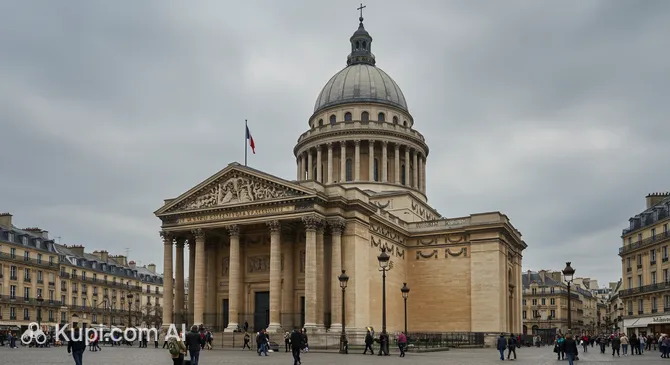
Panthéon. Illustration.
Source: Kupi.com AI

Traveler photos:

Initially, this grand structure was intended as the Church of Saint Genevieve, the patron saint of Paris. However, the French Revolution changed its purpose, and since 1791, the building has been a secular mausoleum. This is proclaimed by the famous inscription on the frieze: "To the Great Men, the Grateful Fatherland" (French: AUX GRANDS HOMMES LA PATRIE RECONNAISSANTE), which precisely defines its new role.

Visiting the Panthéon's crypt is an opportunity to touch history. The remains of such giants of thought and spirit as Voltaire, Jean-Jacques Rousseau, Victor Hugo, Alexandre Dumas, and Émile Zola rest here. In 1995, Marie Curie was buried here, becoming the first woman to be honored with this distinction for her own scientific merits. In addition to the burials, inside you can see the famous Foucault pendulum, which clearly demonstrates the Earth's rotation, adding an educational element to the visit.

Contacts

To plan your visit to the Panthéon and get the most up-to-date information on tickets, temporary exhibitions, and opening hours, it is recommended to use the official contact details. You can easily find all the necessary information on the website or clarify details by phone.

How to contactContact
AddressPl. du Panthéon, 75005 Paris, France
Websitewww.paris-pantheon.fr

What to Do

A visit to the Panthéon offers guests the opportunity to experience the greatness of French history and culture. Once inside, you will be struck by the grand interior with its massive Corinthian columns and high dome. Your attention will surely be drawn to the wall paintings and frescoes depicting the life of Saint Genevieve and key moments in the history of France. Be sure to take time for the famous Foucault pendulum, suspended right under the center of the dome. Watching its slow and rhythmic motion is a unique chance to see firsthand proof of the Earth's rotation, as it was first demonstrated to the public by Léon Foucault in 1851.

One of the main highlights of the visit is descending into the crypt—the final resting place of the nation's great figures. Here you can pass by the tombs of such outstanding individuals as writers Victor Hugo and Émile Zola, philosophers Voltaire and Jean-Jacques Rousseau, as well as the scientist Marie Curie, who became the first woman honored to rest in the Panthéon for her achievements. This is a place where history comes alive, allowing you to pay tribute to those who shaped the country's cultural and scientific heritage.

For the full experience, don't miss the chance to climb to the upper terrace of the dome. From there, one of the most breathtaking panoramic views of Paris opens up, covering iconic spots like the Eiffel Tower, Notre-Dame Cathedral, and the Luxembourg Gardens. It is the perfect place for photos and quiet contemplation of the city from above. To dive deeper into the history of this place, you can use the services of a guide or join an organized tour, which will provide detailed information about every part of this majestic monument.

Getting There

The Panthéon is conveniently located in the heart of the Latin Quarter in Paris, making it easily accessible for tourists. The simplest and fastest way to get here is by using the Paris Metro. The nearest station, Cardinal Lemoine (Line 10), is just a few minutes' walk away. Place Monge (Line 7) and the RER B station Luxembourg are also nearby, offering travelers additional flexibility in planning their route.

For those who prefer surface transport, numerous bus routes serve the Panthéon. You can take buses 21, 27, 38, 82, 84, 85, or 89. Additionally, thanks to its central location, the mausoleum is a pleasant walk from other famous attractions, such as the Luxembourg Gardens. Taking a taxi is also a convenient option, especially if you value comfort.

If you plan to get around the city by car, please note that there are paid parking lots near the Panthéon. However, due to heavy traffic and the limited number of parking spaces in the center, it is strongly recommended to use public transport. This will not only save you time but also help you avoid the extra stress of driving in a major city.

Nearest city: Paris

History & Facts

The history of the Panthéon is inextricably linked to a royal vow. In 1744, King Louis XV of France, having fallen seriously ill, swore to build a majestic temple in Paris in honor of Saint Genevieve, the city's patron saint, if he recovered. The design was entrusted to the outstanding architect Jacques-Germain Soufflot, who drew inspiration from the grandeur of Greco-Roman temples. Construction began in 1758, but neither the king nor the architect lived to see its completion. The work was finished by Soufflot's student, Jean-Baptiste Rondelet, only in 1790, at the height of the French Revolution.

Soufflot's architectural concept was innovative for its time. He sought to combine the lightness and light of Gothic cathedrals with the monumentality and strict forms of classical architecture. The result was a building with a Greek cross plan, adorned with a massive portico featuring Corinthian columns and topped by an impressive 83-meter-high dome. Interestingly, the dome of the Panthéon actually consists of three nested shells, a complex engineering solution that created a structure that is both strong and elegant.

With the arrival of the Revolution, the building's fate changed dramatically. In 1791, the National Assembly decided to turn the nearly completed church into a secular mausoleum for the burial of the country's distinguished citizens. Thus, the Church of Saint Genevieve became the Panthéon. However, its status was not permanent: throughout the 19th century, it returned to its role as a church twice more, until 1885, following the state funeral of Victor Hugo, when it was finally established as the final resting place of great figures. These changes were even reflected in its appearance: windows were walled up to create a more somber atmosphere, and the cross on the dome was replaced by a flag.

Time Needed

When planning a visit to the Panthéon, you should expect a thorough tour to take an average of 1.5 to 2 hours. This time is usually sufficient to leisurely enjoy the majestic architecture of the main hall, examine the famous Foucault pendulum, and descend into the crypt where the great figures of France are buried.

If you want to get the most out of your experience, set aside a little more time. For instance, if your plans include climbing to the dome's observation deck, which offers a stunning view of Paris, or visiting temporary exhibitions often held at the Panthéon, the total duration of the visit may be about 3 hours. This unhurried approach will allow you to immerse yourself deeper into the history of this unique place and fully appreciate its significance.

Working Hours

The Panthéon is open to visitors year-round, making it a convenient stop on any Paris itinerary. Standard opening hours are daily from 10:00, with closing times depending on the season: from April 1 to September 30, it is open until 18:30, and from October 1 to March 31, until 18:00. It is important to remember that last admission is 45 minutes before the official closing time. On public holidays, such as January 1, May 1, and December 25, the Panthéon is closed to visitors.

While pre-booking a time slot is usually not required, buying tickets online will help you avoid queues, especially during the peak tourist season. This is particularly convenient if you plan to visit on popular dates. Before your trip, it is strongly recommended to check the current schedule and any possible changes on the attraction's official website, as special events may sometimes affect access hours.

10:00 – 18:30

Nearby

A visit to the Panthéon is just the beginning of a fascinating journey through the Latin Quarter, one of the oldest and most atmospheric districts in Paris. Strolling through its surroundings will allow you to dive deeper into the city's history and culture, as famous landmarks, cozy gardens, and legendary spots are hidden around literally every corner.

Thanks to its central location, many iconic sites are within easy walking distance of the Panthéon. This is a great opportunity to create a rich full-day itinerary, combining the grandeur of the national mausoleum with the charm of Parisian streets. Below is a list of interesting places located in the immediate vicinity.

NameDistance
Le Caveau de la Huchette0.7 km
Louvre Museum1.7 km
Supersonic1.8 km
Musée d'Orsay2.1 km
Galerie Vivienne2.3 km
La Felicità2.3 km
Les Invalides2.7 km

Have you reached the end of the page?

So the route has been studied inside and out