Support

Ohlsdorf Cemetery

About

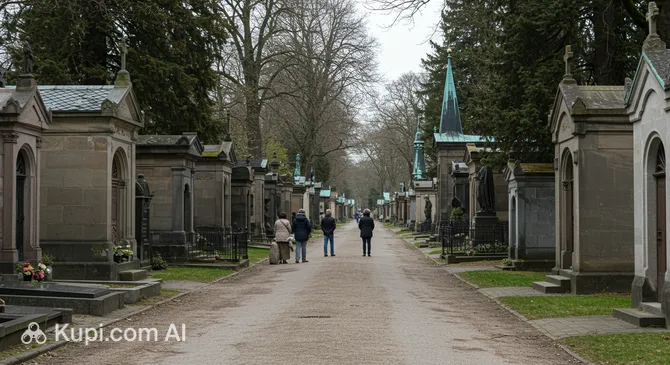
Imagine a space where the boundaries between memorial art and living nature blur, creating a stunning landscape. This is exactly what Ohlsdorf Cemetery is—the largest cemetery in Europe and the most extensive memorial park complex in the world. Located in the north of the Hamburg metropolis, this site has long become something more than just a necropolis, turning into one of the most visited attractions, chosen by more than two million people annually.
\n
Ohlsdorf Cemetery
Ohlsdorf Cemetery. Иллюстрация. Источник: Kupi.com AI
\n

Occupying an impressive area of 391 hectares, this complex in Germany strikes visitors with its regular layout, symmetrical paths, and centuries-old yew avenues. Here, among green hills and ponds, lie not only 280,000 graves but also true architectural masterpieces: from majestic mausoleums to elegant sculptures. At the main entrance, guests are greeted by an impressive white marble figure of Christ, symbolizing the peace and eternity of this place.

\n

Ohlsdorf is not just a historical monument, but a living ecosystem. Here you can see rare plant species, enjoy the blooming rhododendrons, or visit the unique Women's Garden. The cemetery-park harmoniously combines the functions of an open-air museum and a quiet oasis, where architectural elements such as the water tower and numerous chapels create the unique character of this historic district.

Contacts

For those planning a visit to this landmark site, the current contact information will be useful. You can always clarify tour details or find a map of the grounds on the organization's official website.

Contact Details:

How to contactContact
AddressFuhlsbüttler Str. 756, 22337 Hamburg, Германия
Phone+49 40 593880
Websitewww.friedhof-hamburg.de

What to Do

A walk through the grounds of the complex feels like a journey through a vast landscape park. Here you can wander for hours along winding alleys, enjoying the silence and contemplating the picturesque ponds. One of the main gems is the Rose Garden, where more than 2,700 rose bushes are planted. It is an ideal place for those seeking solitude, photography enthusiasts, or bird watchers, as the variety of birds here is immense.

History and architecture lovers should pay attention to the family mausoleums. The grandest of them belongs to the Schröder family and covers an area of 222 square meters. Also, be sure to visit the Museum of Funeral Culture to learn more about the traditions and culture of remembrance. Equally interesting is the Women's Garden—a unique space with a "spiral of memory" dedicated to outstanding women of Hamburg who contributed to the city's science and culture.

For the convenience of visitors, buses run throughout the territory, allowing you to cover as many interesting locations as possible in one visit. You can stop at the Christ sculpture at the entrance, pay your respects in the Ehrenfriedhof area where honorary citizens are buried, or examine the ancient chapels, each possessing its own unique architectural style.

Getting There

The attraction is located in the northern part of the city at Fuhlsbüttler Str. 756. Thanks to its well-developed infrastructure, getting here is easy. The most convenient way is to use public transport. You need to take the metro (U-Bahn) or the city train (S-Bahn) to the Ohlsdorf station. It is only a few minutes' walk from the station exit to the main gates of the complex.

Once inside, you will find that the territory is so large that city buses run through it. There are 25 stops on the grounds, allowing you to move easily between distant sectors, mausoleums, and gardens. If you prefer a taxi, the ride from the city center will take about 20–30 minutes, depending on traffic.

For travelers with their own or rented cars, parking spaces are provided at the entrances. Driving is also permitted within the grounds, making a tour of the massive necropolis as comfortable as possible. From Hamburg Airport, the journey takes no more than 10 minutes heading south.

Ближайший город: Hamburg

History & Facts

The history of this place began in 1875 when city authorities purchased a plot of land in the village of Ohlsdorf to create a modern multi-denominational necropolis. The project was designed by architect Franz Andreas Meyer, who envisioned the cemetery not just as a place of mourning but as a harmonious park ensemble. The official opening took place on July 1, 1877, and a memorial stone still stands there in memory of the first three burials.

The first director, Johann Cordes, made an enormous contribution to the development of the complex. He actively attracted wealthy citizens by offering them plots for the construction of grand family tombs. Thanks to his efforts, numerous mausoleums appeared here, which are today recognized as architectural monuments of the 19th and 20th centuries. Later, in 1919, the territory was expanded by the next director, Otto Linne, who added a strict geometric layout to the new sectors.

Over a century and a half, the area of the necropolis has grown to an incredible 391 hectares. During this time, about 1.5 million people have found their final resting place here. Ohlsdorf has become a mirror of the city's history: here you will find the graves of honorary citizens, figures of art and science, and memorials dedicated to victims of various historical events, turning a walk into a true immersion into Europe's past.

Time Needed

Given the colossal scale of the site, which spans nearly 400 hectares, it is worth planning your visit in advance. If your goal is just a brief introduction to the main monuments and the central avenue, the walk will take about 1.5–2 hours.

However, to truly feel the unique atmosphere, explore the remote themed gardens, visit the Rose Garden, and the Museum of Funeral Culture, it is better to set aside 3 to 5 hours (half a day). The vast length of the paths invites leisurely exploration, so comfortable shoes are a must for a pleasant visit.

Working Hours

The complex is open to visitors daily. You can plan your walk for any day of the week, as the site operates without days off or holidays.

Typically, the gates are open for entry from 09:00 to 18:00. Nevertheless, we recommend checking the official website before your visit, as opening hours may change depending on the season or special memorial events.

09:00–18:00

Nearby

After a stroll through the quiet alleys of the park-cemetery, you can continue exploring the northern part of the city and its surroundings. Visiting nearby locations will allow you to switch the atmosphere from quiet contemplation to active recreation or family entertainment.

Nearby Attractions:

NameDistance
Alstertal Shopping Center5.3 km
Birdland6.6 km
Hagenbeck Zoo6.8 km
Hamburg Conference Hotel7.2 km
Hamburg Kunsthalle7.5 km
Alster Fountain7.6 km
Lokmam Köz7.9 km

Reached the end of the page?

That means the route is fully explored