Support

Neapolis Archaeological Park

Nearby interesting places

About

Neapolis Archaeological Park is one of the most impressive and significant archaeological complexes not only in Sicily but in all of Italy. Located in the modern city of Syracuse, this massive open-air museum covers an area of about 240,000 square meters and houses treasures from the ancient era. The park is a unique collection of monuments that allow you to journey back to the times of Ancient Greece and the Roman Empire.

The heart of the park is the majestic Greek Theatre, carved directly into the rock in the 5th century BC. It is one of the largest theaters in the Hellenic world, and even today, it continues to amaze with its grandeur and incredible acoustics. Nearby is the Roman Amphitheater — a testament to another great era, where gladiatorial battles once took place. Another iconic part of the park is the ancient stone quarries, known as latomies.
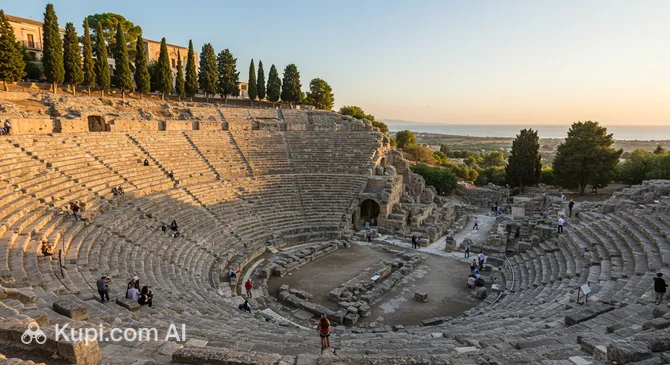
Neapolis Archaeological Park. Illustration.
Source: Kupi.com AI

Traveler photos:

Of particular interest to visitors is the cave known as the "Ear of Dionysius." This man-made cave, 23 meters high and 65 meters long, possesses unique acoustic properties that amplify sound several times over. The legend to which the cave owes its name says that the tyrant Dionysius I used it as a prison to eavesdrop on the conversations of his captives. The grotto's shape does indeed resemble a human ear.

Visiting the Neapolis Archaeological Park is a must-do for anyone interested in Mediterranean history, architecture, and culture. A walk through its grounds allows you not just to see ancient ruins, but literally to touch history and feel the greatness of the civilizations that left their mark here.

Contacts

To plan your visit to the Neapolis Archaeological Park, it is recommended to check official resources for current information on opening hours and ticket prices, as these may vary depending on the season. You can contact the park administration or book a guided tour using the provided contact details.

How to contactContact
AddressVia Luigi Bernabò Brea, 14, 96100 Siracusa SR, Italy
Websiteparchiarcheologici.regione.sicilia.it

What to Do

Visiting the Neapolis Archaeological Park is a true immersion into history. The main activity here is exploring its outstanding monuments. You can personally experience the unique acoustics in the famous "Ear of Dionysius" cave, where even a quiet whisper echoes throughout the grotto. Walk the steps of the massive Greek Theatre, one of the largest in the ancient world, and imagine yourself as a spectator of an ancient Greek tragedy. Then, head over to the Roman Amphitheater to feel the atmosphere of the gladiatorial fights that once took place in this arena.

Walking through the park is more than just seeing the main sites. Visitors can explore the ancient stone quarries (latomies), where the stone for building ancient Syracuse was extracted, and peer into the picturesque Cordari Cave, also known as the Ropemakers' Cave. Be sure to see the ruins of the monumental Altar of Hieron II, which was once one of the largest in the ancient world. You can also find ancient necropolises from the Roman and Byzantine periods and the small Norman church of San Nicolò on the park grounds.

To make your visit even more informative, you can join one of the many guided tours. Guides will share fascinating stories and legends associated with this place. Additionally, the Neapolis Park occasionally hosts themed events and even theatrical performances that bring the ancient ruins to life and allow guests to feel the atmosphere of antiquity more deeply. Simply walking along the ancient paths among olive and citrus trees is a pleasure in itself.

Getting There

Getting to the Neapolis Archaeological Park is quite easy, as it is well-integrated into the urban layout of Syracuse. The park is located about a 30-minute walk from the city's historic center, the island of Ortygia. This walk is a great way to stretch your legs and get to know the city better; in fact, many tourists find that walking is often faster than waiting for public transport.

For those who prefer public transportation, city buses run regularly, connecting the park with the main districts. For example, you can take bus No. 2 from Ortygia. If you are traveling by car, there is a large and convenient parking area for private vehicles and tour buses near the entrance to Neapolis. The entrance is easy to find, as it is located next to the parking lot and a souvenir market, where tickets can also be purchased.

Nearest city: Syracuse

History & Facts

The history of the Neapolis Archaeological Park is inextricably linked to the history of Syracuse itself. The city was founded by Greek colonists from Corinth in 733 BC and quickly grew into one of the most powerful poleis of the ancient world. Initially, the settlement was located on the island of Ortygia, but as the city expanded, a new district emerged — Neapolis, which translates to "new city." It became the cultural and social heart of the city, where the most significant buildings of the era were erected.

Each monument in the park tells the story of its own time. The majestic Greek Theatre, built in the 5th century BC, served not only for performances but also for important public assemblies. Later, during the Roman period, the Roman Amphitheater was added, designed for entirely different spectacles — gladiatorial combat. This proximity clearly demonstrates the shift in cultures and values that took place on this land. Other structures, such as the stone quarries (latomies) and the monumental Altar of Hieron II, were closely woven into the economic and religious life of the ancient city.

The park took on its modern form relatively recently. In the 1950s, large-scale work was undertaken to systematize and preserve the unique heritage scattered over the vast territory. It was then that the Neapolis Archaeological Park was officially established, with the primary goal of protecting these priceless monuments and allowing everyone to experience the great past of one of the key civilizations in the history of Italy.

Time Needed

When planning a visit to the Neapolis Archaeological Park, you should expect to spend an average of 2 to 3 hours for a tour. This time is usually enough to leisurely walk through the entire site, paying attention to the main attractions: the Greek Theatre, the Roman Amphitheater, the Altar of Hieron II, and, of course, the famous "Ear of Dionysius" cave. The park territory is quite extensive, so this time buffer allows you to enjoy your walk without rushing.

If you are a serious history or archaeology buff, you may need more time — perhaps even half a day — for a more detailed study of each site. This will allow you not only to see the main monuments but also to explore the ancient stone quarries, walk along the less crowded paths, and fully soak in the atmosphere of this unique place. To avoid the scorching Sicilian sun, especially during the summer months, it is best to plan your visit for the morning or late afternoon.

Working Hours

Neapolis Archaeological Park is generally open to visitors year-round, although its operating hours can vary significantly depending on the season. Typically, the park is open daily from morning until evening, but the exact schedule may be shorter in the winter months and longer in the summer. Since specific hours are subject to change, it is highly recommended to check the most up-to-date information on the park's official website before planning your visit.

While pre-booking is not always mandatory, purchasing tickets online can be a good idea, especially during the peak tourist season, to avoid long queues. Some sources indicate that ticket offices close an hour to an hour and a half before the park's official closing time, which should also be taken into account when planning your day.

8:30 – 19:30

Nearby

A visit to the Neapolis Archaeological Park is just the beginning of your journey through the historical heritage of Syracuse. Within the park and in its immediate vicinity, you will find many other interesting sites that help complete the picture of this ancient city's rich history and culture. For example, the famous "Ear of Dionysius" and the Greek Theatre are actually part of the park itself.

By setting aside a little extra time, you can significantly enrich your experience by exploring other treasures located nearby. Below is a list of nearby attractions that are worth including in your itinerary.

NameDistance
Greek Theatre of Syracuse0.3 km
Ear of Dionysius0.3 km
Archimedes Technopark Museum0.4 km
Sanctuary Basilica of Our Lady of Tears0.6 km
Paolo Orsi Regional Archaeological Museum0.7 km
Sanctuary of Saint Lucy at the Tomb1.1 km
Archimede Shopping Center1.6 km

Have you reached the end of the page?

So the route has been studied inside and out