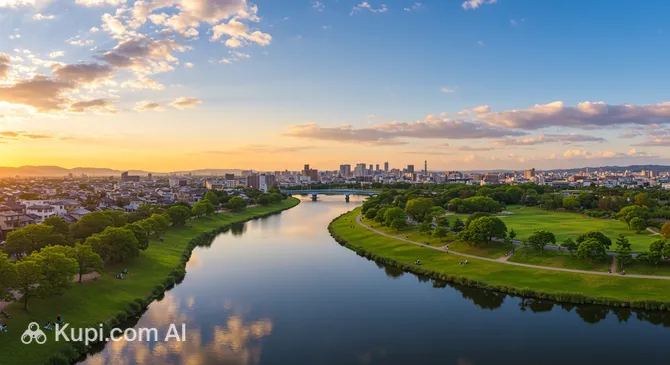
Nagareyama is a wonderful corner of Chiba Prefecture that harmoniously combines the dynamics of a modern suburb with the charm of old Japan. With a population of over 200,000, the city is deservingly considered one of the most comfortable places to live, attracting families with its peaceful atmosphere and abundance of greenery. Located less than an hour's drive from central Tokyo, it serves as an important link between the capital and the picturesque areas of the Kanto region.
The city's geographical position along the Edogawa River historically defined its development as a significant trading port. Today, you can feel the spirit of the past while strolling through the historic Nagareyama Honcho district, where old warehouses and temples from the Edo period have been preserved. You can learn more about how Nagareyama's rich heritage was formed at local museums that tell the story of the times when the city flourished through trade and the production of mirin.
Nagareyama. Illustration.
Source: Kupi.com AI
For tourists, the city is primarily interesting for its authentic streets, modern shopping complexes in the Otaka-no-mori Station area, and cozy parks. This place is ideal for those who want to escape the hustle and bustle of the metropolis without losing access to urban amenities. We invite you to discover this "oasis of nature" and feel the welcoming atmosphere of one of the fastest-growing cities in the region.
Weather Overview
The climate in Nagareyama is classified as humid subtropical, which is typical for this part of Honshu Island. This means travelers can expect distinct seasons: a hot and humid summer, and a rather cool but mostly dry winter. The abundance of greenery in the city helps to endure the summer heat more easily, and the proximity to the Edogawa River often brings a pleasant coolness in the evening hours.
Expect a warm summer with occasional rain, especially in June and July when the "tsuyu" rainy season arrives, and cold, dry winters where January temperatures can drop to 0°C. Spring and autumn are the most comfortable periods for a visit, when the city's climate delights with mild temperatures in the range of 15–20°C and picturesque color changes in the local parks.
It is worth considering that typhoons are possible in August and September, bringing strong winds and heavy rain, so it is recommended to follow forecasts closely during this time. In winter, snow falls rarely and usually melts quickly, not creating serious obstacles for walks. Overall, the weather in Nagareyama is favorable for tourism year-round if you choose the right wardrobe.
Average monthly temperature
Average monthly precipitation
Interesting Facts
The Birthplace of White Mirin: It was in Nagareyama in 1814 that shiro-mirin was invented—a sweet rice wine that became incredibly popular in Edo (modern-day Tokyo) and brought wealth to the city.
"Flowing Mountain": The city's name literally translates to "flowing mountain." According to local legend, during a severe flood, a piece of Mount Akagi from Gunma Prefecture floated here, giving the settlement its name.
Ryutetsu Railway: The city operates one of the shortest and most colorful private railways in Japan. Its trains are painted in different colors and bear flower names, creating a retro travel atmosphere.
Samurai Past: At the end of the Edo period, Nagareyama was an important base for the Shinsengumi—the famous special police force of samurai. Places associated with their final days are still preserved here.
An Oasis for Families: The city officially promotes itself under the slogan "The City Closest to the Forest in Tokyo," emphasizing the preservation of green zones amidst dense development.
How to Get There
Nagareyama boasts excellent transport accessibility, making it an ideal destination for short trips from the capital. The main flow of tourists and locals uses modern high-speed lines that allow you to find yourself in a quiet suburb just 20–30 minutes after starting from the noisy quarters of Tokyo. You can find more detailed information about routes in the section on how to get to the city.
If you are arriving on an international flight, it is most convenient to use Narita Airport (NRT). From there, the city can be reached by bus or train with one transfer, which takes about an hour and a half. Another option is a flight through Haneda Airport (HND), located closer to central Tokyo, from where it is convenient to transfer to the Tsukuba Express line at Akihabara Station.
The railway connection is the heart of the city's transport system. Nagareyama-centralpark Station on the Tsukuba Express line provides a fast connection to the metropolis. For lovers of more relaxed and authentic transport, the Ryutetsu Nagareyama line connects the city to Mabashi Station. Traveling on this single-track road in multi-colored trains is a pleasant tourist attraction in itself.
Station
Passenger traffic
Distance
Asakusa Station
21
19 km
Akabane Station
16
19 km
Nippori Station
16
19 km
Uguisudani Station
15
19 km
Okachimachi Station
16
20 km
Main Attractions
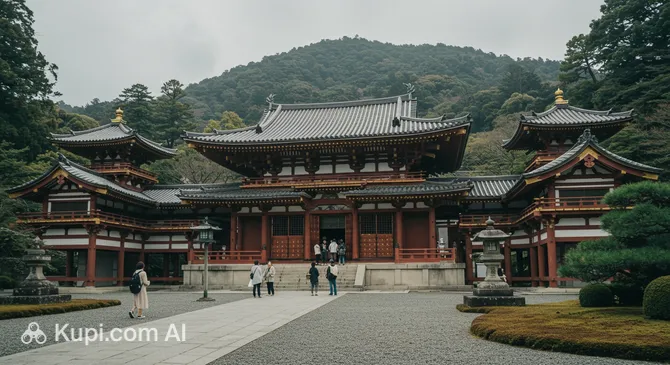
Despite often being perceived as a cozy suburb, the city hides many interesting places. One of the main gems is the ancient Hondoji Temple, which is especially beautiful during the hydrangea and autumn maple seasons. This place is imbued with tranquility and allows you to touch the spiritual traditions of the region.
Hondoji Temple. Illustration.
Source: Kupi.com AI
Traveler photos:
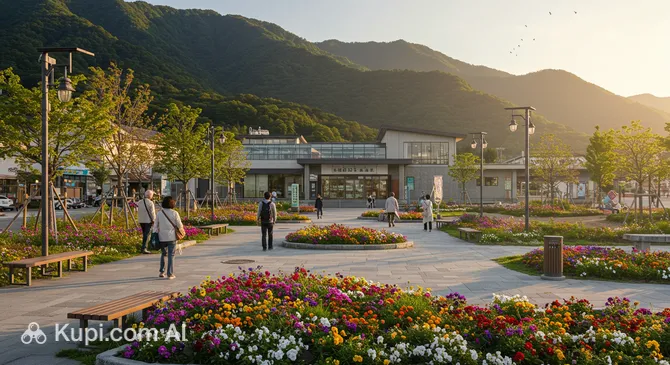
For lovers of active recreation and outdoor walks, the Nagareyama City Sports Park is an excellent choice. This is a vast territory with modern infrastructure for sports and quiet zones for family picnics. And if you are looking for a place with interesting landscape design, stop by Misato Sky Plaza, which offers pleasant views and always features a refreshing breeze.
Misato no Kaze Hiroba. Illustration.
Source: Kupi.com AI
Traveler photos:
Special attention should be paid to the historic Nagareyama Honcho district. Here, far from the skyscrapers, ancient merchant houses and temples such as Suwa and Akagi have been preserved. The city museum is also located in this area, where you can see exhibitions dedicated to the production of the famous white mirin. For those who prefer a modern rhythm, the Nagareyama Otakanomori S.C. shopping complex, with its numerous shops and recreation areas, will be a center of attraction.
Local Cuisine
A gastronomic journey through Nagareyama is impossible to imagine without getting to know its main symbol—white mirin (shiro-mirin). This sweet rice wine is not just an ingredient here, but part of the cultural code. It is added to sauces and desserts, and even served as a standalone drink. In the historic Honcho district, you can find old shops where mirin has been produced according to traditional recipes for over two centuries.
For those who want to try classic Japanese cuisine in a cozy setting, the Misatoya restaurant is an excellent choice. Here you can enjoy seasonal dishes prepared with great attention to detail. And if you are looking for a more modern approach to culinary arts or want to dine in an elegant atmosphere, visit the restaurant at the Lumiere Grande Nagareyama Otakanomori hotel, where international traditions and local products are combined.
The overall character of local cuisine is honest and high-quality food for local residents. Along the shopping streets and in modern malls, you will find many izakayas, ramen shops, and sushi bars. Be sure to try dishes using local soy sauce from neighboring Noda and tempura, the sweetness of which is highlighted by that very legendary mirin from Nagareyama.
Travel Tips
A trip to Nagareyama will give you a rare opportunity to see everyday life in Japan at its best. To ensure your trip is as comfortable as possible, we have prepared some practical tips.
Clothing and Season: In summer, the region is very humid and hot, so choose light natural fabrics. In winter, it can be quite cool, so dress in layers. For walking through parks and temples, comfortable shoes that are easy to take off are mandatory—this will be required when entering many temples and traditional restaurants.
Transport and Cards: Be sure to purchase an IC card (Suica or Pasmo). This will save you from having to buy tickets for each trip and allow you to pay for small purchases. Avoid traveling to Tokyo from 7:00 to 9:00 AM—Tsukuba Express trains will be overcrowded.
Finances: Although Japan is actively moving toward cashless payments, Nagareyama still has many small family shops and temples where they accept cash only. Always carry a supply of yen with you for such cases.
Connectivity and Internet: Free Wi-Fi is available in shopping centers and at major stations, but for navigation, it is better to rent a pocket router or buy a tourist SIM card directly at Narita Airport.
Etiquette: In Japan, it is customary to maintain silence on public transport. Loud phone conversations on the train are considered bad manners. When visiting temples, behave with restraint and follow the example of locals when performing rituals.
Language Barrier: In Nagareyama, the level of English is lower than in central Tokyo. We recommend downloading an offline translator in advance and having the names of key places in Japanese with you.
What to Avoid: Do not leave tips in restaurants and cafes—in Japan, this is not customary and may even embarrass the staff. All service is already included in the price of the dishes.
Environment: The city has very strict rules for waste sorting. If you don't see a suitable bin on the street, it's better to take your trash with you to the nearest konbini or hotel.
Nagareyama is a place where time flows a little slower than in the metropolis. Enjoy every moment and discover the real Japan!
Entertainment & Nightlife
Nightlife in the city is calm and relaxed, as the city is geared toward family vacations and the comfort of local residents. You won't find noisy nightclubs open until dawn here, but you can enjoy the cozy atmosphere of local bars and restaurants. Most evening activity is concentrated around the modern Tsukuba Express railway stations and in the historic center.
For those who want to spend a pleasant evening over a great cup of coffee or a glass of a drink, Espresso D Works Nagareyama Otaka-no-mori is a wonderful choice. This establishment is famous for its stylish setting and is popular with both young people and families. If you are looking for a place with more refined gastronomy and interesting desserts, you should visit Bistro and Bar Vigo, where they serve the famous "night parfaits"—the perfect end to the day.
Espresso D Works Nagareyama Ohtakanomori. Illustration.
Source: Kupi.com AI
Traveler photos:
Daytime entertainment includes visiting modern spa complexes such as Spa Metsä Otaka, where you can relax in authentic onsens. In summer, the city is transformed during a large-scale fireworks festival that gathers thousands of spectators on the banks of the Edogawa River. Safety in the city is at a very high level, so evening walks along the illuminated streets and parks are perfectly comfortable and pleasant.
Parks & Museums
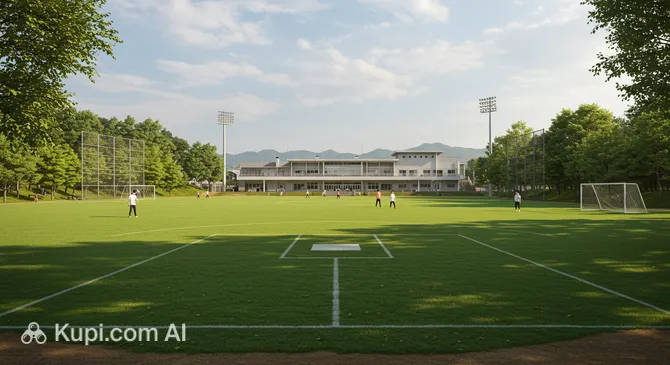
The city's green zones and cultural sites create the atmosphere of a "suburban oasis" that local authorities care for so much. One of the most popular places for walking is the Nagareyama City Sports Park. This is not just a training ground, but a vast territory with shaded alleys where residents rest from the city's bustle surrounded by trees. For those who prefer views of open spaces and the river, Misato Sky Plaza, located nearby, is an excellent choice.
Nagareyama General Athletic Park. Illustration.
Source: Kupi.com AI
Traveler photos:
The Nagareyama City Museum will help you dive into the region's history. This small but very soulful museum focuses on key milestones in the city's development: from the production of legendary mirin to the daily life of ordinary Japanese people in the Showa era. The exhibitions include reconstructions of living rooms and old shops, literally allowing you to step back in time. Other important cultural points are temples such as Hondoji, whose gardens themselves represent a living museum of changing seasons.
Hondoji Temple. Illustration.
Source: Kupi.com AI
Traveler photos:
Natural landscapes along the Edogawa River also deserve attention. It is an ideal place for cycling or morning jogs. While there are no huge national parks in the city, the abundance of compact squares and careful attention to greenery make Nagareyama one of the most pleasant cities for leisurely nature contemplation right in the middle of residential quarters.
Getting Around
The public transport system in the city is organized with Japanese punctuality and is oriented toward a fast connection with the capital. The main artery is the high-speed Tsukuba Express (TX) line, whose trains will whisk you to Tokyo's Akihabara district in a matter of minutes. It is important to remember that during morning and evening peak hours, trains can be very crowded due to the large flow of people commuting to work in Tokyo.
To move around the city itself, it is convenient to use the Ryutetsu Nagareyama line. This is a small private railway that has preserved the spirit of old Japan. Its short, colorful trains run between five stations, linking historic districts with the main transport hubs. Besides trains, the city has a developed network of bus routes, but they run less frequently, and for a tourist, a trip on them may require a bit more planning.
Fare payment is simplified as much as possible thanks to universal contactless Suica or Pasmo cards. They can be used on all types of transport, as well as for payment in konbini stores. You can buy and top up a card at machines at any station. Given the city's compactness and abundance of flat paths, a bicycle is an excellent alternative to transport—Nagareyama has a very developed cycling culture, and rental points are often found near major stations.
Accommodation
Accommodation in Nagareyama is primarily focused on those who appreciate the comfort of modern residential areas and proximity to transport hubs. Unlike large tourist centers, modern business hotels and apartments predominate here, often chosen by travelers who want to save on accommodation in Tokyo itself while maintaining a high level of service and convenient access to the capital.
The most convenient option for tourists is the Nagareyama-Otakanomori Station area. Here you will find the high-class Lumiere Grande Nagareyama Otakanomori, which offers guests modern rooms and direct access to shopping and transport zones. Renting guest houses and apartments through online services is also popular in the city, allowing you to feel like a local in a quiet Japanese suburb.
Lumiere Grande Nagareyama Otakanomori. Illustration.
Source: Kupi.com AI
Traveler photos:
The price range for housing in the city is medium, making it attractive for long-term stays. It is recommended to book in advance, especially if your trip coincides with the cherry blossom season or major festivals, as the choice of hotels directly within the city limits is not very large. For more budget-friendly options, you can consider neighboring cities connected to Nagareyama by a direct train line.
Nearby Cities
Nagareyama serves as an excellent starting point for exploring the northern part of the capital region and neighboring prefectures. Thanks to the well-developed railway network, you can find yourself in interesting places in just minutes, each with its own unique character. This makes the city a convenient hub for those who prefer day trips without the need for frequent hotel changes.
Just a few kilometers away is the city of Misato, known for its parks and modern shopping zones. Also worth a visit is the city of Kashiwa—a major educational and commercial center, often called "Little Shibuya" for its lively atmosphere and abundance of shops. For tradition lovers, neighboring Noda is an interesting destination, where you can visit soy sauce factories and learn the secrets of this key Japanese product.
Exploring the city's surroundings will allow you to see the many faces of Japan: from quiet agricultural lands and picturesque riverbanks to bustling shopping districts and modern university campuses. Each of these destinations is easily reachable by train, turning any day trip into an easy and pleasant adventure.
Shopping & Souvenirs
Shopping in Nagareyama offers travelers an interesting combination of ultra-modern shopping centers and atmospheric shops with a century of history. The city is not a mecca for high fashion, but here you can find everything you need for a comfortable life and unique local goods that will be a great reminder of your trip to Japan.
The heart of modern shopping is the Otaka-no-mori Station area, where the large-scale Nagareyama Otakanomori S.C. complex is located. Hundreds of famous brand stores, a cinema, and a huge food court are gathered here under one roof. In the same area, you can visit stylish spaces such as Espresso D Works Nagareyama Otaka-no-mori, where shopping can be combined with relaxation in a pleasant cafe.
To find authentic souvenirs, head to the historic Honcho district. The main local specialty is white mirin. A bottle of this elite sweet sauce from an old shop will be the perfect gift for gourmets. You can also purchase items from local craftsmen and traditional Japanese sweets here. Most shops accept bank cards, however, in the small shops of the old town, it is still better to have some cash yen with you.