Support

Jeju National Museum

About

The Jeju National Museum, located in Jeju City on the picturesque Jeju Island, is one of the key cultural and historical centers of South Korea. This museum is not just a storehouse of artifacts, but a real window into the rich and unique history of the island, from ancient times to the present day. A visit to the museum will allow you to gain a deeper understanding of the culture and traditions of this amazing corner of the world.
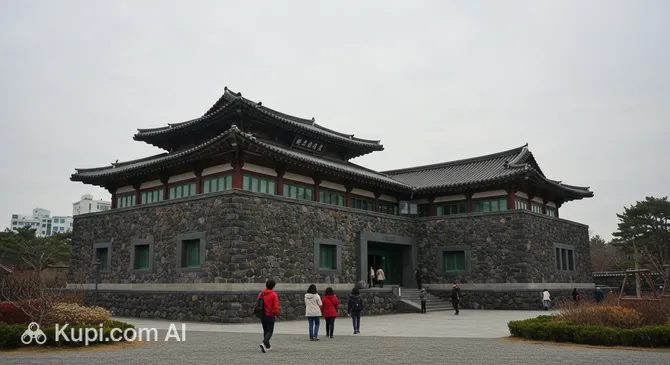
Jeju National Museum. Illustration.
Source: Kupi.com AI

Traveler photos:

The museum's collection is striking in its diversity and covers a vast period of time. Here you will find exhibits telling the story of life on Jeju Island since the Stone Age. Of particular interest are samples of ancient earthenware, some of which scientists believe were made around 8000 BC, making them among the oldest such finds in the region. Each hall of the museum is carefully designed so that visitors can trace the evolution of the island's culture.

One of the highlights of the Jeju National Museum is the central hall, adorned with impressive stained glass windows. They depict the “Myth of the Samseong” (Samseong)—an ancient legend about the founding of the legendary state of Tamna on Jeju Island. These colorful works of art are not only pleasing to the eye but also serve as an important reminder of the mythological roots and distinctiveness of the island's identity. The museum offers a unique opportunity to touch the origins of Jeju's history.

Contacts

For up-to-date information on opening hours, ticket prices, and available guided tours at the Jeju National Museum, it is recommended to visit the museum's official website or contact local tourist information centers in Jeju City. You can also find contact phone numbers and email addresses there.

How to contactContact
Address17 Iljudong-ro, Cheju, Jeju-do, South Korea
Phone number+82 64-720-8000
Websitejeju.museum.go.kr

What to Do

At the Jeju National Museum, visitors can immerse themselves in the island's history by exploring a variety of exhibits. Among them, particular attention is drawn to artifacts such as ancient abalone shells, which testify to the islanders' close connection to the sea, and an old map, presumably created in the 18th century, which gives an idea of the geographical knowledge of that time. These items help recreate the picture of Jeju's past and understand the uniqueness of its development.

In addition to archaeological finds, the museum displays valuable works of art. For example, visitors can see the Tamna Sullyeokdo paintings, one of which depicts an inspection tour of the island in great detail. These paintings not only demonstrate the skill of the artists but also serve as an important historical document illustrating aspects of life and governance on Jeju in past eras.

The central hall is a special place in the museum. After passing through the main entrance, be sure to stop here to admire the impressive stained glass on the ceiling. Scenes from the “Myth of the Samseong” (Samseong) come to life there, closely linked to the majestic Hallasan Mountain and the three symbols of Jeju culture: lava stones, representing the island's volcanic origin, wind, constantly shaping its landscape, and women, who play a special role in the island's history and daily life. These stained glass windows are not just decoration, but a deep cultural narrative reflecting the mythology and soul of Jeju.

Getting There

Getting to the Jeju National Museum is quite simple, especially if you are arriving on the island by plane. The museum is conveniently located relative to Jeju International Airport. A car ride from the airport to the museum takes about 20 minutes, making it a great option to visit either right after your arrival or before your flight home.

Since the museum is located in Jeju City, the island's administrative center, it is easily accessible by taxi from any part of the city. You should also consider using local public transport – buses in Jeju City have an extensive route network and frequently stop near popular tourist sites. Check the nearest stops and route numbers in advance.

Thanks to its location within the city limits and proximity to the island's main transport hub, the Jeju National Museum is an easily accessible attraction for all travelers. For precise directions, you can use navigation apps by searching for the museum's name – it is easy to find due to its prominence.

Nearest city: Jeju City

History & Facts

The Jeju National Museum is not just a repository of antiquities, but the result of dedicated efforts to preserve and interpret the unique history of Jeju Island, which developed in relative isolation for a long time. Opened in 2001, the museum has become the primary center for studying the rich heritage of Jeju City and the entire island. Its exhibition tells the story not only of ancient Neolithic settlements—whose traces, including pottery up to 10,000 years old, are truly impressive—but also of the formation of a distinctive island culture separate from mainland South Korea.

A special place in the exhibition is dedicated to the myth of the Samseong (삼성, 三姓)—the three progenitor demigods who emerged from the ground and founded the ancient Kingdom of Tamna. This myth is more than just folklore; it is the cornerstone of Jeju’s identity, explaining the origins of its people and unique cultural traits. The museum's stained glass windows in the main hall, depicting this legend, serve not only as decoration but as a powerful visual narrative linking the past to the present. Interestingly, the interpretation of this myth still influences how islanders perceive their connection to the sacred Hallasan Mountain and the island's three symbols: stones, wind, and women, whose traditionally strong role in Jeju society is reflected in its mythology.

One of the museum's unique treasures is the “Tamna Sullyeokdo” (탐라순력도) collection—a series of 41 painted scrolls created in 1702 by order of Yi Hyeong-sang, the island's magistrate. These scrolls are more than just works of art; they are an invaluable historical document, a kind of illustrated report of his inspection tour. With stunning detail, they capture not only official ceremonies and military exercises but also the daily life of the islanders, landscapes, flora, and fauna of early 18th-century Jeju. Studying these scrolls allows scholars to reconstruct many aspects of Tamna's history and culture that might otherwise have been lost, serving as a vivid example of how art becomes a key to the past.

Time Needed

When planning a visit to the Jeju National Museum, it is worth setting aside about 2-3 hours for a thorough exploration of its exhibits. This amount of time is generally enough to tour the main halls, see the key artifacts, and gain a general overview of Jeju Island's history and culture. The museum is not overly vast, allowing you to explore it without rushing.

Of course, the length of your visit may vary depending on your interest in specific periods or themes. If you wish to study the collection of ancient pottery in more detail, delve into the Samseong mythology presented in the stained glass, or carefully examine the “Tamna Sullyeokdo” scrolls, your stay might be longer. A superficial tour might take only 1-1.5 hours, but for a deeper dive, it is better to aim for the suggested 2-3 hours.

In any case, the Jeju National Museum offers a rich program, and to avoid rushing and to get the most out of your visit, it's best to allow enough time for this important cultural site of South Korea in your Jeju City itinerary.

Working Hours

When planning a visit to the Jeju National Museum, it is important to check its current opening hours in advance. Since this information is subject to change, and there may be special conditions for visiting—such as the need for advance ticket booking or registration for tours—it is recommended to consult official sources.

The most reliable way to find the museum's exact schedule, including whether it is open year-round or has seasonal changes, as well as information on the need for advance ticket purchases, is to visit the official website of the Jeju National Museum. You can also obtain up-to-date information at tourist information centers in Jeju City.

DayOpening hours
MondayClosed
Tuesday9:00 – 18:00
Wednesday9:00 – 18:00
Thursday9:00 – 18:00
Friday9:00 – 18:00
Saturday9:00 – 18:00
Sunday9:00 – 18:00

Nearby

Visiting the Jeju National Museum is a wonderful opportunity to immerse yourself in the island's history and culture. However, to make your journey even more fulfilling and memorable, don't limit yourself to just the museum. Exploring the surrounding area will allow you to discover other interesting corners of Jeju City and better understand the multifaceted nature of this amazing place.

There are several notable sites near the Jeju National Museum that can complement your cultural itinerary or offer a pleasant break. Below is a list of some of them, along with their approximate distances.

NameDistance
Dongmun Traditional Market2.1 km
Asalam Restaurant2.3 km
Tapdong Cinema Museum2.4 km
Gwandeokjeong Pavilion2.5 km
Horse Meat Lab2.7 km
Jungjong Jeju Black Pork BBQ5.1 km
Magpie Brewery6.4 km

Have you reached the end of the page?

So the route has been studied inside and out