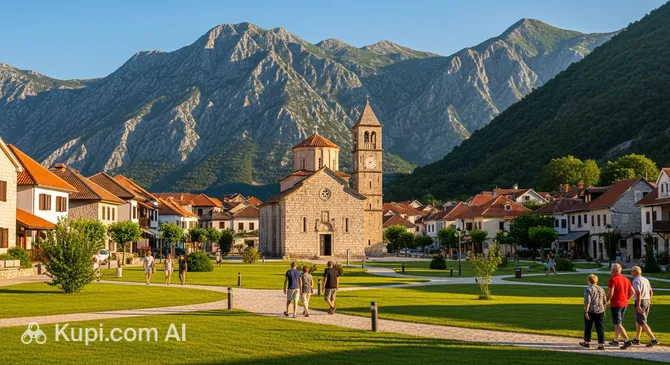
Despite its modest size, Andrijevica offers guests an amazing combination of natural luxury and historical memory. You won't find huge museum complexes here typical of metropolises, but the town itself and its surroundings can easily be called an open-air museum where every stone breathes the history of the Vasojevići clan, and green zones transition seamlessly into wild mountain landscapes.
Knjaževac Park. This is not just the town's "green lungs" but a real historical memorial and the main public space of Andrijevica. The park was laid out in the 19th century and features a unique layout, combining ancient trees with architectural monuments. For tourists, it is an ideal place to rest in the shade after a long journey and touch the past: busts of national heroes and memorials dedicated to those who fell in the Balkan and World Wars are set along the park's alleys. In autumn, the park is painted in golden tones, creating an incredibly photogenic atmosphere.
Komovi Regional Nature Park. Although technically a mountain massif, for Andrijevica, it serves the role of the main nature park, beginning practically at the town's doorstep. This is a zone of subalpine meadows and thick forests where many endemic plants grow. Tourists come here for walks along marked trails leading to the peaks and to see glacial traces on the rocks. In summer, rare mountain herbs bloom here, filling the air with healing scents.
The cultural life of the town is concentrated around several iconic sites that replace traditional museums and galleries, preserving the spiritual and material heritage of the region.
Church of St. Archangel Michael. This temple, located within Knjaževac Park, is the main architectural and cultural landmark. Built in 1887 on the initiative of Prince Nikola, the church is a beautiful example of religious architecture of that time. Inside, you can see an iconostasis and frescoes that, while modest, are deeply revered by locals. For a tourist, this is an opportunity to get acquainted with the Orthodox traditions of the northern part of the country, which includes Montenegro.
Center of Culture (Centar za kulturu). This is the main institution responsible for preserving the cultural code of Andrijevica. It regularly hosts temporary exhibitions of local artists, ethnographic displays showing the life of highlanders, and literary evenings. Although the permanent museum collection is small, the building often serves as a venue for festivals and folk performances, offering a great chance to see the region's living culture.
Among other significant sites are the old stone houses in the town center, which have preserved the features of traditional mountain architecture. They create a special flavor, recalling the times when Andrijevica was an important trade and administrative hub on the caravan route.
Insider Tip: If you want a truly authentic experience, go in search of "living museums" in the mountains—the katuns (summer pastures). In surrounding villages, such as Trešnjevik, traditional wooden shepherd huts have been preserved. There, far from civilization, locals still make cheese and kaymak using techniques that are centuries old. This gastronomic and ethnographic adventure will tell you more about the life of the region than any museum display.