Support

Kotor Fortress

About

Kotor Fortress, also known as the Fortifications of Kotor or St. John's Fortress, is an impressive historical fortification system. These ancient defenses protected the medieval town of Kotor, located in picturesque Montenegro, for centuries. Stretching across the slopes and summit of Mount Saint John (San Giovanni), the fortress towers over the town, offering spectacular views and a deep dive into history.
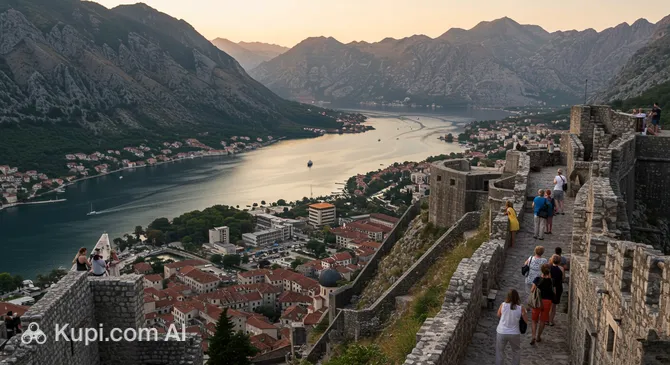
Kotor Fortress. Illustration.
Source: Kupi.com AI

Traveller photos:

This grand defensive structure includes not only powerful city walls but also towers, citadels, gates, bastions, forts, and even a castle. The fortress walls stretch for 4.5 kilometers, and their height reaches up to 20 meters in some places, with a thickness ranging from 2 to 16 meters. Climbing to the top of the fortress is a true adventure, rewarding travelers with panoramic views of the Bay of Kotor and the surrounding area.

Kotor Fortress is a prime example of medieval fortification architecture, harmoniously blending influences from various cultures: Illyrian, Byzantine, Venetian, and Austrian. Due to its uniqueness and historical value, the fortress, along with the old town of Kotor, is included in the UNESCO World Heritage list as part of the "Natural and Culturo-Historical Region of Kotor." Visiting this site is an opportunity to touch centuries of history and enjoy incredible beauty.

Contacts

Kotor Fortress is an open-air historical site, so it does not have a single office with direct contact details. To visit the fortress, you will need to reach the Old Town of Kotor, where the paths leading up the mountainside to the ancient walls and towers begin. For the most up-to-date information on access hours and potential entry fees, it is best to check on-site at the entrance or visit the tourist information centers in Kotor.

How to contactContact
AddressTvrđava Svetog Ivana, Put do Svetog Ivana, Špiljari, Montenegro

What to Do

Visiting Kotor Fortress is, first and foremost, an opportunity to touch history and enjoy truly breathtaking views. The main thing that awaits every tourist here is the climb up numerous steps, which itself becomes a small adventure for outdoor enthusiasts. Having overcome it, you will be rewarded with stunning panoramas of the Bay of Kotor—many of the famous photographs that grace Montenegro's tourist brochures are taken from here.

Once inside the fortress grounds, you can spend time exploring its various elements. Walk along the ancient fortress walls, feeling their centuries-old power, and inspect the old towers and bastions, each of which holds its own secrets. At the very top of the mountain, a fort awaits you, offering even more impressive views. This is a unique opportunity to see how a medieval defensive system was organized.

During your walk, pay attention to the architecture of the structures themselves—you can see traces of influence from different eras and cultures, from Illyrian and Byzantine to Venetian and Austrian. And, of course, don't forget to take your own photos! Views of the Bay of Kotor, which many consider one of the most beautiful in the world, and the old town of Kotor from a bird's-eye view will become the highlights of your travel collection and a vivid memory of your visit to this landmark.

Getting There

To reach Kotor Fortress, your first step is arriving in the town of Kotor itself. This charming town, nestled on the coast of the picturesque Bay of Kotor in Montenegro, has excellent transport links. You can reach it by bus from other Montenegrin towns like Budva or Podgorica, as well as from neighboring countries. The nearest international airports are in Tivat (just a few kilometers away), Podgorica, and Dubrovnik (Croatia), from which you can reach Kotor by taxi or bus.

Kotor Fortress rises directly above the Old Town of Kotor, and the journey to its peaks starts there. The entrance to the path leading to the fortifications is located in the northern part of the Old Town. There are usually several entry points, but the main and most well-known one starts near the North Gate (River Gate). The route is well-marked, and given the site's popularity with tourists, finding it won't be difficult. Just follow the signs or ask a local – they will be happy to point you in the right direction.

The ascent to the fortress is an exciting yet demanding climb up an ancient stone staircase with several hundred, and by some estimates, over a thousand steps. The path is quite steep and uneven in places, so it is highly recommended to wear comfortable athletic shoes with non-slip soles. Don't forget to bring a hat for sun protection and plenty of drinking water, especially if you plan to climb on a hot summer day. Your efforts will be rewarded not only by the chance to touch history but also by stunning panoramic views of the Bay of Kotor and the red-tiled roofs of the Old Town.

Nearest city: Kotor

History & Facts

The history of Kotor Fortress dates back to antiquity. The first defensive structures on the summit of Mount Saint John, where the fortress now stands, appeared in Illyrian times, long before the common era. Centuries later, in the 6th century, the Byzantine Emperor Justinian I made a significant contribution to strengthening this strategic point, ordering a large-scale reconstruction. Even as Byzantine influence waned and Kotor gained a degree of independence, the development of the fortifications never ceased, underscoring the enduring importance of this site throughout the ages.

A key stage in shaping the appearance of Kotor Fortress as we see it today began in 1420. This was when the independent Republic of Cattaro (one of Kotor's former names) came under the protection of the powerful Venetian Republic. The Venetians, fully aware of the strategic significance of Kotor—located deep within the Bay of Kotor and serving as a "key city" to the Adriatic—invested significant effort and resources into creating the formidable defensive system that survives to this day. It is no surprise that subsequent rulers of these lands—from Serbian lords to the French and Austrians—also paid close attention to the continuous reinforcement and improvement of the city's fortifications.

Modernization and rebuilding of the Kotor Fortress fortifications continued until the 19th century, adapting them to changing military technologies and the challenges of the time. An important and unfortunately tragic event in the fortress's modern history was the powerful 1979 earthquake, which caused significant damage to both the walls and the old town of Kotor. However, thanks to extensive and timely restoration work, this unique historical and architectural complex was restored. In that same year, 1979, Kotor Fortress, along with the entire old town, was rightfully included in the UNESCO World Heritage list, becoming the only site of such cultural importance in Montenegro, further highlighting its outstanding universal value to humanity.

Time Needed

To fully experience Kotor Fortress, it is recommended to set aside at least 2-3 hours. This is generally enough time to make the climb to the top of Mount Saint John, which itself can take between 30 and 45 minutes depending on your fitness level and pace. The remaining time will allow you to explore the main elements of the impressive fortification system and, of course, enjoy the breathtaking panoramic views of the Bay of Kotor and the ancient town of Kotor spread out at the base.

If you plan on a leisurely walk, want to explore every corner of the ancient walls and bastions, or are a passionate photographer aiming to capture all the beauty from different angles, it's better to allow a bit more time for your visit to Kotor Fortress—about 3-4 hours. This extra time will allow you to immerse yourself in the atmosphere of this historical site without rushing, take plenty of magnificent photos, and fully appreciate the grandeur of this unique structure.

Working Hours

Kotor Fortress, being essentially an open-air historical complex, does not have strict working hours in the traditional sense, like a museum. Access to the paths leading up is usually open during daylight hours. However, visiting conditions, including potential entry fees and the hours when fees are collected, may change depending on the season. Generally, during the tourist season (spring-autumn), entry may be paid during the day, while at other times or in the early morning/late evening, access may be free. The fortress is open for visits year-round, but the comfort of the climb depends heavily on weather conditions.

Since specific information regarding opening hours and ticket reservations is unavailable, it is highly recommended to check the latest details before your visit. You can check information on unofficial travel websites dedicated to Kotor or directly on-site at the city's tourist information centers or at the path's entrance. Advance booking is usually not required as it is a hiking route, but double-checking information will help you plan your visit in the best possible way.

7:00 – 20:00

Nearby

A visit to the majestic Kotor Fortress is certainly the highlight of a trip to Kotor, but you shouldn't stop at this iconic landmark. The surroundings of the fortress and the Old Town itself hide many other interesting corners that can significantly enrich your experience and offer new discoveries. Exploring nearby attractions will allow you to dive deeper into the atmosphere of this amazing Montenegrin town.

Walking through the neighboring streets, visiting other historical sites, or simply relaxing in a cozy nearby cafe will help form a more complete picture of Kotor and its rich heritage. Below is a list of some interesting places located in the immediate vicinity of Kotor Fortress that might interest you.

NameDistance
San Giovanni Fortress0 km
Ladder of Kotor0.2 km
Old Town Road0.2 km
Nitrox Pub & Eatery0.2 km
Patisserie by Wine House0.4 km
Jazz Club Evergreen0.4 km
Cathedral of Saint Tryphon0.4 km

Reached the bottom of the page?

Looks like you know this route inside out