Support

Church of Saint Sava

About

The Church of Saint Sava is not just one of the main attractions in Belgrade, but a true spiritual and cultural symbol of all Serbia. This majestic cathedral, located on the scenic Vračar hill, is one of the largest Orthodox churches in the world. Its monumental dimensions and white walls with a massive central dome are visible from almost any point in the city, making it a dominant feature of the urban landscape.

Built in the Neo-Byzantine style, the church serves as a reminder of the famous Hagia Sophia in Istanbul. Construction began on the site where, according to legend, Ottoman authorities burned the relics of Saint Sava—the founder of the Serbian Orthodox Church and the country's most revered saint—in 1594. This memorial temple has become the embodiment of the national identity and faith of the Serbian people.
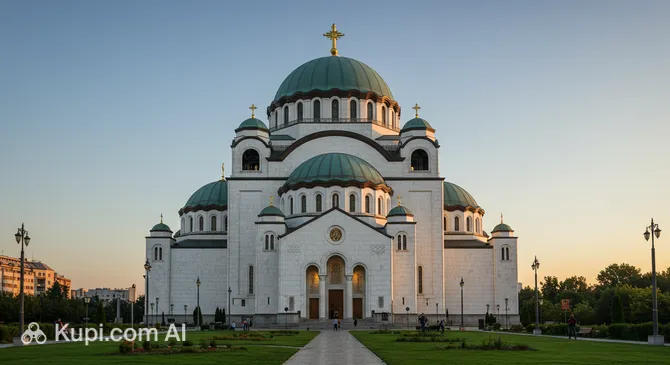
Church of Saint Sava. Illustration.
Source: Kupi.com AI

Traveler photos:

The interior decoration of the cathedral is stunning, especially the grand mosaics covering the walls and domes. The best Serbian and Russian masters worked on creating these works of art. Today, the Church of Saint Sava is not only an important pilgrimage center but also a must-visit destination for all tourists wishing to experience Serbia's history and spirituality.

Contacts

For the most accurate and up-to-date information regarding opening hours, service schedules, and cultural events, it is recommended to check on-site. Official contact details, such as phone numbers or email addresses, are not publicly provided.

How to contactContact
AddressKrušedolska 2a, Beograd 11000, Serbia
Phone number+381 11 2432585
Websitehramsvetogsave.rs

What to Do

A visit to the Church of Saint Sava offers many impressions both inside and out. First and foremost, guests can explore its majestic exterior, designed in the Serbo-Byzantine style, and its rich interior decoration. The unique mosaics covering the walls and vaults, as well as the grand central dome, attract particular attention. Four massive towers give the structure the characteristic features of medieval Serbian architecture. In the basement of the church, there is a crypt where you can also see lavish decorations and burials.

The temple is not only an architectural monument but also an active spiritual center. Services, religious ceremonies, and spiritual music concerts are regularly held here, allowing for a deeper immersion into the atmosphere of this holy place. After touring the cathedral, it is worth taking a walk through the large, well-maintained park that surrounds it—it is the perfect place for quiet relaxation. Additionally, the National Library of Serbia is located in the immediate vicinity, making it easy to combine a visit to the church with cultural enrichment.

Getting There

Reaching the Church of Saint Sava is quite easy from any part of Belgrade. Although the cathedral is not located in the historic center, it sits on Vračar hill, within walking distance of many popular tourist districts. For those who enjoy walking, the journey from the city center takes about 20–30 minutes. This walk is a great opportunity to get better acquainted with the city, especially if you start from Slavija Square, which offers a picturesque view of the church.

The most convenient way to reach the temple is by public transport. Near the cathedral, on Liberation Boulevard (Bulevar Oslobođenja), is the "Karađorđev park" stop, served by many routes. You can get here on trams No. 9, 10, or 14, or buses No. 31, 33, 39, 78, and others. This allows you to reach the attraction quickly from almost any district of the capital.

For those who prefer maximum comfort, taxis are always available; a trip from the center is fast and inexpensive. If you are traveling by car, there is parking directly at the temple, which is very convenient. Thus, regardless of your chosen mode of transport, the path to the main spiritual symbol of Serbia is straightforward.

Nearest city: Belgrade

History & Facts

The history of the Church of Saint Sava is inextricably linked to Serbia's quest for national and spiritual independence. The idea of its construction arose as early as the late 19th century, and the site was chosen for its deep symbolism: according to tradition, it was here on Vračar hill in Belgrade that Ottoman authorities burned the relics of Saint Sava in 1594. In 1895, on the 300th anniversary of this tragic event, a special construction committee was formed, though several decades passed before real work began.

Actual construction only started in 1935 and became a long-term project spanning nearly a century. Work was interrupted many times due to the turbulent historical events of the 20th century, including World War II and the subsequent period when the project was frozen. Construction resumed only in 1985, and by 1989, the giant dome was completed. Although the cathedral officially opened for services in 2004, the grand work on the interior decoration continued until recently, allowing visitors to witness living history.

The architectural design, developed by Aleksandar Deroko and Bogdan Nestorović, was largely inspired by the grandeur of the Hagia Sophia in Istanbul. However, the architects did not simply copy the Byzantine model but creatively reimagined it, adding elements of traditional Serbian style. A striking feature is the four graceful bell towers surrounding the massive central dome, giving the church's silhouette a unique and recognizable look.

Time Needed

When planning a visit to the Church of Saint Sava, it is recommended to set aside 1.5 to 2 hours. This time is generally sufficient to leisurely explore all the main parts of this magnificent structure and its surrounding territory. You will be able to examine the magnificent interior in detail, including the unique mosaics and the richly decorated crypt, as well as walk around the exterior to fully appreciate its monumental architecture.

The suggested time will also allow you to enjoy the peaceful atmosphere and stroll through the picturesque park surrounding the cathedral. Here, you can relax and take beautiful photographs. If you wish to combine your visit with other sights in Belgrade or simply spend more time in this spiritual place, you should plan for a bit longer.

Working Hours

The Church of Saint Sava is open to visitors daily, year-round. Generally, the cathedral doors are open from early morning until evening, typically from 07:00 to 20:00. However, keep in mind that this is an active church, so opening hours may change depending on the schedule of services, church holidays, and other special events. To avoid surprises, it is recommended to check the current schedule on the church's official website or by phone, if available, before your visit.

For a standard visit and tour of the church, no prior booking or ticket purchase is required—admission is free. Fees may only apply for organized tourist tours with a guide. If you are planning a self-guided visit, you can come at any convenient time during opening hours and enjoy the majesty and beauty of this iconic landmark at your own pace.

7:00 – 20:00

Nearby

Visiting the Church of Saint Sava is just the beginning of discovering the rich cultural and historical heritage of Belgrade. Located in the prestigious Vračar district, the cathedral is surrounded by many other interesting sites within walking distance. Strolling through the surrounding area will allow you to not only get to know the city better but also form a more complete picture of life and history in the capital of Serbia.

Combining a visit to the church with sightseeing at nearby attractions is an excellent way to make the most of your time. You can find quiet parks, significant museums, and other architectural monuments nearby. Below is a list of places near the cathedral that might interest you.

NameDistance
Academy 280.7 km
Nikola Tesla Museum0.8 km
St. Mark's Church1.4 km
Museum of Yugoslavia1.8 km
Jevremovac Botanical Garden1.8 km
House of Flowers1.9 km
Museum of Illusions1.9 km

Have you reached the end of the page?

So the route has been studied inside and out