Support

Kalemegdan Fortress

About

Kalemegdan Fortress (Serbian: Beogradska tvrđava), also known as Belgrade Fortress, is the heart and soul of Belgrade, the capital of Serbia. Located on a picturesque hill at the confluence of the Sava and Danube rivers, it is not just a historical monument but a true symbol of the city. This is the place where the fate of Belgrade was decided over centuries, and today it attracts thousands of tourists and locals with its unique atmosphere.
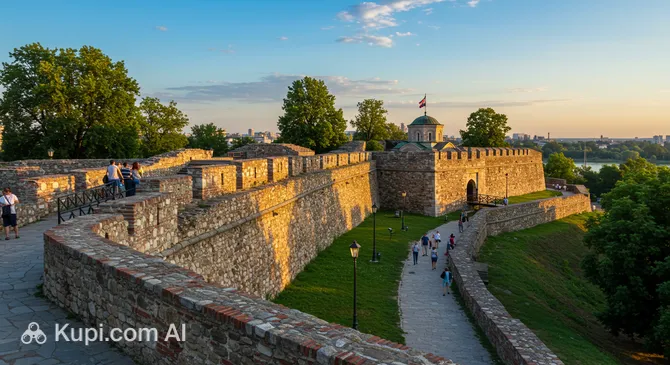
Kalemegdan Fortress. Illustration.
Source: Kupi.com AI

Traveler photos:

The history of the fortress dates back more than two millennia, and various eras and civilizations—from the Romans and Byzantines to the Ottomans and Austrians—have left their mark on its walls. Today, the complex is a grand structure that includes the Upper and Lower Towns. Its territory preserves ancient gates and towers, and it also houses the Military Museum, the Victor monument, and ancient churches such as Ružica and Sveta Petka.

However, Kalemegdan is not just about austere walls and towers. The vast and beautiful Kalemegdan Park surrounds the fortress and is divided into Great and Little Kalemegdan. It is a favorite place for walks, relaxation, and cultural events. Here, you can stroll leisurely along shaded paths, enjoy panoramic views of the rivers and New Belgrade, or simply sit on a bench and reflect on the history of this amazing place, which the Turks once called the "hill for contemplation."

Contacts

Kalemegdan Fortress is a vast open-air historical and cultural complex, so it does not have a single contact center. Entry to the main grounds of the park and the fortress is free and open 24/7. It is very easy to reach: it is located in the heart of the city, at the end of the main pedestrian street, Knez Mihailova. You can also reach the "Kalemegdan" stops by tram lines 2, 5, 10, 11 or bus EKO2.

How to contactContact
AddressKalemegdan bb 11000, Beograd, Serbia
Phone number+381 11 2620685
Websitewww.beogradskatvrdjava.co.rs

What to Do

A visit to Kalemegdan Fortress is more than just looking at ancient walls; it's an entire adventure with many activities. History enthusiasts can spend hours exploring its numerous corners: from ancient gates and powerful bastions to mysterious underground galleries. The complex houses interesting museums, most notably the Military Museum with its extensive collection of weapons and artifacts, as well as the Natural History Museum. Be sure to climb to the famous viewpoint, which offers a breathtaking panoramic view of the confluence of the Sava and Danube rivers—Belgrade's signature landmark.

Beyond the historical section, Kalemegdan is a vast and picturesque park, an ideal place for relaxation and leisurely strolls. Here, you can have a picnic on the grass, relax on a bench in the shade of trees, or simply enjoy the peaceful atmosphere. The park is full of life: cultural events, open-air concerts, art exhibitions, and festivals are frequently held here. As a result, every visit to the fortress can offer new impressions and emotions.

Getting There

Getting to Kalemegdan Fortress is very easy, as it is located in the heart of Belgrade, in the historic Stari Grad district. The most pleasant way is on foot. If you are in the city center, simply walk along the main pedestrian street, Knez Mihailova, until its end. After crossing the road with tram tracks, you will find yourself right at the entrance to Kalemegdan Park, which surrounds the fortress. A walk from any part of the old town will be short and allow you to enjoy the atmosphere of the Serbian capital.

For those who prefer public transport, there are several convenient routes. The closest stops to the fortress are called "Kalemegdan" and "Trg Republike" (Republic Square). They can be reached by numerous buses and trams running through the city. For example, trams No. 2, 5, and 10, as well as bus EKO2, go to the "Kalemegdan" stop. This is a great option if you are staying in more remote areas of Belgrade.

Additionally, you can always reach the fortress comfortably by taxi—any driver in the city knows this iconic landmark perfectly well. Another interesting and active way is to use the city's bike rental service. This will allow you not only to reach your destination quickly but also to take an exciting bike ride through the picturesque surroundings. For car owners, there are paid parking lots near the fortress, although they can be crowded on weekends and holidays. It is important to note that entry to the park and the fortress itself is free, making it accessible for a visit at any time.

Nearest city: Belgrade

History & Facts

The history of Kalemegdan Fortress is a true chronicle of Belgrade, spanning more than two millennia. Its origins go back to the time of the Celts, who founded a settlement here called Singidunum. However, the Romans were the first to truly appreciate the strategic importance of this location. In the 2nd century AD, they built a powerful military camp here—a castrum—which became the permanent base for the Legio IV Flavia Felix. It was from this Roman fortification that the long military history of the fortress began, which for centuries served as the core of the city.

After the fall of the Roman Empire, the fortress survived many turbulent eras. It was repeatedly destroyed during the invasions of the Huns, Goths, and Avars, but each time it rose from the ruins. The Byzantine Emperor Justinian I played an important role in its fate, ordering its walls to be restored and strengthened in the 6th century. In the following centuries, the fortress changed hands, belonging at times to Byzantium and at others to Hungary, until it finally became part of the Serbian state. For many centuries, the entire life of medieval Belgrade was concentrated within these powerful walls.

A new stage in the history of Kalemegdan began in 1521 when the fortress was conquered by the Ottoman Empire. The Turks not only reinforced it but also gave it its modern name: "Kale" means "fortress" and "megdan" means "field." During nearly 350 years of Ottoman rule, the fortress remained a vital military facility in the region. It wasn't until 1867 that the Turkish garrison finally left it, which became a symbolic act of the city's return to the Serbs. Today, Kalemegdan Fortress is not just a monument, but a living witness to a turbulent history, preserving the memory of dozens of nations and civilizations.

Time Needed

When planning a visit to Kalemegdan Fortress, you should consider how much time you are willing to dedicate to this amazing place. For a general overview of the complex, including a walk through the park and seeing the main attractions from the outside, it is recommended to allocate at least 2–3 hours. This time is enough to leisurely walk along the picturesque alleys, enjoy panoramic views of the confluence of the Sava and Danube rivers, see the Victor monument, and sense the scale of the historical fortifications.

If you are a history buff or plan a deeper immersion, the duration of the visit can easily increase to half a day. There are several museums within the fortress, such as the Military Museum and the Natural History Museum, where exploring the exhibits can take several hours. Additional time will also be needed to visit ancient churches like Ružica and Sveta Petka, or to descend to the Lower Town to the Nebojša Tower. Ultimately, Kalemegdan is a place where you can spend anywhere from an hour to a whole day, depending on your interest and pace.

Working Hours

One of the main advantages of Kalemegdan Fortress is its exceptional accessibility. The grounds of the fortress and the adjacent park are open to visitors 24/7 year-round, making it an ideal place for walks at any time of day or night. Entry to the main area is free, and no tickets need to be booked for a regular stroll along the historical walls or park paths.

At the same time, it is important to remember that there are many individual cultural sites within Kalemegdan, including the Military Museum, the Natural History Museum Gallery, ancient churches, and the Nebojša Tower. These institutions have their own schedules, which may change depending on the season. Before your visit, it is highly recommended to check the current opening hours and visiting conditions on their official websites or at the tourist information centers in Belgrade. This will help you plan your route through this iconic Serbia landmark and ensure you get into the museums you are interested in.

Open 24 hours

Nearby

A visit to Kalemegdan Fortress is a fascinating journey into history in itself, but exploring its surroundings will make your experience even richer. The fortress is the heart of old Belgrade, and many other iconic sites are within walking distance, helping you gain a deeper understanding of the culture and spirit of the Serbian capital.

Walking through the streets branching out from the walls of Kalemegdan is an opportunity to discover cozy corners of the city, from ancient churches to modern museums. Thanks to its compact layout, you can easily plan a full itinerary for the day without even using transport. Below is a list of interesting places located very close by.

NameDistance
Belgrade Fortress0.2 km
Belgrade Zoo0.4 km
Yugoslav Film Archive0.5 km
Museum of Contemporary Art0.7 km
National Museum of Serbia0.9 km
Branko's Bridge0.9 km
Prince Mihailo Monument1 km

Have you reached the end of the page?

So the route has been studied inside and out