Support

Branko's Bridge

About

Branko's Bridge is one of the key transport arteries and recognizable landmarks of Belgrade, the capital of Serbia. This impressive road and pedestrian bridge spans the Sava River, elegantly connecting the city's historic center with the modern Novi Beograd district. For many residents and guests of the city, it is an integral part of daily routes and a symbol of the capital's dynamic development.
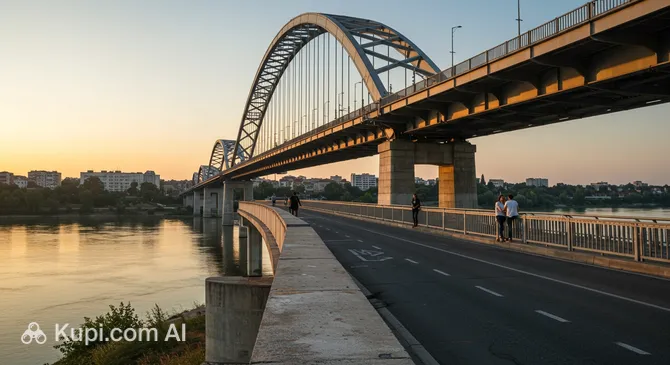
Branko's Bridge. Illustration.
Source: Kupi.com AI

Traveler photos:

Built as a steel girder structure, Branko's Bridge is impressive in its size. Its total length is 450 meters, and the central span reaches 261 meters—at the time of its construction, this was a world record for bridges of this type. Although it is secondary to the Gazela Bridge in terms of overall significance and size, Branko's Bridge plays a vital role in Belgrade's transport system, providing a fast connection between two major districts.

A walk along the pedestrian part of Branko's Bridge offers picturesque views of the Sava River, the old city, and the modern blocks of New Belgrade. It is not just an engineering structure but also a place from which to get a fresh look at the Serbian capital. The bridge is especially beautiful in the evening when the lights come on, creating a romantic atmosphere and attracting both locals and tourists alike.

Contacts

Since Branko's Bridge is an essential transport structure and a public facility, there is generally no dedicated contact information for tourists. You can easily reach the bridge on foot or by public transport from the center of Belgrade or the Novi Beograd district to enjoy the views or cross the Sava River. For general tourist information about Belgrade, it is recommended to contact local tourist information centers or the city's official tourism portals.

How to contactContact
AddressSava City, Beograd, Serbia

What to Do

The main reason to visit Branko's Bridge is, without a doubt, the breathtaking panoramic views. From its height, a magnificent picture of the deep Sava River, the lush green historic quarters of Belgrade, and the contrasting modern buildings of New Belgrade unfolds. The bridge looks especially impressive at sunset when the rays of the setting sun paint the sky and city in warm tones, creating ideal conditions for photoshoots and romantic moments.

Branko's Bridge is not just a transport artery but also a great place for leisurely walks or bike rides. Thanks to the convenient sidewalks, you can move comfortably while enjoying the fresh river air. Special observation platforms are equipped along the bridge, from which you can watch the life of the river: the movement of ships, the play of waves, and views of the embankments. This is a great opportunity to take a break and look at the city bustle from above.

Additionally, Branko's Bridge often serves as a convenient starting point for further exploration of Belgrade. After crossing it, you can easily reach the picturesque Sava embankments, which host numerous cafes and relaxation areas, or head off to explore the sights of both the old and new parts of the city. In this way, the bridge becomes a kind of gateway to new experiences in the Serbian capital.

Getting There

Branko's Bridge is very conveniently located in the heart of Belgrade, serving as a vital link between the historic Stari Grad district and modern Novi Beograd. Due to its central position, reaching it on foot from many key points in the city is easy. For example, a pleasant stroll from the famous Republic Square to the bridge takes very little time, allowing you to soak up the atmosphere of the Serbian capital along the way.

If you prefer using public transport, reaching Branko's Bridge is also very simple. Numerous bus and tram routes pass in the immediate vicinity, connecting it with the main districts of Belgrade. This is a convenient and economical way to reach one of the city's main transport arteries and a starting point for exploring both the old and new parts of the capital.

For travelers arriving in Belgrade by train or intercity bus, the walk to Branko's Bridge from the main railway or bus station takes approximately 10–15 minutes. It is also convenient for drivers: well-equipped access roads lead to the bridge from both sides, and parking spaces can be found nearby along the scenic embankments, allowing you to leave your car and continue your walk on foot.

Nearest city: Belgrade

History & Facts

The history of Branko's Bridge dates back to the early 20th century when another bridge was erected on its current site. Between 1930 and 1934, King Alexander's Bridge was built here, which at the time was considered one of the most significant engineering feats of its era. Unfortunately, this predecessor of the modern bridge was destroyed during World War II, leaving only the foundations for future structures.

After the war, the modern Branko's Bridge was built on the remaining foundations of the destroyed King Alexander's Bridge between 1953 and 1956. It was originally officially named the "Bridge of Brotherhood and Unity," reflecting the spirit of that era in Yugoslavia. However, locals more commonly referred to it as the Sava Bridge (after the Sava River it crosses) or by Branko's Street, which leads to it from the old town of Belgrade.

The final and widely known name today—Branko's Bridge—did not stick immediately and is associated with several figures. One version says the bridge was named after the famous Serbian romantic poet Branko Radičević, whose street (Brankova Street) adjoins the bridge. Another, more somber story links the name to a tragic event in 1984 when the famous Yugoslav writer Branko Ćopić died after jumping from the bridge. These associations have become firmly rooted in Belgrade's urban memory, making "Branko's Bridge" the generally accepted name.

Time Needed

To cross Branko's Bridge and enjoy the views it offers, a typical visitor won't need much time. If your goal is simply to walk across the bridge, take a few photos, and admire the panorama of Belgrade and the Sava River, 30-40 minutes will be quite enough. This is enough time to leisurely walk along the pedestrian section, stop at several points for photos, and simply soak in the atmosphere of this iconic spot.

However, if you plan a more thoughtful visit—for example, if you want to wait for the sunset for particularly beautiful shots or use the bridge as a starting point for a longer walk along the embankments or surrounding districts—your stay may be longer. Some tourists prefer to combine a visit to the bridge with exploring the sights of the Old Town or New Belgrade, in which case Branko's Bridge becomes part of a longer itinerary.

Overall, exploring the bridge itself doesn't take much time, but it can be a pleasant and memorable part of your walk through Belgrade. It is more of a short but bright stop that allows you to see the capital of Serbia from an interesting perspective.

Working Hours

Branko's Bridge in Belgrade is a vital transport artery and a public pedestrian site, so it is open for visiting 24/7, year-round. You can stroll across it at any time of day or night that suits you, without any time restrictions or holidays. This allows you to enjoy the views of the Sava River and the city in both daylight and evening lighting.

As it is a public bridge, no advance ticket booking or registration is required. Access to the pedestrian part of the bridge is free. Simply come and enjoy the walk and the opening panoramas of the Serbian capital.

Open 24 hours

Nearby

Visiting Branko's Bridge provides vivid impressions on its own, but exploring its surroundings can significantly enrich your trip to Belgrade. Many interesting places are located in the immediate vicinity of this iconic structure, each revealing the history and culture of the Serbian capital in its own way.

Exploring the attractions near Branko's Bridge will allow you to get a more complete picture of Belgrade, seeing its different facets—from historical shrines to modern art spaces. Short walks from the bridge will lead you to landmark sites worthy of every tourist's attention. Below is a list of some of them, including their distance from the bridge.

NameDistance
Museum of Contemporary Art0.7 km
Yugoslav Film Archive0.8 km
Kalemegdan Fortress0.9 km
Belgrade Fortress1 km
Prince Mihailo Monument1 km
National Museum of Serbia1 km
Museum of Illusions1.1 km

Have you reached the end of the page?

So the route has been studied inside and out