Support

Diocletian's Palace

About

Diocletian's Palace is not just a landmark but the living heart of Split, located in Croatia. This outstanding architectural monument from the ancient Roman era is considered the best-preserved palace from the Roman Empire period. Together with the city's historical center, it is rightfully included in the UNESCO World Heritage list, attracting travelers from all over the world.
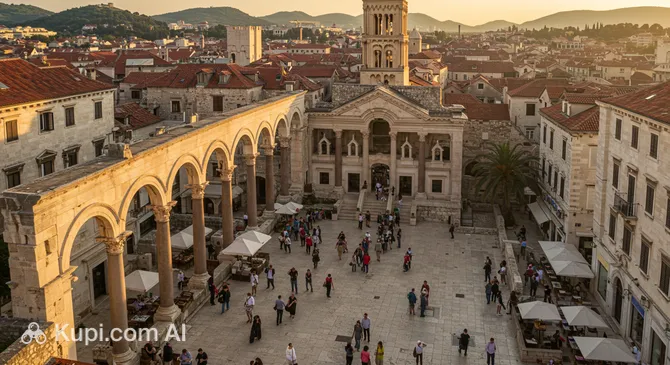
Diocletian's Palace. Illustration.
Source: Kupi.com AI

Traveller photos:

Built at the turn of the 4th century for Emperor Diocletian, the palace originally served as both a luxurious residence for relaxation and a powerful military fortress. The complex is a grand structure covering an area of over 30,000 square meters. It is surrounded by imposing walls that reach a thickness of six meters in some places, making it a true marvel of ancient engineering.

Strolling through the palace grounds, you immerse yourself in history. Here, you can see majestic columns, elegant arches, and intricate stone carvings that adorn the ancient walls. Today, life thrives within the palace walls: it houses numerous cafes, shops, and even residential homes, making it a unique "living monument" to history. Visitors can explore the mysterious cellars, climb the bell tower for a panoramic view of the city, or simply enjoy the atmosphere in the central square—the Peristyle.

Contacts

Since Diocletian's Palace is a vast historical complex integrated into the urban life of Split, the best way to get the most accurate information about visiting individual sites within its grounds—such as the substructures or the cathedral—is to visit the official tourism portal or local information centers. You can find the main contact details for planning your visit below.

How to contactContact
Address21000, Grad, Split, Croatia

What to Do

Immersing yourself in the atmosphere of Diocletian's Palace is a true journey back in time. The primary activity for visitors is exploring the unique architectural ensemble, where every stone tells a story. The heart of the complex is the Peristyle—a majestic central square surrounded by a colonnade. This is where the emperor once addressed his subjects; today, it is filled with a special atmosphere where you can take stunning photos and enjoy live music in the evenings. A walk through the palace allows you to fully appreciate the craftsmanship of ancient builders by examining the numerous arches, stone carvings, and columns.

The well-preserved palace substructures (cellars) deserve special attention. Once used as storage spaces, today their mysterious halls and passages are open to tourists. Descending into the cellars, you can better imagine the scale of the entire structure and its original layout. Additionally, the palace showcases a unique blend of secular and sacred elements from the Roman era, including the remains of ancient temples. The complex's architecture bears features of both classical Roman urban planning and Syrian influence, making it a fascinating site for history and culture enthusiasts.

Beyond exploring ancient ruins, modern life buzzes within the palace grounds. Its walls house numerous cafes, restaurants, and souvenir shops. You can climb the bell tower of the Cathedral of Saint Domnius, which was originally Diocletian's mausoleum, to enjoy a panoramic view of Split and the Adriatic Sea. At the entrance to the former mausoleum, you will be greeted by an authentic Egyptian sphinx over 3,500 years old—one of several brought by the emperor to decorate his residence.

Getting There

Reaching Diocletian's Palace is very easy, as it serves as the historical core and the main landmark of Split. In fact, the entire old town is located within and around the palace walls. This area is primarily a pedestrian zone, so the best way to explore it is on foot. No matter where you are heading in central Split, you will eventually find yourself at one of the walls or gates of this majestic structure.

If you are arriving in Split by intercity bus or ferry, you will be practically at the palace's doorstep. The main bus station and ferry terminal are just a few minutes' walk from the southern entrance to the palace—the Bronze Gate, which opens onto the Riva promenade. For travelers flying into Split Airport, the most convenient way to reach the center is to use the shuttle bus that takes you directly to the main bus station, or to take a taxi.

Driving in the immediate vicinity of the palace is restricted. While there are paid parking lots around the old town, finding a free space can be challenging, especially during the peak tourist season. A convenient alternative is to use taxis or ridesharing services, which can drop you off as close to the pedestrian zone as possible. City buses also run throughout the city, and many routes stop near the center, from where the palace is an easy 5–10 minute walk away.

Nearest city: Split

History & Facts

The history of Diocletian's Palace began at the turn of the 4th century when the powerful Roman Emperor Diocletian, preparing for his retirement from power, decided to build a luxurious residence on the Adriatic coast. Construction of this grand complex in his native Dalmatia took place approximately between 295 and 305 AD. Thus, the palace was not intended as another imperial capital, but as a secluded fortress-villa for the ruler's private life after his voluntary abdication.

The architectural design of the palace was a true innovation for its time, differing significantly from the residences of Roman emperors of previous centuries. The complex combined the features of a luxury palace and a fortified military camp, reflecting the restless spirit of the era. This concept was not unique and fit into the general typology of imperial residences of that period built throughout the empire. The choice of location was deliberate: besides being close to the emperor's birthplace, an important factor was the presence of an aqueduct that ensured a steady water supply for this massive structure.

After the fall of the Roman Empire, the palace gradually fell into disrepair, and its grandeur was forgotten for a long time. Interest in it was revived only in the 18th century thanks to the Scottish architect Robert Adam. In 1757, he spent several weeks sketching and measuring the ruins, and in 1764, he published a book with detailed engravings and descriptions of the palace, effectively rediscovering it for European culture. This work not only brought fame to the palace itself but also significantly influenced the development of the Neoclassical architectural style, and the concept of the imperial residence established in Split inspired architects of subsequent eras.

Time Needed

Determining the exact time needed to explore Diocletian's Palace in Split can be tricky, as it is not just a museum but a living part of the city. For a quick overview and a walk through the main streets, such as Cardo and Decumanus, as well as a visit to the central Peristyle square, 1-2 hours might be enough. This is sufficient to soak in the atmosphere of the ancient complex, take photos, and get a general idea of its scale.

If you are planning a deeper dive into history, it is worth setting aside from three hours to half a day. A significant portion of this time will be spent visiting the paid sites within the palace grounds. For example, exploring the mysterious substructures (cellars), where scenes from "Game of Thrones" were filmed, can take about an hour. It is also worth visiting the Cathedral of Saint Domnius (formerly Diocletian's Mausoleum) and the Temple of Jupiter. If you decide to climb the cathedral's bell tower to enjoy panoramic views of Croatia and the Adriatic Sea, safely add another 30–40 minutes.

Ultimately, the length of your visit depends on your personal interests. Since there are numerous cafes, restaurants, and souvenir shops within the palace, you could easily spend an entire day here. You can leisurely stroll through the ancient streets, relax in the shade of old walls with a cup of coffee, and then continue exploring this unique "living monument" that harmoniously combines the heritage of the Roman Empire with modern urban life.

Working Hours

It is important to understand that Diocletian's Palace is not a separate museum with a single entrance, but the historical center of Split, so access to its streets and squares is open 24/7 and free of charge. You can freely walk through the ancient alleys at any time of year. However, individual attractions within the palace, such as the substructures, the Cathedral of Saint Domnius, the Temple of Jupiter, and the bell tower, operate on their own schedules and require a ticket.

The operating hours for these sites depend on the season. During the tourist season (roughly from April to October), they are usually open longer, often from morning until late evening. In the winter months, hours are reduced. Since exact times can change, it is highly recommended to check current information on the official Split tourism portal or at information centers immediately before your visit. Advance ticket booking is generally not required, but during the peak season (July–August), purchasing tickets online or getting a combined ticket for multiple sites can help save time and avoid queues.

Open 24/7

Nearby

A visit to Diocletian's Palace is just the beginning of your journey through Split. Since the palace is the city's historical heart, many other iconic sites are just a few steps away. Exploring the surroundings allows you not only to see individual monuments but also to feel the vibrant pulse of the city, where ancient Roman architecture harmoniously coexists with cozy cafes, artisan shops, and lively squares.

Walking through the adjacent streets will enrich your experience, as many of Split's most interesting sites are located directly within the palace walls or within a short walking distance. From ancient temples and gates to modern bars—every location adds a new touch to the portrait of this amazing city.

NameDistance
Temple of Jupiter0 km
Diocletian's Palace0 km
Vestibule of Diocletian's Palace0 km
Cathedral of Saint Domnius0 km
Old Town Hall0.1 km
Golden Gate0.1 km
Diocletian's Cellars0.1 km

Reached the bottom of the page?

Looks like you know this route inside out