Support

Archaeological Museum in Split

About

A journey back through the centuries should begin with a visit to the oldest cultural institution that Croatia is rightfully proud of. The Split Archaeological Museum, founded back in **1820**, is the keeper of the region's richest heritage, offering guests a unique opportunity to see artifacts that are thousands of years old.
\n
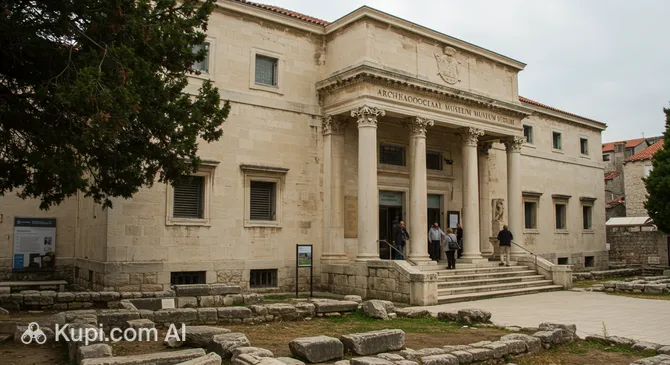
Archaeological Museum Split
Archaeological Museum Split. Иллюстрация. Источник: Kupi.com AI
\n

Located in the city of Split, this museum occupies a building constructed specifically for its needs in 1922. Its halls house treasures spanning a vast period of time—from prehistoric eras to the early Christian period. A special place in the exhibition is held by finds from ancient Salona and objects illustrating the life of the Roman community.

\n

This is not just a collection of antiquities, but a true scientific and cultural center where history comes alive through stone monuments, mosaics, and everyday objects. Visiting the museum allows for a better understanding of the Mediterranean's development context and shows how the foundations of the modern city were laid two millennia ago.

Contacts

For more information regarding special exhibitions or visiting rules, you can use the official communication channels. The museum is open to tourists and researchers, providing up-to-date information on its collections via the website and by telephone.

How to contactContact
AddressUl. Zrinsko Frankopanska 25, 21000, Split, Croatia
Phone+385 21 329 340
Websitearmus.hr

What to Do

The primary reason history enthusiasts visit this place is the chance to literally touch antiquity. In the museum halls, you can study a brilliant collection of artifacts that reveals the material culture of past eras in great detail. Of particular interest are the exhibitions dedicated to the daily life and art of the Romans, allowing visitors to reconstruct scenes from the lives of ancient settlers.

In addition to viewing the main displays, visitors are encouraged to pay attention to the contextual link between the exhibits and Diocletian's Palace. This helps build a cohesive perception of the city not just as a modern resort, but as a great historical monument. The museum provides a rare chance to see what is hidden from view during a typical stroll along the promenade, revealing the deeper meanings of the Adriatic's archaeological heritage.

Getting There

Finding this attraction is quite straightforward: the museum is located in the central part of the city at 25 Zrinsko-Frankopanska St. Thanks to its convenient location, it is within walking distance of the main tourist arteries, including the historical center and the waterfront.

If you are staying in the old town, the walk to the museum entrance will take no more than 10–15 minutes. For those who prefer comfort or are traveling from more distant areas, taxi services are always available to quickly drop you off right at the doors of this historic building. Public transport routes also pass nearby, making the site highly accessible for independent travelers.

Ближайший город: Split

History & Facts

The history of this place is closely intertwined with the fate of the Roman Emperor Diocletian. It was he who, at the end of the 3rd century, chose this picturesque bay to build his residence, which later became the heart of the modern city. Interestingly, Split literally "grew" out of a single building—the massive imperial palace, whose walls eventually transformed into city fortifications.

In the 7th century, following the fall of the nearby city of Salona, surviving residents sought refuge behind the palace's powerful walls. This event was a turning point: the former imperial quarters began to transform into residential homes, and the wide galleries into narrow, winding streets. The museum carefully preserves evidence of this unique transformation, allowing visitors to see how ancient architecture was adapted for the needs of the medieval population.

The museum itself, founded in 1820, is the oldest institution of its kind in the country. Its collection began to take shape back when archaeology was just emerging as a science, making its holdings among the most valuable in the Adriatic. Since 1922, the exhibition has been housed in its current building, which has itself become an important element of the cultural landscape.

Time Needed

To thoughtfully explore the rich collection and enjoy the tranquility of the museum halls, most visitors require between 1.5 to 2 hours. This is ample time to view the key exhibits representing the Greek and Roman periods, as well as to get acquainted with early Christian finds.

If you are a passionate archaeology enthusiast, it is worth setting aside a little more time to examine the smaller artifacts in detail and read through the informational materials. In any case, a visit to the museum does not take much time and easily fits into a busy day of exploring the city.

Working Hours

When planning your visit, it is important to note that the museum follows a traditional schedule with a midday break. On weekdays, from Monday to Friday, the doors are open to visitors from 9:00 to 14:00 and, after a break, from 15:00 to 20:00.

If you decide to stop by on the weekend, remember that on Saturday the museum operates on a reduced schedule—only in the morning, from 9:00 to 14:00. The institution is closed on Sundays, so it is worth adjusting your travel plans in advance.

DayWorking hours
Понедельник9:00 – 14:00, 3:00 – 20:00
Вторник9:00 – 14:00, 3:00 – 20:00
Среда9:00 – 14:00, 3:00 – 20:00
Четверг9:00 – 14:00, 3:00 – 20:00
Пятница9:00 – 14:00, 3:00 – 20:00
Суббота9:00 – 14:00
ВоскресеньеЗакрыто

Nearby

A visit to the museum is just one part of a larger journey through the region's history. Surrounding it are many iconic sites that will help complete the overall picture of the Adriatic coast's development and allow you to soak in the atmosphere of the old city.

Below are the sites located in the immediate vicinity that are worth including in your walking route:

NameDistance
Stari Plac Stadium0.4 km
Ćiri Biri Bela0.5 km
Old Town Hall0.8 km
Diocletian's Dream0.8 km
Pizzeria Sette Sorelle0.8 km
Diocletian's Palace0.9 km
Golden Gate0.9 km

Reached the end of the page?

That means the route is fully explored