Support

Walls of Dubrovnik

About

The Walls of Dubrovnik are a grand complex of defensive structures, rightfully considered one of the greatest monuments of fortification architecture in the world. Located in the city of Dubrovnik, this stone crown encircles the historical center, creating the unique appearance of the "Pearl of the Adriatic."
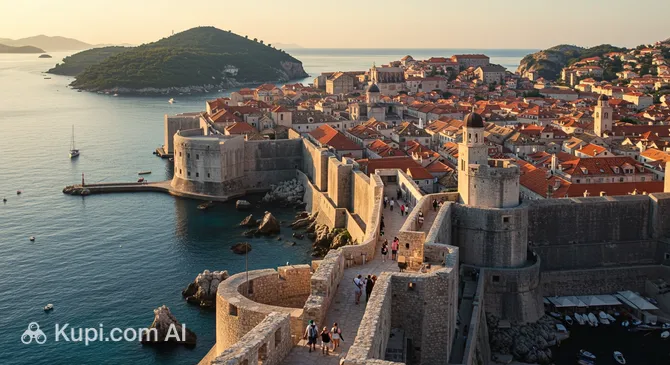
Walls of Dubrovnik
Walls of Dubrovnik. Иллюстрация. Источник: Kupi.com AI

This impregnable fortress, built in the country of Croatia, includes an entire system of bastions, towers, and citadels. The total length of the walls is an impressive 1,940 meters, and their height in some places reaches 25 meters. Remarkably, their thickness varies: while on the sea side it ranges from 1.5 to 3 meters, on the land side, the protective layer of stone reaches 6 meters, providing reliable protection throughout the centuries.

Today, the walls are not just a military site of the past, but a UNESCO World Heritage site. Travelers from all over the world come here to touch the ancient stones of the five fortresses and sixteen towers that once made this city-state one of the most protected in the Balkans.

Contacts

To check the latest information before your visit, you can use the official contact details of the service managing the site.

How to contactContact
AddressPoljana Paska Miličevića bb, 20000, Dubrovnik, Croatia
Websitecitywallsdubrovnik.hr

What to Do

The main highlight worth climbing up for is a walk along the crest of the walls. From a bird's-eye view, breathtaking vistas open up over the terracotta roofs of the Old Town and the endless blue of the Adriatic Sea. Be sure to visit Minčeta Tower—the highest point of the fortifications and a true symbol of the city, where the panorama seems truly infinite.

History and nature lovers will find it interesting to visit the Fort of St. John. Within its powerful walls, two fascinating attractions are located today: the Aquarium, where you can meet inhabitants of the deep sea, and the Maritime Museum, which tells the story of the region's glorious seafaring past. Each of the five fortresses in the complex has its own character: for example, Revelin reliably guards the city from the east, while Lovrijenac majestically rises on a separate cliff, protecting the port.

Beyond exploring the forts, you can simply enjoy the atmosphere on the walls. Passing by towers and bastions, you will see how architectural styles from different eras blend into a single ensemble. Don't forget to notice the old cannons and embrasures—silent witnesses to the centuries-long defense of free Dubrovnik.

Getting There

The legendary fortifications are located in the heart of the city at Poljana Paska Miličevića bb. Since the walls encircle the entire Old Town, they can be accessed through several entrances. The Pile Gate is considered the most popular and convenient for tourists, serving as the main entry point for most guided tours.

The historical center is easily reachable by public transport—most city buses stop directly at the entrance to the old part of the city. If you prefer comfort, you can use taxi or transfer services from any part of the city to the square in front of the Pile Gate.

There are also additional entrances: Ploče Gate, Peskarija Gate, and the Buža Gate in the northern part, which was opened in the early 20th century. The choice of entrance depends on which part of the city you are in, but a walk through the ancient streets to any of these points will be a pleasant part of the journey in itself.

Ближайший город: Dubrovnik

History & Facts

The history of these monumental fortifications began back in the early Middle Ages, in the 8th century. Initially, these were modest limestone structures that eventually evolved into one of the most sophisticated defensive systems in Europe. As early as the 9th century, the walls underwent a severe test of strength, withstanding a fifteen-month siege by the Saracens.

The walls began to acquire their modern, imposing appearance in the 13th century, when the entire city was finally enclosed in a stone ring. In the 14th century, the Dominican monastery was included in the defense system, and architects built 15 square forts to strengthen the protection. The "Golden Age" of construction occurred between the 15th and 16th centuries, when famous Italian masters Michelozzo di Bartolomeo and Antonio Ferramolino worked on the fortifications.

Remarkably, during the catastrophic earthquake of 1667, which practically leveled the rest of the city, the walls remained almost unscathed. This proved the exceptional skill of the medieval builders. Dubrovnik, being a wealthy port, was forced to defend itself not only from land but also from the sea; therefore, the seaside of the walls is reinforced with additional bastions and citadels, making the city virtually impregnable for centuries.

Time Needed

To walk the entire ring of fortifications at a leisurely pace and enjoy the panoramic views, we recommend setting aside 2 to 3 hours. The route is nearly two kilometers long, and you will likely want to make dozens of stops for photos along the way.

Keep in mind that climbing the walls involves physical activity, and on sunny days, it can be quite hot in open sections. If you plan to visit the museums located in the towers or decide to relax in the small cafes overlooking the sea, your visit could extend to half a day.

Working Hours

When planning your visit, please take note of the complex's opening hours. On Mondays, the walls are open to visitors from 8:30 AM to 6:30 PM. On other days of the week, from Tuesday to Sunday, the site operates on a slightly extended schedule—from 8:00 AM to 6:30 PM.

It is recommended to arrive at opening or closer to evening to avoid the midday heat and large tourist groups, as well as to catch the softest light for beautiful photos.

DayWorking hours
Понедельник8:30 – 18:30
Вторник8:00 – 18:30
Среда8:00 – 18:30
Четверг8:00 – 18:30
Пятница8:00 – 18:30
Суббота8:00 – 18:30
Воскресенье8:00 – 18:30

Nearby

A walk along the walls is just the beginning of discovering the rich heritage of this region. Many iconic sites are concentrated around the fortifications, allowing you to dive deeper into the atmosphere of the medieval city and enjoy its architectural elegance.

NameDistance
Pile Gate0 km
Franciscan Monastery0 km
Onofrio's Large Fountain0 km
War Photo Limited0.1 km
Buza Gate0.2 km
Minčeta Fortress0.2 km
MILK0.2 km

Reached the end of the page?

That means the route is fully explored