Support

Diocletian's Cellars

About

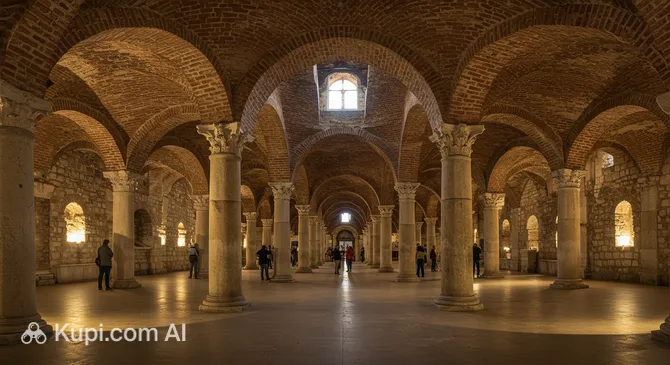
Descending underground in the heart of the historic center of Split, you will enter a fascinating world of antiquity. Diocletian's Cellars (or the Substructures) is a massive complex of underground halls located beneath the former imperial residence. This site is considered one of the most remarkable and best-preserved monuments of Roman architecture not only in Croatia but in the entire world.
Diocletian
Diocletian's Cellars. Иллюстрация. Источник: Kupi.com AI

These structures originally served as a functional foundation, leveling the slope of the landscape for the construction of the palace's upper floors. Today, it is a unique museum site where stone walls and vaults demonstrate the incredible skill of ancient engineers. The scale of the structure is impressive: the labyrinth of rooms and wide corridors once occupied an area of about 3 hectares.

For the modern traveler, the cellars have become a kind of "portal" to the past. Thanks to their excellent preservation, you can literally feel the atmosphere of the late Roman Empire era. They are not just a foundation but a complex system of rooms that today is used for exhibitions, fairs, and cultural events, remaining the living heart of the ancient palace complex.

Contacts

For more information regarding visits or events, you can use the official contact details. The cellars are located in the heart of the historic center and are open to tourists daily.

How to contactContact
AddressUl. Iza Vestibula 3, 21000, Split, Croatia
Phone+385 21 360 171
Websitevisitsplit.com

What to Do

A walk through these mysterious underground corridors is a must for every explorer. Visitors can move freely between massive stone pillars, examining preserved elements of masonry that have stood the test of time for 1,700 years. Here, it is easy to imagine how the vast imperial villa functioned during its heyday.

This place is perfect for atmospheric photoshoots. The unique play of light and shadow under the stone vaults, ancient columns, and textured walls provide an impressive backdrop. Even on the hottest day, a pleasant coolness is maintained here, making a visit to the cellars a comfortable addition to a walk through the sun-drenched city.

In some halls, you will often find stalls of local artisans where you can purchase unique souvenirs, jewelry, and artworks. It is also worth paying attention to the information plaques, which help you understand the purpose of various parts of the underground—from storage rooms to drainage systems and support for the grand halls above.

Getting There

Finding the entrance to the cellars is easy, as they are located in the historical core at Ul. Iza Vestibula 3. Since the old town is a pedestrian zone, the best way to get here is a walk through the picturesque streets. Head towards the central Peristyle and the Palace Vestibule.

If you arrive in the city by public transport, the walk from Split's main bus or train station takes only about 10–15 minutes on foot. For those using a taxi, it is recommended to ask the driver to drop you off at one of the entrances to the old town (for example, at the Silver or Iron Gates), as vehicles cannot drive directly to the site.

For travelers with a personal car, it is wise to arrange parking in advance. It is recommended to use paid parking lots around the perimeter of the historic center, as there are no parking spaces inside the palace complex. From the nearest parking lots, the entrance to the substructures is just a few minutes' walk following the tourist signs.

Ближайший город: Split

History & Facts

The construction of these impressive structures took place between 295 and 305 AD. They were designed as the foundation for the private apartments of the Roman Emperor Diocletian. Because the cellars exactly mirrored the layout of the upper floors, modern archaeologists have been able to reconstruct the appearance of the imperial residence, which has undergone significant changes over time.

During the Middle Ages and later, as a residential city grew above the palace, the basement rooms were used quite mundanely as garbage dumps and storage areas. Paradoxically, this is exactly what helped them survive to this day: the rooms filled with waste did not collapse and were protected from remodeling. At the end of the 16th century, during a major reconstruction of the port, they began to be used as commercial warehouses.

A new chapter in the site's history opened in 1764, when the British architect Robert Adam explored and described the palace ruins in detail, presenting them to the global scientific community. Since 1979, the cellars, as part of the city's historical center, have been included in the UNESCO World Heritage list, confirming their exceptional cultural significance for all humanity.

Time Needed

For a standard tour of the attraction, 1 to 1.5 hours is sufficient for most tourists. This time is quite enough to walk through the main halls, take memorable photos among the massive stone vaults, and look through the information boards.

If you are an enthusiast of ancient Roman architecture or plan to study every corridor and delve into the engineering details, you should set aside about 2 hours. The atmosphere of the substructures invites leisurely contemplation, so it is better not to plan your visit in a hurry.

Working Hours

The site is open to visitors daily, which is very convenient for planning your travel itinerary. The opening hours remain consistent throughout the week, including weekends:

Monday — Sunday: from 8:30 AM to 8:00 PM. Please note that opening times may vary slightly on public holidays, so it is worth checking the latest information on the official website or at the entrance before your visit.

8:30 – 20:00

Nearby

A visit to the underground halls is just one part of exploring the rich heritage of this ancient city. Stepping back onto the surface, you will find yourself surrounded by architectural monuments that literally layer on top of each other, creating a unique historical "layer cake."

Exploring the surrounding streets will allow you to see how Roman columns stand alongside Venetian windows and modern cafes, creating the vibrant atmosphere of a museum-city. Below are the sites located within walking distance:

NameDistance
Diocletian's Palace0.1 km
Temple of Jupiter0.1 km
Diocletian's Palace0.1 km
Vestibule of Diocletian's Palace0.1 km
Cathedral of Saint Domnius0.1 km
Old Town Hall0.2 km
Golden Gate0.2 km

Reached the end of the page?

That means the route is fully explored