Support

Golden Gate

About

Among the majestic walls of Diocletian's Palace, the Golden Gate holds a special place — the ceremonial northern entrance to the Emperor's ancient residence. This unique monument of Roman architecture is located in the heart of the city of Split, presented to travelers by sunny Croatia. The gate is part of a UNESCO World Heritage site and is considered one of the best-preserved triumphal portals from the Late Imperial era.
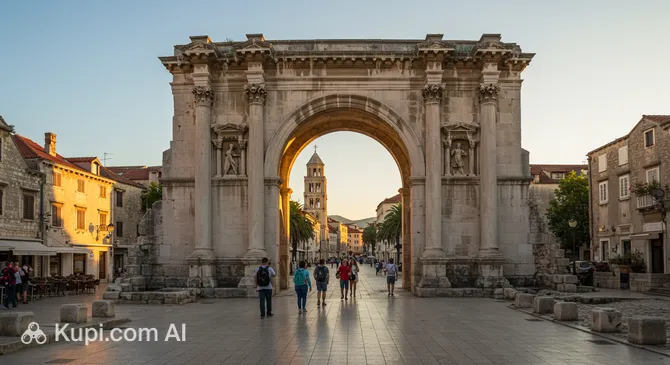
Golden Gate
Golden Gate. Иллюстрация. Источник: Kupi.com AI

The structure consists of a powerful double arch with an inner courtyard that served as a trap for enemies in ancient times. The facade is decorated with elegant niches, which once held statues of the tetrarchs, and ancient columns with Corinthian capitals. The Golden Gate served as the beginning of the main road leading directly to the Peristyle — the central square of the palace.

Today, this site attracts thousands of travelers not only for its historical significance but also for the remarkable preservation of its details. Fine stone carving and the monumentality of the building allow one to fully experience the greatness of ancient Rome right on the busy streets of the modern city.

Contacts

Since the Golden Gate is part of an open architectural complex and is not a standalone museum, it does not have a dedicated office or telephone line. All necessary information can be obtained at the city's tourist information center.

How to contactContact
AddressDioklecijanova 7, 21000, Split, Croatia

What to Do

The first thing worth doing at the Golden Gate is to carefully examine the ancient reliefs and niches on the facade. Massive stone blocks, bearing the marks of 4th-century craftsmen's tools, create the perfect backdrop for historical photos. Be sure to walk through the long internal corridor: this was the path the imperial retinue took to reach the heart of the palace.

Pay special attention to walking through the paved courtyard between the outer and inner arches. Here, you can feel the power of Roman defensive engineering. For those who want to see more, it is recommended to climb the preserved sections of the walls to look at the city of Split from above and appreciate the scale of the fortress pylon towers.

In the evening, the atmosphere around the gate is completely transformed thanks to soft illumination that highlights every detail of the ancient masonry. This is an excellent time for a romantic stroll or to enjoy street performances that often take place near the entrance. The gate also serves as a wonderful starting point for the themed "Palace Gates" route, which will lead you to the Silver, Iron, and Bronze gates around the perimeter of the historical center.

Getting There

Reaching this historical landmark in the center of Split is quite easy. The Golden Gate is located at Dioklecijanova 7 and is just a 15-minute walk from the main bus station and the ferry port (a distance of about 800–1000 meters). If you are arriving from the airport, it is most convenient to take the shuttle bus to the central terminal and then enjoy a walk through the old quarters.

For those who prefer public transport, city buses No. 12 and No. 21 are suitable; they stop at Marmontova ulica, from where it is just a 5-minute leisurely walk to the gate. If you are planning a trip by taxi or private car, remember that the historical center is a pedestrian zone. It is best to leave your car at the paid parking lot near the Riva embankment (Obala Hrvatskog narodnog preporoda) and continue on foot.

Walking to the gate is a great opportunity to soak in the authentic atmosphere of Dalmatia. The path leads through narrow streets filled with cafes and artisan shops, making the journey to the attraction part of a fascinating tourist route.

Ближайший город: Split

History & Facts

The majestic Golden Gate was erected around 305 AD as the primary ceremonial entrance to the luxurious Diocletian's Palace. It originally bore the Latin name Porta Aurea. Through this northern portal, Emperor Diocletian entered his residence after voluntarily abdicating power in the Roman Empire, becoming the first ruler in history to take such a step.

In ancient times, the facade of the gate was richly decorated: statues of the emperor and his co-rulers stood in the niches, and the gates themselves were covered in gold leaf, which gave the structure its famous name. The architecture of the gate reflects the transition from the classical Roman style to early Byzantine, combining the strength of a defensive structure with the elegance of a triumphal arch. In the 7th century, when residents of nearby Salona sought refuge from barbarian raids within the palace walls, the gate continued to play a key role in the life of the new settlement.

Interestingly, in the Middle Ages, the space above the gate was converted into a small Christian chapel dedicated to Saint Martin. This transformation helped keep the gate's structure in relatively good condition to this day. The site regained international fame in the 18th century when the British architect Robert Adam made detailed drawings of the palace ruins, inspiring European architects to create buildings in the Neoclassical style.

Time Needed

For a quick look at the architecture of the Golden Gate itself, studying the reliefs, and taking commemorative photos, 30–45 minutes is sufficient for most tourists. This time is enough to appreciate the grandeur of the Roman masonry and examine the details of the facade's decoration.

However, if you plan to include the gate in a full tour of the entire Diocletian's Palace, an inspection of the cellars, and a climb up the fortress walls, you should set aside at least 2–3 hours. The evening hours are especially conducive to a leisurely exploration of the landmark, when the artistic lighting is turned on and the main crowds of tourists subside.

Working Hours

The Golden Gate is part of an open urban space, so it is available for viewing 24 hours a day. You can admire this masterpiece of ancient architecture at any time convenient for you, whether it is early morning, when there are few people on the streets, or late at night under the glow of streetlights.

According to official data, the site is open daily (from Monday to Sunday) without days off or breaks. Access to the gate is completely free and open to all visitors.

Круглосуточно

Nearby

Exploring the surroundings of the Golden Gate allows you to literally travel through time. Since the gate is part of a massive palace complex, the most important historical and cultural monuments are concentrated just a few steps away.

A stroll through the adjacent streets will give you access to cozy squares, ancient temples, and authentic restaurants where you can taste Dalmatian cuisine. Below are the key sites located within walking distance:

NameDistance
Diocletian's Palace0.1 km
Old Town Hall0.1 km
Temple of Jupiter0.1 km
Diocletian's Palace0.1 km
Vestibule of Diocletian's Palace0.1 km
The Daltonist Craft Bar0.1 km
Marvlvs Library Jazz Bar0.1 km

Reached the end of the page?

That means the route is fully explored