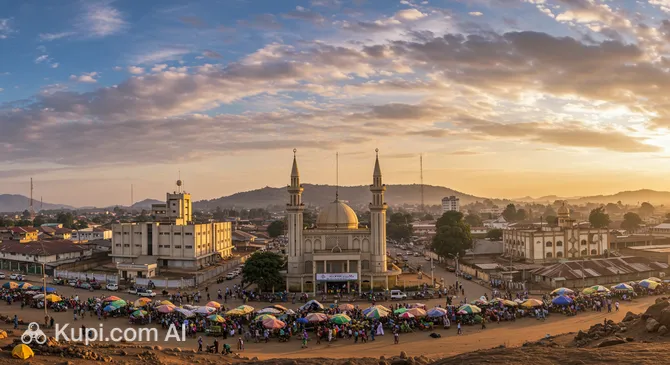
Lafia is a dynamically developing administrative center of Nasarawa State, located in the very heart of Nigeria. Situated at an altitude of 289 meters above sea level, the city serves as a crucial logistics and agricultural hub for the region. Unlike major metropolises, Lafia maintains the atmosphere of a hardworking provincial center, where daily life is closely intertwined with trade and the agricultural sector.
According to census data, the city's population exceeds 330,000 people, representing a diverse palette of ethnic groups such as the Eggon, Alago, Kanuri, and Koro. This multi-ethnic community creates a unique cultural layer reflected in local traditions and hospitality. Lafia. Illustration.
Source: Kupi.com AI
The history of Lafia's foundation dates back to the late 17th century, when settlers from the Kanem-Bornu Empire established the first settlement here.
While Lafia is primarily known as a business and trade center, it attracts attention for its authenticity and its role in the economy of the country's "Middle Belt." The city is the center of a Catholic diocese, and its surroundings beckon nature lovers with hills and caves. If you want to see the real, unembellished life of central Nigeria, Lafia will be an interesting point on your itinerary.
Weather Overview
The climate of Lafia is a tropical savanna type, which means there are clearly defined dry and wet seasons. The average annual temperature remains around 36 °C, creating a hot and sunny atmosphere. The hottest months are traditionally March and April, when the thermometer can rise to 39 °C.
The rainy season in the region lasts from May to October, reaching its peak rainfall in August and September. During this time, the nature of Nasarawa State transforms, becoming emerald green, though humidity increases significantly. The dry period, beginning in November, brings relief from the rain but is accompanied by Harmattan winds carrying dust from the Sahara. Detailed weather in Lafia will help you choose the ideal time for your trip.
When preparing for your journey, focus on a warm-weather wardrobe and sun protection. In the dry season, rain is practically non-existent (especially in December and January), making this the most favorable time for road travel and visiting natural sites such as the Eggon Hills.
Average monthly temperature
Average monthly precipitation
Interesting Facts
The city was founded by Muhammadu Dunama in the late 17th or 18th century by Kanuri settlers who left the great Kanem-Bornu Empire in search of new lands.
Lafia has several historical names, including Lafian Bare-Bari and Lafia Beri-Beris, highlighting the ethnic roots of its founders.
The city is considered one of the world's centers for sesame and soybean production; local products are exported far beyond Nigeria's borders.
In the late 19th century, Lafia officially became the capital of an influential local chiefdom, solidifying its status as the region's political center.
The city's cathedral, St. William's Church, was consecrated in honor of the diocese's establishment by Pope John Paul II himself in 2000.
How to Get There
The easiest way to reach Lafia is by road, as the city is a vital transport hub connecting Nigeria's northern and southern regions. Traveling to Lafia is usually planned from neighboring major centers. The main Jos-Makurdi highway passes directly through the city, providing regular connections to these regions.
If you are traveling from the southern states, a trip by intercity bus or private taxi will cost approximately 600–1000 Naira, while from the northern parts of the country, the cost can reach 3000 Naira. It is important to remember that road conditions can change significantly depending on the season.
Railway service in this region is poorly developed, so motor transport remains the primary choice for tourists. Lafia is conveniently located for those traveling by private car or rented vehicle with a driver, allowing for flexible planning of stops along the way.
Station
Passenger traffic
Distance
Makurdi Railway Station
1
86 km
Amina Mohammed Train Station
1
143 km
Jos Terminal
1
161 km
Bauchi Railway Station
1
242 km
Minna Railway Station
1
249 km
Main Attractions
Although Lafia is better known as a business center, there are several noteworthy places to visit. One of the most impressive natural attractions is the Eggon Hills and Caves. These rock formations, rising over 30 meters high, are striking for their whimsical shapes resembling spears and inselbergs, offering excellent opportunities for light trekking and nature observation.
For sports fans and event-goers, the central point of attraction is Lafia Township Stadium, located on the busy Jos-Makurdi road. This is the home arena for the Nasarawa United football club, with a capacity of about 10,000 spectators. On match days, the energy here is incredible, allowing tourists to experience the Nigerian passion for football firsthand.
In the city itself, you can visit St. William's Cathedral, the seat of the local diocese and an important spiritual center. Overall, Lafia's attractions are not of a mass-tourist nature, which makes visiting them especially valuable for those seeking seclusion and authenticity.
Local Cuisine
The gastronomic culture of Lafia is built upon the abundance of local agricultural lands. The diet is based on fresh products: yam, millet, and sorghum. Be sure to try traditional Nigerian soups and yam side dishes, which are prepared here with special skill using freshly harvested crops.
In the city center, Lafia Food Court is a popular spot, operating from morning until late evening. This is an excellent space to explore a variety of street foods, try grilled meats, and traditional snacks in a relaxed atmosphere. For a more formal dinner, De Madiba restaurant is a great choice, known for its focus on authentic African recipes.
Regarding drinks, look for local non-alcoholic variations made from grains and tropical fruits. Given the city's status as a trade hub, Lafia's markets always offer the freshest and highest-quality ingredients, making the local cuisine simple yet incredibly hearty and natural.
Travel Tips
Lafia is a city with a true Nigerian character, and to ensure your trip goes smoothly, it's worth considering a few practical nuances. These tips will help you adapt more quickly to the local rhythm of life and avoid minor difficulties.
Clothing and Essentials: Choose light clothing made from natural fabrics, as it is often very hot in Lafia. During the rainy season (May–October), be sure to bring a reliable umbrella or raincoat. For visiting religious sites, a conservative style of dress is recommended.
Transport: The best way to get around is by taxi. Avoid motorcycle-taxi rides after dark and always negotiate the fare with the driver beforehand.
Finances: The primary currency is the Nigerian Naira. Cards are only accepted in large hotels and some restaurants, so always carry a sufficient supply of cash.
Health and Safety: Drink only bottled water and use insect repellent. In the evening, it is better to stay in well-lit central areas and avoid carrying large sums of money.
Communication: Although English is the official language, its usage may be limited in provincial areas. Knowing a few phrases in Hausa or the local dialect will bring a sincere smile to the residents' faces.
Local Etiquette: Nigerians highly value polite greetings. Always greet people before asking a question or starting to bargain at the market.
What to Avoid: Do not take photographs of government buildings, sensitive infrastructure, or bridges without special permission, as this may raise questions from the police.
Seasonality: Plan your visit for the dry season (November to April) when the roads are in better condition and traveling around the region is much easier.
May your introduction to Lafia be filled with interesting discoveries and warm encounters with the local people!
Entertainment & Nightlife
The entertainment scene in Lafia has a calm and relaxed character typical of an administrative center. Most evening activity is concentrated around local restaurants and bars where civil servants and businesspeople gather. The atmosphere is friendly, and local music and traditional drinks provide a way to unwind after a hot day.
The main center for daytime entertainment and excitement is sports. Attending a match at the Lafia stadium is perhaps the most vibrant event the city can offer. If you are looking for more boisterous nightlife with Western-style clubs, locals often recommend taking a trip to nearby larger cities like Jos or Abuja.
For family leisure or daytime strolls, head to the local food courts and markets, which transform into lively social hubs by evening. Safety in the city is maintained at a good level, though it is always better to use a trusted taxi for nighttime travel.
Parks & Museums
The system of public parks and museums in Lafia is still in the development stage. The city does not have classic green zones within the residential areas, so locals and guests head to the outskirts for nature-based recreation. The primary recreational site remains the Eggon Hills, where natural landscapes take the place of traditional urban parks.
Regarding cultural institutions, the city lacks large historical museums. However, the uniqueness of Lafia is best experienced by visiting local community centers and traditional markets, which are "living museums" of the culture of the Eggon and Kanuri peoples.
The absence of formal museums is compensated for by the architecture of administrative buildings and religious sites, such as the central mosques and the Catholic cathedral. For those who appreciate ethnographic tourism, Lafia offers a unique opportunity to observe daily life and crafts without museum display cases and barriers.
Getting Around
The public transport system in Lafia is mostly comprised of private carriers. The main means of transportation for residents are minibuses (shuttle taxis) and motorcycle taxis, known in Nigeria as "okada." They do not have a fixed schedule—transport departs as it fills up, and routes can change flexibly depending on current demand.
For tourists, the most comfortable and safest way to move around the city is by renting a car with a driver or using a standard taxi. It is advisable to agree on the fare in advance, as meters in cars are extremely rare. In the central part of Lafia, distances allow for walking, but the hot climate can make this tiring.
It is worth noting that streets can be quite busy and traffic chaotic during peak hours. If you plan trips outside the city, it is best to go to official motor parks where licensed carriers operate. Fares in urban transport are paid only in cash in the local currency.
Accommodation
Hotel accommodations in Lafia are primarily geared toward business travelers, government officials, and trade representatives. You won't find large chain resorts here, but the city offers a decent selection of guest houses and small mid-range hotels that provide basic comfort, air conditioning, and secure parking.
The most convenient lodging options are concentrated in the city center and along major highways, allowing quick access to administrative buildings and markets. For longer stays, you might consider renting apartments, which are popular among expats and employees of international organizations.
Accommodation prices in Lafia remain quite affordable. It is recommended to book rooms in advance if your visit coincides with major regional holidays or national-scale football matches. Most lodging facilities can be booked through local services or directly by phone.
Nearby Cities
Thanks to its location in the central part of the country, Lafia serves as a convenient starting point for exploring the surrounding areas. Just a couple of hours away is Makurdi, the administrative center of Benue State, known for its picturesque river views. This direction is perfect for a day trip to change scenery and enjoy the river landscapes.
Another interesting destination is the town of Keffi, located on the way to the capital. For those seeking a cooler climate and more developed tourist infrastructure, a trip to Jos is a good choice. Also relatively nearby is Abuja, Nigeria's modern capital, offering world-class museums, parks, and shopping centers.
Exploring neighboring cities will allow you to see the contrast between business-oriented Lafia and other cultural and natural centers of the region. Road connections between these points are quite regular, making travel through Nasarawa State and beyond accessible and interesting.
Shopping & Souvenirs
Shopping in Lafia primarily involves visiting colorful markets where you can find everything from the freshest produce to local fabrics. Lafia Central Market is the heart of the city's trade; it's worth visiting for the spices, yams, and grains for which this region is famous. There is also a large selection of everyday clothing and cosmetics.
For larger-scale purchases, Karu International Market is a good fit. It is known for its huge range of goods at affordable prices, including textiles and household items. Another important trading site is the Lafia International Market, where wholesale and retail trade bustles, reflecting the city's status as an agricultural hub.
As souvenirs from Lafia, consider bringing back products made by local artisans or unique agricultural products such as high-quality oil or sesame seeds. Shops typically operate from early morning until sunset, and payments are primarily made in cash (Naira), so it's wise to carry small denominations.