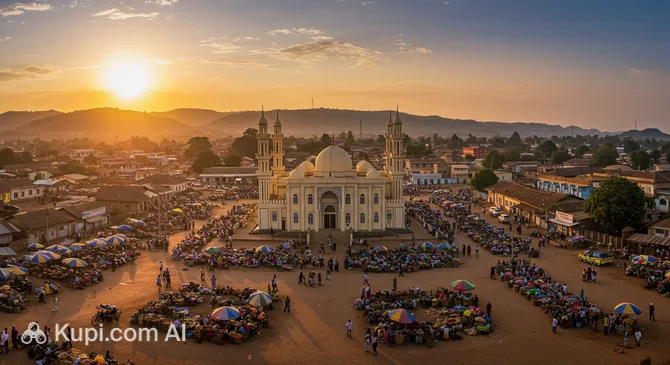
Okene is a dynamic and colorful city located in Kogi State, in the heart of Nigeria. As an important administrative and commercial center of the region, it attracts visitors with its authentic atmosphere and the deep cultural traditions of the Ebira people. The city is nestled in the picturesque Ubo River valley, surrounded by hills, creating a unique landscape that harmoniously combines urban bustle with natural beauty.
The city's geographic location at the intersection of key highways makes it a strategic transport hub. With a population of over 320,000, Okene lives at a pace of constant motion, with bustling markets and lively commercial quarters defining its everyday character. Although the city is primarily a commercial hub, its rich heritage and traditional way of life are of particular interest to those who want to see the real, non-touristy side of the country.
Okene. Illustration.
Source: Kupi.com AI
One of the city's main highlights is the majestic palace of the traditional ruler, which is rightfully called one of the most beautiful in West Africa. Here, you can immerse yourself in Ebira culture, learn about their ancient crafts, and experience the hospitality of the local residents. Visiting Okene is an opportunity to look deep into the Nigerian province, where ancestral traditions are closely interwoven with modern urbanization.
Weather Overview
Okene is characterized by a typical tropical climate with a clear distinction between the dry and rainy seasons. If you are planning a trip, it is worth considering that high temperatures persist in the city throughout the year. The average maximum often reaches 34–36°C, especially between January and April, which is considered the hottest time of the year.
The rainy season usually begins in May and lasts until October, peaking in September when the maximum amount of precipitation falls. During this time, the hills surrounding the city are covered in lush greenery, and the air becomes fresher, although humidity increases significantly. You should study the detailed Okene climate in advance to choose the most comfortable time for your visit.
The optimal period for a visit is considered to be the dry season, especially the months from November to January. During this time, there is virtually no rainfall, and the sky remains clear, which is ideal for walking and exploring local markets. Nighttime temperatures during this period can drop to a comfortable 21–23°C, providing a pleasant rest after the daytime heat.
Average monthly temperature
Average monthly precipitation
Interesting Facts
Okene has been a recognized center of iron processing for centuries; blacksmithing is a sacred craft of the Ebira people, the secrets of which are strictly guarded and passed down from father to son.
The Ebira ethnic group (or Tao) inhabiting the city has a unique migration history: their ancestors traveled a long way from Taraba State before settling in this fertile valley.
Over the last forty years, the city has experienced a real demographic explosion—its population has grown by more than 120%, turning a small town into a densely built-up urban center.
The population density in Okene is about 1,677 people per square kilometer, making it one of the most densely populated areas in Kogi State.
The city is located at a unique geographical point, at the intersection of roads connecting five important regional centers: Lokoja, Kabba, Ikare, Ajaokuta, and Auchi.
How to Get There
The city of Okene is a vital strategic hub in the central part of the country, thanks to its location on the A2 federal highway. This road provides stable connections to major economic centers, making the city accessible for travelers moving by land. If you are planning a trip, research the routes and travel options to this commercial hub in advance.
There is no direct air service to the city, so most tourists use the nearest major airports in neighboring regions and then transfer to buses or taxis. A network of intercity transport is well-developed within the country, and regular services departing from cities like Lokoja or Abuja pass through Okene. It is worth considering that road conditions may deteriorate during the rainy season, which slightly increases travel time.
There is currently no railway service directly in the city. The main methods of transportation remain state and private bus lines, as well as shared taxis, which connect Okene with key points in Kogi State and neighboring states. This is the most practical and popular way to reach the city among the local population and visitors to the region.
Station
Passenger traffic
Distance
Enugu Railway Station
1
185 km
Amina Mohammed Train Station
1
204 km
Minna Railway Station
1
229 km
Alfred Rewane Station
1
236 km
Makurdi Railway Station
1
253 km
Main Attractions
Although Okene is not a typical tourist destination, it hides several gems that can surprise the curious traveler. The city's main pride is the Ohinoyi Palace—the residence of the traditional ruler of the Ebira people. This architectural ensemble impresses with its scale and elegance, serving as one of the most striking examples of palace architecture in West Africa.
For those interested in culture and everyday life, the central markets of Okene are a must-visit. These are not just places of trade, but true centers of social life where you can see local agricultural products and the work of traditional artisans. The city is also known as a historical center for iron processing; the art of local blacksmiths has been passed down through generations and still plays an important role in the community's life.
The surrounding landscape of the city also deserves attention. The hilly terrain in which Okene is nestled offers picturesque panoramas, especially at sunset. Walks on the outskirts allow you to enjoy views of the Ubo River valley and feel the scale of this important transport and cultural crossroads of Kogi State.
Local Cuisine
The culinary traditions of Okene are closely linked to the agricultural wealth of Kogi State. The staple diet of local residents consists of dishes made from yam, cassava, and corn. You should definitely try the traditional "fufu" or "pounded yam" with various aromatic sauces prepared with palm oil and local herbs and spices. The gastronomy here is simple, filling, and very spicy.
Legumes and peanuts play an important role in local cuisine, added to soups or served as standalone snacks. Street vendors often sell roasted corn and plantains, which are ideal snacks for those on the move. In Okene, meat dishes cooked over an open fire, such as "suya"—spicy grilled meat—are popular and particularly tasty in the evening.
The food culture in the city is mainly represented by local eateries and "bukas" (local canteens), where you can experience the true taste of home-cooked Nigerian food. There are few fine-dining restaurants, but street food in the markets offers an authentic experience. For drinks, try fresh tropical fruit juices or traditional non-alcoholic grain-based beverages.
Travel Tips
A trip to Okene promises to be a vibrant ethnographic adventure if approached with proper preparation. These tips will help you confidently navigate life in this bustling Nigerian city.
Clothing and Essentials: Choose clothing made of light, natural fabrics (cotton, linen), as the region has a predominantly hot climate. Bring comfortable closed-toe shoes for walking through markets and hills, as well as a power adapter (Nigeria uses type G and D plugs).
Transport: The best way to get around is by taxi. Always agree on the fare in advance. Be prepared for the fact that public buses can be very cramped.
Finance: Make sure to have a sufficient supply of cash in the local currency (Naira). There are few ATMs, and international cards are rarely accepted, only in major establishments.
Health and Safety: Drink only bottled water and avoid ice in drinks. It is recommended to carry a basic first-aid kit and insect repellent. Try not to plan travel during the hours of darkness.
Communication: The official language is English, but knowing a few phrases in the local Ebira language will earn you genuine appreciation from the residents. A local SIM card can be purchased at any major market.
Local Etiquette: Greetings are an important part of the culture. Always greet people politely before asking a question. Asking for permission before photographing people or their stalls is a sign of good manners.
What to Avoid: Do not discuss political or sensitive social topics. Also, refrain from openly displaying expensive equipment or large sums of money in crowded places.
Seasonality: The best time to visit is the dry season (from November to April) when the roads are in good condition and humidity is at its lowest.
Following these simple rules will allow you to fully enjoy the hospitality of Okene and bring home only positive memories of the heart of Kogi State!
Entertainment & Nightlife
The entertainment scene in Okene is predominantly local and informal. You won't find large nightclubs or massive concert venues typical of megacities here; however, the city offers cozy places to relax after a workday. Main activity is centered around small bars and cafes in the commercial districts, where locals gather to discuss the news over a cup of a traditional drink or a light dinner.
For those seeking more vibrant experiences, the cultural festivals of the Ebira people are worth noting. During these periods, the city is transformed: the streets are filled with the sounds of traditional music, colorful costumes, and energetic dances. This is the best time to see the region's living culture in all its diversity and feel the true spirit of Okene.
During the day, leisure activities revolve around visiting markets and exploring local crafts. Safety in the city is supported by the high population density and the busyness of the central streets, but tourists are advised to plan their leisure time so they return to their hotel before dark. For those who miss the metropolitan glitz, trips to neighboring Lokoja are always an option, where the entertainment infrastructure is somewhat more developed.
Parks & Museums
Due to the high population density and active commercial development, Okene does not have an extensive network of public parks. Nevertheless, the landscape of the city itself, surrounded by hills, creates natural zones for walking and contemplating nature. Locals and visitors often use the nearby heights to enjoy panoramic views of the Ubo River valley and the urban skyline.
As for cultural institutions, the role of museums in Okene is largely played by open-air historical sites. The main one is the Ohinoyi Palace, where you can learn about the history of the Ebira people and the traditions of regional governance. The absence of specialized art galleries is compensated by living art on the streets: in the workshops of hereditary blacksmiths, you can see the process of creating iron products, which is a living historical museum in itself.
For those seeking quiet and greenery, the best option is to head outside the dense city limits. The proximity to the river and foothills allows you to find secluded spots with picturesque tropical vegetation, providing a pleasant contrast to the noisy commercial streets of Okene.
Getting Around
The transport system in Okene is mainly represented by the private sector and is focused on practicality. The main means of transportation within the city are shared taxis and small buses. This is a budget-friendly but sometimes specific way to get around: vehicles are often overcrowded, and the schedule depends entirely on how quickly the vehicle fills with passengers.
For tourists, the most comfortable option is to hire a taxi for an individual trip ("drop"). This saves time and avoids the squeeze; however, the price of the trip must be negotiated with the driver in advance before boarding. There are currently no modern ride-hailing apps in the city, so you can catch a car right on the street or at designated taxi stands.
There are no subways, trams, or trolleybuses in Okene. The entire urban rhythm depends on the condition of the roads, which can be quite congested in central areas. Travelers should take peak hours and seasonal characteristics into account: traffic can slow down significantly during heavy rains. Nevertheless, thanks to the city's compactness, getting from one point to another usually isn't too difficult.
Accommodation
The hotel infrastructure in Okene is primarily geared toward business travelers, trade agents, and transit passengers. Budget guest houses and small mid-range hotels offering a basic set of amenities predominate here. You should not expect luxury international hotel chains, but local hospitality and affordable prices make for a comfortable stay.
Most accommodation options are concentrated near the central commercial districts and along the main transport arteries, which is convenient for those who value proximity to markets and transport hubs. When choosing a hotel, it is recommended to check for the availability of a generator and secured parking, as these are important aspects of comfort and safety in the region.
It is better to book accommodation in Okene in advance, especially if your trip coincides with major regional festivals or market days, when the demand for rooms increases sharply. Most small guest houses operate on a cash-only basis, so you should ensure you have local currency on hand.
Nearby Cities
Okene serves as an excellent starting point for exploring central Nigeria, offering travelers easy access to neighboring cultural and administrative centers. Thanks to its location at a crossroads, you can easily plan several interesting day trips to broaden your impressions of the region.
Just 60 kilometers away is Lokoja—the administrative center of Kogi State, located at the confluence of the great Niger and Benue rivers. This is a city with a rich colonial history and many monuments. Also of interest are the city of Ikare, known for its picturesque surroundings, and Auchi, which can be reached in about an hour to experience the life of another major regional center.
Traveling to neighboring cities is a great opportunity to see the diversity of landscapes and ethnic traditions of Kogi State. The developed network of regional roads allows for comfortable travel by taxi or bus, opening up new horizons beyond Okene.
Shopping & Souvenirs
Shopping in Okene is primarily an immersion into the atmosphere of traditional African markets. The city is the largest trading hub for agricultural products in the entire region. Here you can find endless rows of fresh yam, cassava, aromatic spices, and grains. The markets pulse with energy from early morning, offering shoppers everything from food to household items.
If you are looking for unique souvenirs, pay attention to the products of Ebira folk artisans. Okene is famous for its textiles and traditional hand-woven fabrics, which feature original patterns and high quality. The city is also known as a historical center for metalworking, so you can purchase interesting forged items created using the ancient techniques of local blacksmiths.
Trade is mainly conducted in open markets and small shops along the main roads. There are virtually no modern Western-style shopping centers in the city, which only adds to the authenticity of the shopping experience. Haggling is expected when buying at the markets, and payment is made exclusively in cash in the local currency (Naira), as card terminals are very rare.