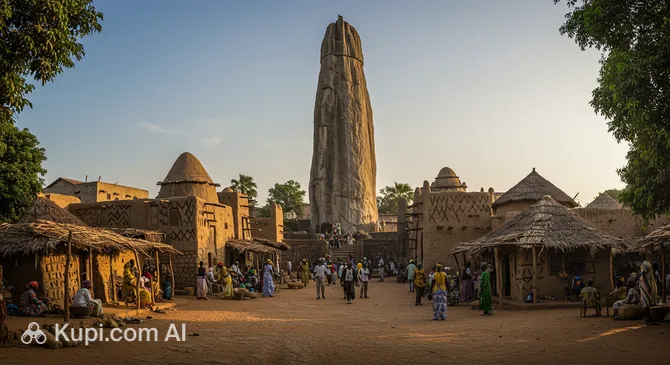
The ancient city of Ile-Ife, located in Osun State in southwestern Nigeria, is rightfully considered the cradle of Yoruba civilization. This place is filled with a special spiritual atmosphere and shrouded in legends: according to local cosmology, it was here that the creation of humanity once began. With a population of over 500,000, the city represents a harmonious blend of agricultural tranquility and a lively student rhythm.
Ile-Ife. Illustration.
Source: Kupi.com AI
Geographically, the city spreads across a picturesque landscape of hills and fertile soils, which has made it an important agricultural hub. Ile-Ife is not just a point on the map, but the heart of the cultural heritage of the Yoruba people, where ancestral traditions are closely interwoven with a modern academic environment. Exploring the rich history of the city allows for a better understanding of the origins of West African art and philosophy.
The main magnets for travelers here are unique archaeological sites and famous universities, such as Obafemi Awolowo University. A visit to Ile-Ife will be an unforgettable experience for those seeking authenticity, wishing to see the legendary bronze sculptures, and wanting to touch the living origins of one of Africa's greatest cultures. We invite you on this amazing journey, where every stone holds the memory of centuries.
Weather Overview
Ile-Ife is dominated by a typical tropical climate of southwestern Nigeria, characterized by high humidity and consistently warm temperatures throughout the year. The thermometer usually fluctuates between 25–32°C, creating conditions of eternal summer. However, tourists should take into account the clear division of the year into the dry season and the monsoon period, which significantly affects the comfort of walks and road conditions.
The dry season lasts from November to March, when precipitation is minimal and the sky mostly remains clear. February is considered the hottest month, with daytime highs reaching 36°C. During this period, dust in the air is possible due to the influence of the Harmattan winds. If you are planning a trip, check the detailed climate of the city to better prepare for the weather conditions.
The period from May to October brings heavy tropical rains, which peak in June and September. Humidity increases significantly during this time, while the average daily temperature drops slightly to a comfortable 25-26°C. Rains in Ile-Ife are often brief but very intense, contributing to the lush growth of greenery in the agricultural lands and hills surrounding the city.
Average monthly temperature
Average monthly precipitation
Interesting Facts
According to Yoruba mythology, Ile-Ife is a sacred place where the god Olodumare began the creation of the earth, making the city a spiritual center for millions of people around the world.
The city became world-famous for its realistic bronze and terracotta heads, created between the 12th and 14th centuries, which rivaled the work of European Renaissance masters in their level of craftsmanship.
Ile-Ife is considered the oldest city in West Africa, with a continuous history tracing back to the 6th century BC, when the first settlements of blacksmiths and farmers emerged.
The local Odo-gbe market is a literal city within a city, featuring about 1,500 stalls where you can find everything from fresh cocoa to unique magic amulets.
Obafemi Awolowo University, located in the city, is considered one of the most beautiful and prestigious higher education institutions on the African continent.
How to Get There
The accessibility of Ile-Ife largely depends on road networks, as the city is an important transport hub for the southwestern region. Most tourists arrive here from major Nigerian metropolises. The journey from Ibadan takes about 1–2 hours (around 64 km), while a trip from Lagos takes 4 to 6 hours depending on traffic intensity and road conditions. More detailed information on flights and routes can be found in the section on ways to get to the city.
Ile-Ife does not have its own airport. Travelers preferring air travel should aim for Ibadan International Airport or the airport in Akure. From there, the city can be reached by taxi or intercity bus, taking between 30 minutes to an hour. It is important to note that during the rainy season, travel time can increase significantly due to local road conditions.
Railway connections in this area are underdeveloped, so the main form of public transport remains buses and shared taxis, known as "danfo." They connect Ile-Ife with neighboring cities in Osun State and more distant regions. For a comfortable trip, it is recommended to book a private transfer or use the services of major transport companies.
Station
Passenger traffic
Distance
Train Station Ibadan
1
75 km
Lagos Terminus Railway Station
5
172 km
Lagos Terminus Railway Station
5
172 km
Alfred Rewane Station
1
263 km
Main Attractions
The main symbol and most mysterious attraction of the city is the Staff of Oranmiyan (Opa Oranmiyan). This massive granite obelisk, over five meters high, is dedicated to the legendary founder of the royal dynasties of Benin and Oyo. According to legend, the staff possesses magical powers, and the iron nails driven into it form mysterious symbols that still spark debate among historians and archaeologists.
For those interested in science and ancient art, the Natural History Museum of Nigeria is a must-visit. It houses an impressive collection of artifacts, including the famous terracotta and bronze heads that made Ile-Ife world-famous as a center of exquisite foundry craftsmanship as early as the 9th–12th centuries. The museum allows visitors to trace the development of Yoruba civilization from antiquity to the present day.
No less interesting is the campus of Obafemi Awolowo University, which is itself an architectural masterpiece and a cultural hub. A walk through its grounds allows you not only to appreciate Nigeria's modern intellectual life but also to see art galleries showcasing the work of young local artists. Although the city is not a mass tourism center, these sites make it a vital pilgrimage point for history and culture enthusiasts.
Local Cuisine
A gastronomic journey in Ile-Ife is an immersion into the authentic flavors of the Yoruba land. The local cuisine is based on fresh products from local farms: yam, cassava, corn, and aromatic palm oil. Be sure to try pounded yam—a smooth, elastic mash served with thick, spicy soups like egusi or vegetable soup with beef.
Other iconic dishes include amala (a dish made from dark root flour) and moi moi—a savory pudding made from ground beans with spices. The food culture here is closely linked to markets and street cafes called "bukas." It is in these establishments that you can taste the most delicious and affordable home-cooked food, prepared according to ancient recipes.
As for drinks, Ile-Ife is famous for its palm wine—a traditional African drink made from palm sap. Cocoa drinks are also popular, as the city is surrounded by extensive cocoa plantations. For dessert or an energy boost, locals often offer kola nuts, which are an important part of hospitality and social rituals in the region.
Travel Tips
A journey to Ile-Ife promises to be a fascinating immersion into Yoruba culture, and these practical tips will help make your trip as comfortable and safe as possible.
Clothing and Essentials: Choose light clothing made of natural fabrics (cotton, linen), as the city is almost always hot and humid. During the rainy season (May–October), be sure to bring a reliable umbrella or raincoat. A conservative clothing style is recommended for visiting sacred sites and interacting with locals.
Transport: Use taxis or tricycles (keke) for getting around the city. Motorcycle taxis (okada) are convenient but require caution. For long-distance trips to Ibadan or Lagos, it's better to book seats in comfortable buses from major companies.
Finances: The primary currency is the Nigerian Naira. Always carry a sufficient supply of cash, as cards are only accepted in large hotels and some shops. ATMs can be unreliable.
Health and Safety: Drink only bottled water and use insect repellent. It is recommended to consult a doctor regarding malaria prevention before your trip. Avoid walking in remote areas after dark.
Communication: The main language is Yoruba, but English is widely spoken, especially in the university environment. Knowing a few phrases in Yoruba (e.g., "E nle" — a greeting) will help you quickly build rapport with locals.
Local Etiquette: Show special respect to elders—this is the foundation of Yoruba culture. Greetings are often accompanied by a slight bow. Always ask permission before photographing people or their market stalls.
What to Avoid: Avoid discussing political or religious topics in a sharp manner and do not photograph government buildings. Avoid night trips between cities due to road conditions and potential risks.
Specific Tip: Visit the grounds of Obafemi Awolowo University—it is not only an educational center but also the safest and most picturesque place for a walk in the city.
Following these simple rules will allow you to fully enjoy the hospitality of Ile-Ife and bring home only warm memories of this ancient city.
Entertainment & Nightlife
Entertainment in Ile-Ife is primarily quiet and cultural in nature. Most activity is centered around the university campuses, which often host student festivals, theater productions, and lectures open to the general public. This is a city where evening walks through the Obafemi Awolowo university grounds replace noisy discos, offering guests an intellectual atmosphere and the chance to meet local youth.
Nightlife in the classic sense—with bright clubs and bars open until dawn—is practically non-existent here, as the city maintains its agricultural and conservative way of life. However, in the evenings, local markets like Oja Titun come to life, where you can not only shop but also watch traditional dances or street musicians' performances. This is the best time to feel the true rhythm of Yoruba life.
If you're looking for more active nightlife, locals often head to neighboring Ibadan, where the selection of entertainment venues is much broader. In Ile-Ife itself, it's better to focus on daytime activities: visiting the Staff of Oranmiyan or exploring museum halls, which offer far more impressions than a standard nightclub. For safe travel in the evening, it is recommended to use verified taxi services.
Parks & Museums
The cultural heart of Ile-Ife beats in the halls of its unique museums. The main object of interest for any tourist is the Natural History Museum of Nigeria, located at Obafemi Awolowo University. Its walls house priceless treasures: from ancient archaeological finds to a rich collection of Yoruba art. This place allows for a journey through the centuries in a single visit, revealing the greatness of an ancient civilization.
The university's own galleries are also worth attention: they regularly host exhibitions demonstrating the development of contemporary Nigerian art. Exhibits range from traditional masks to avant-garde canvases by young masters. Another important open-air historical site is the area around the Staff of Oranmiyan, which locals regard as a sacred open-air space.
While Ile-Ife doesn't have large classical parks with amusement rides, the city is surrounded by lush tropical greenery and agricultural lands. The hilly terrain and proximity to farms create a sense of living in harmony with nature. For walks, the well-maintained and green areas of the university campuses are best, serving as the city's main "lungs" and a place of relaxation for residents and guests.
Getting Around
The public transport system in Ile-Ife is simple and closely adapted to the needs of local residents. The main way to get around the city is by mini-buses ("danfo") and motorcycle taxis, known as okada. Motorcycles are particularly popular due to their maneuverability: they can quickly reach any market or academic building, bypassing traffic on the main roads. Also common in the city are tricycles (keke), which are convenient for small groups of passengers.
Fares are always paid in cash directly to the driver. There are no unified transit passes or transport cards in the city, and trip prices are fixed but may vary slightly depending on the time of day and weather conditions. Travelers are advised to clarify the fare in advance and carry small Naira notes, as drivers often don't have change.
For tourists, the most convenient option will be official taxi services or renting a car with a driver, which provides greater comfort and safety, especially in the evening. It is important to note that the city's main transport arteries can be congested during peak hours when students and farmers are heading to work and study. Walking is possible within university campuses, but for travel between districts, it's better to use transport due to the hilly terrain and road conditions.
Accommodation
Accommodation in Ile-Ife is primarily geared towards those visiting the city for university business or to study its cultural heritage. You won't find large luxury hotel chains here, but you can choose from many cozy guesthouses and mid-range mini-hotels. Most decent lodging options are concentrated near Obafemi Awolowo and Oduduwa Universities, which guarantees relative peace and security.
Numerous apartments and hostels are available for budget travelers and students. If you plan to visit the Staff of Oranmiyan or other iconic sites, it's better to choose accommodation in the central part of the city or closer to the main markets for quick access to transport links. It's worth noting that the level of service in local hotels may be simple, but the hospitality of the staff compensates for the lack of frills.
We recommend booking accommodation in advance, especially if your trip coincides with major university events or traditional festivals, when demand for rooms increases sharply. The primary payment method remains cash (Naira), although some larger hotels are starting to accept international cards. Always confirm the availability of air conditioning and a generator when booking, as power outages in the region are not uncommon.
Nearby Cities
Ile-Ife serves as an excellent starting point for exploring the cultural and historical landscape of Osun State and neighboring regions. Thanks to its central location, the city makes it easy to take day trips to places that will round out your view of Nigeria. Short transfers by bus or taxi make such journeys accessible and exciting.
Just 32 kilometers away is the city of Osogbo, famous for its sacred Osun-Osogbo Grove, a UNESCO World Heritage site. Another interesting destination is Ilesa (22 km), a major administrative and commercial hub where you can feel the rhythm of modern Nigerian life. It's also worth stopping by Ipetumodu, located just 12 kilometers away, to enjoy the rural scenery and local hospitality.
We highly recommend not limiting yourself to just the center of Ile-Ife and taking the time to explore the surroundings. The region is rich not only in history but also in picturesque agricultural landscapes where you can see cocoa and cotton being grown. Every trip to neighboring cities will reveal new facets of the amazing Yoruba culture.
Shopping & Souvenirs
Shopping in Ile-Ife is primarily an experience of visiting traditional African markets. The city does not have modern shopping centers with glass storefronts, but it offers something more valuable: the atmosphere of lively trade in open-air markets. The largest and most popular are Oja Titun and Odo-gbe. Here, among more than a thousand stalls, you will find everything this land is rich in: from bags of cocoa and kola nuts to vibrant local fabrics.
If you're looking for unique souvenirs, look for the works of local artisans. Ile-Ife has been famous for its blacksmiths and woodcarvers for centuries. Small figurines, masks, and metalwork inspired by the famous Ife bronze heads make excellent mementos of the trip. Also, look out for Adire fabrics, which are hand-dyed using natural indigo according to ancient Yoruba techniques.
Shops and markets are usually open from early morning until sunset. Payment is mostly made in cash in the local currency (Naira), so it's always good to have small bills with you. Don't hesitate to bargain in the markets—it's an important part of the local social culture. Visiting the markets of Ile-Ife is not just a shopping trip, but an opportunity to see the city's daily life in all its diversity.