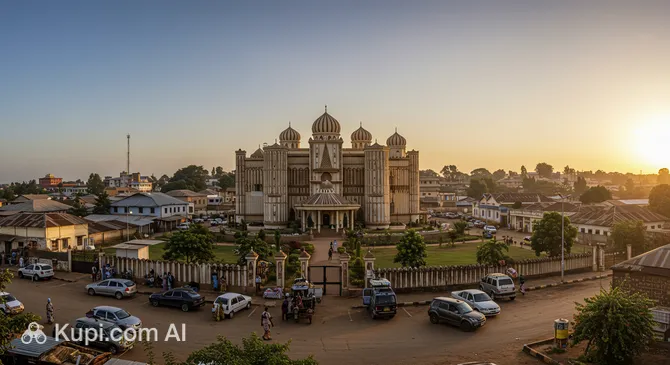
Owo is a fascinating corner in southwestern Nigeria, located in Ondo State. The city is steeped in the spirit of tradition and is one of the most important cultural centers of the Yoruba people. Its atmosphere is a blend of a quiet provincial pace of life and living history that can be felt in every neighborhood. Situated at an altitude of about 304 meters above sea level, the city offers travelers an authentic look at life in the modern Nigerian province.
With a population exceeding 276,000, Owo remains an important administrative and residential hub of the region. Although the city is not a typical tourist magnet with well-established infrastructure, it attracts those who appreciate a rich historical past. In the 14th–17th centuries, it was the majestic capital of a city-state whose influence extended far beyond the current borders of Ondo State.
Owo. Illustration.
Source: Kupi.com AI
Today, visiting Owo is an opportunity to see the everyday life of the Yoruba people without embellishment. Walking through local markets and quiet residential areas, you can experience the unique identity of this region, manifested in traditions and vibrant festivals. We invite you to discover this original city, where history meets modernity in the heart of West Africa.
Weather Overview
The city of Owo is located in a tropical climate zone typical of the southern part of Nigeria. There are two distinct seasons here: wet and dry. The rainy season lasts from April to October, bringing heavy precipitation that reaches its peak in September (about 233 mm). The dry season, covering the months from November to March, is characterized by clear skies and significantly less rainfall, especially in December and January.
The temperature regime in the city remains consistently warm throughout the year. The hottest month is usually February, when the average maximum reaches 35.6°C. If you are planning a visit, keep in mind that the climate of Owo features high humidity, especially near the Niger Delta. Expect hot days with temperatures around 28-30°C and pleasant, milder evenings when the thermometer drops to 21-23°C.
Spring is considered one of the most favorable periods for visiting, as temperatures at this time are most comfortable for walking. However, no matter what season you travel, be prepared for sudden tropical downpours in summer or the dusty Harmattan wind in the middle of the dry season.
Average monthly temperature
Average monthly precipitation
Interesting Facts
Ancient Capital: Between the 15th and 17th centuries, the city was the capital of a powerful Yoruba city-state, making it one of the oldest political centers in the region.
Geographical Crossroads: The city is located in the western part of the Niger Delta and is equidistant from many key points: it is only 37 km to the state capital Akure and about 280 km to the national capital Abuja.
Demographic Growth: According to the 1991 census, about 157,000 people lived here, but modern estimates suggest the city's population has nearly doubled, exceeding 276,000 residents.
Cultural Bastion: Owo is considered one of the main keepers of Yoruba identity, where ancient rituals are still strictly observed and large-scale ethnic festivals are held.
Transit Hub: Due to its location, the city serves as an important point for regional travel between the southwest and central parts of the country.
How to Get There
Reaching Owo is primarily possible by land transport, as the city is an important transit point in Ondo State. The main flow of travelers arrives from neighboring Akure, a journey of 1 to 2 hours depending on traffic conditions. Connections are also established with Abuja, which takes about 5–7 hours by car or bus via the federal highway.
The nearest airport to the city is in Akure (AKR). It accepts domestic flights from Nigeria's largest aviation hubs. Upon arrival at the airport, tourists can use local taxis or private carriers for a transfer to Owo. For international travelers, the optimal route would be a flight to Lagos or Abuja followed by an intercity bus.
There is currently no direct rail link to Owo, so buses and taxis remain the only options. Among bus companies, it is recommended to choose proven carriers such as GUO Transport, which provide a higher level of comfort and safety on routes from Lagos.
Station
Passenger traffic
Distance
Train Station Ibadan
1
191 km
Alfred Rewane Station
1
193 km
Enugu Railway Station
1
226 km
Lagos Terminus Railway Station
5
257 km
Lagos Terminus Railway Station
5
257 km
Main Attractions
Unlike major metropolises, Owo does not offer classic tourist routes, but interesting local infrastructure can be found here. The main points of attraction for residents and visitors are sports and community grounds. One such location is the Owo Township Stadium—a city stadium where football matches and important regional events take place, bringing the whole community together.
Another significant place is the Rufus Giwa Polytechnic Sport Complex. This complex serves not only educational purposes but is also a center for the city's active youth. For cultural events and official meetings, the SB Aruwajoye Civic Centre is often used—a multifunctional center reflecting the city's modern social life.
The main value of Owo lies in its intangible heritage. Tourists will find it interesting to observe the traditional Yoruba way of life, which is best seen in the central squares and busy markets. Despite the absence of world-class specialized museums, the city environment itself, with its chaotic but colorful architecture, serves as a living backdrop to the history of this ancient region.
Local Cuisine
A gastronomic journey to Owo is an introduction to the classic cuisine of the Yoruba people, where dishes made from tubers and grains play the leading role. Be sure to try pounded yam—a delicate yam puree served with a variety of thick, savory soups. Also popular are amala and egusi soup, made from melon seeds with herbs and spices.
Local street food deserves special attention. Suya—spicy beef or chicken skewers abundantly sprinkled with a mixture of spices and nut flour—is prepared everywhere here. For those who love light snacks, fresh tropical fruits are always available in abundance at city markets. As for drinks, it's worth noting the local palm wine, which has a distinct sweetish taste.
The food culture in the city is centered in so-called bukas—small local eateries where they cook simple and delicious home-style meals. Most of these establishments are located around the central markets. Tourists are advised to choose high-traffic spots where food is always fresh and to prefer bottled water for hygiene.
Travel Tips
A trip to Owo promises to be a vibrant cultural experience, and to ensure your journey goes smoothly, we have prepared some useful practical tips.
Clothing and Essentials: Choose light clothing made from natural fabrics, as humidity in the region is high. Clothing style should be modest, especially when visiting traditional neighborhoods. Don't forget comfortable shoes and a British-type plug adapter.
Transport: It is best to use licensed taxis for moving around the city. Okada (motorcycle taxis) are a fast but less safe option. It is better to refrain from traveling to the outskirts after dark.
Finance: The main currency is the Nigerian Naira. Always have a sufficient supply of cash, as cards are only accepted in large hotels, and ATMs can be unreliable.
Health and Safety: Be sure to use repellents against malaria mosquitoes and drink only bottled water. Pharmacies can be found on central streets, but it's better to bring a basic first-aid kit with you.
Communication: The official language is English, but knowing a few phrases in Yoruba (for example, "E nle" — a greeting) will help you win over the locals. A SIM card (MTN or Airtel) can be easily purchased in the city center.
Local Etiquette: Greeting is very important in Yoruba culture. Always be the first to say hello; it is a sign of respect. It is customary to remove your shoes when entering private homes or traditional premises.
What to Avoid: Do not take photos of people without their explicit consent and avoid filming government buildings. Also, try not to display valuables in crowded places.
Extra Tip: Plan your visit for the spring—this is festival time when Owo reveals itself in all its glory, but remember the need to book transport in advance.
May your introduction to this historic city be filled with only pleasant discoveries and kind encounters!
Entertainment & Nightlife
Entertainment in Owo is primarily local and traditional. You won't find noisy nightclubs or European-style bars here, as the city maintains a conservative and provincial way of life. Main activities are centered around sports arenas such as the Owo Township Stadium, where the passion of football fans creates a unique energy accessible to every visitor.
The Civic Centre is also a hub of social life, where cultural gatherings, celebrations, and local festivities are periodically held. If you are looking for a more modern nightlife with dance floors and cocktail bars, experienced travelers recommend heading to the state capital, Akure, located just 37 kilometers away, or to larger regional centers such as Benin City.
Nevertheless, a stay in Owo can be made memorable by participating in traditional Yoruba festivals that take place on the city streets during certain seasons. This is a unique chance to see folk dances and hear ethnic music in their natural environment. In the evening, it is recommended to exercise caution and use taxi services for moving between establishments or guesthouses.
Parks & Museums
Park infrastructure in Owo is underdeveloped, which is typical for many provincial cities in the region. You won't find extensive landscaped gardens here, but the city is surrounded by lush tropical vegetation characteristic of southern Nigeria. Small green zones can be found near administrative buildings and on the grounds of educational institutions.
Museum activity in the classic sense is practically nonexistent in the city. The main "open-air museum" is the historical center of Owo itself, where echoes of ancient Yoruba heritage are preserved. Instead of visiting galleries, tourists are recommended to head to local markets, which are a living reflection of the culture, crafts, and traditions of this land.
For those looking for more organized forms of cultural leisure, the best option is to visit public spaces during festivals. It is at these times that the city streets transform into a massive stage where the history and traditions of the Yoruba people are demonstrated in all their glory through music, costumes, and rituals.
Getting Around
The transport system in Owo is typical for Nigerian cities and is based on private carriers. The main means of getting around the city are danfo—yellow minibuses that run along major routes. This is the cheapest but also the most crowded way to travel, requiring a certain amount of knack from the passenger.
For faster and more maneuverable trips, locals and tourists use okada (motorcycle taxis). This is a popular type of transport that allows you to easily bypass the traffic jams that often occur on central roads. However, it is worth remembering safety and always asking the driver to go carefully. Standard taxis are also available in Owo and can be hired for individual trips around the city or beyond.
Fares are paid in cash directly to the driver or conductor. There are no fixed schedules for public transport—vehicles depart as they fill up. If you prefer comfort, it is recommended to use registered taxis or ride-hailing apps if they are available in this region of Ondo State.
Accommodation
The hotel sector in Owo is primarily oriented toward business travelers and transit guests crossing Ondo State. Budget hotels and guesthouses offering a basic set of amenities predominate here. There are no luxury five-star hotels in the city, but you can find quite decent middle-class options with air conditioning and secure parking.
Most popular accommodation options are concentrated in the central part of the city, near administrative buildings and main markets. This is convenient for those who want quick access to transport hubs and key infrastructure. You can use international booking services to find accommodation, but keep in mind that not all local guesthouses are represented online.
When planning a trip, especially during local festivals or holidays, it is recommended to book a room in advance. The price range in Owo remains very affordable compared to the country's major cities, and payment is most often made in cash in the local currency, although some hotels are beginning to accept bank cards.
Nearby Cities
Owo is a convenient starting point for those who want to explore the flavor and attractions of Ondo State. Thanks to its location at the intersection of regional roads, it is easy to make several fascinating trips to neighboring cities, each possessing its own unique character.
Just 11 kilometers away is the town of Ipele, which is perfect for a brief introduction to the rural lifestyle of the region. A larger journey awaits you in Akure—the administrative capital of the state, where more modern amenities, shops, and cultural sites are concentrated. It is also worth visiting the town of Ikare, known for its picturesque hills and lively trade.
Equally interesting destinations include the historic city of Ondo and Ado-Ekiti. These trips will allow you to dive deeper into the culture of southwestern Nigeria and see the diversity of landscapes in this tropical region.
Shopping & Souvenirs
Shopping in Owo is primarily about visiting the vibrant and noisy local markets, which are the heart of the city's economy. There are no giant shopping malls with global brands, but there is an abundance of handmade goods and authentic products. Trade is concentrated on the central streets, where life bustles from early morning until late evening.
The main reason to visit the market in Owo is for traditional Yoruba fabrics and products made by local artisans. You can find unique hand-embroidered cloths or traditional clothing. The city is also famous for its agricultural products: here you can buy the freshest spices, tropical fruits, and nuts, which will be a great addition to your gastronomic experience.
Shops usually operate from morning until sunset, and payment at most points is made exclusively in cash in the local currency (Naira). Bargaining in the markets is not only appropriate but is an important part of the local social culture. Don't hesitate to discuss the price with vendors—it will help you not only save money but also better feel the atmosphere of this hospitable city.