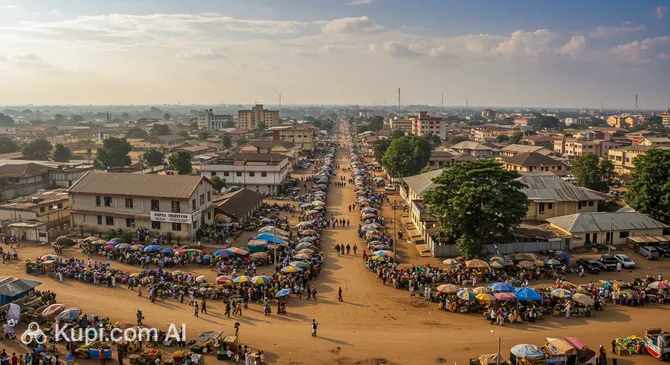
Nnewi is a dynamic commercial and industrial hub located in Anambra State in southeastern Nigeria. The city has rightfully earned the nickname "The Japan of Africa" due to its incredible entrepreneurial spirit and rapid industrial development. As the second-largest city in the state, Nnewi impresses with its energy and business activity, where the pulse of the Nigerian economy can be felt at almost every turn.
Geographically, the city is situated in the tropical rainforest zone, which provides lush greenery in the surrounding areas, although the center itself is densely built up with industrial and commercial facilities. The population of Nnewi is estimated to be between 900,000 and over a million people. The city attracts ambitious individuals from across the country, creating a unique cultural melting pot where the rich traditions of the Igbo people intertwine with modern business strategies.
Nnewi. Illustration.
Source: Kupi.com AI
While Nnewi may not be a classic tourist destination, it offers a unique look at modern Africa. Here, you can see giant Christian cathedrals standing alongside modern factories and immerse yourself in the atmosphere of the country's largest auto parts markets. Visiting this city is an opportunity to see Nigeria at its most progressive and hardworking, feeling the spirit of success that has made this place home to numerous billionaires.
Weather Overview
The weather in Nnewi is determined by its location in the humid tropical rainforest zone, which guarantees consistently high temperatures and distinct seasonal rainfall. Travelers should be prepared for the city's climate, which is characterized by high humidity felt throughout the year.
A typical weather scenario for Nnewi involves hot summers with frequent tropical downpours and drier but still warm winter months. The peak of the rains occurs between May and October, with rainfall in September reaching up to 260 mm. During this time, humidity is at its maximum, and the sky is often overcast, providing a slight relief from the sun. The average maximum temperature during the rainy season stays around 29-30°C.
The hottest period is considered to be from January to March, when daytime temperatures often rise to 35-36°C. January and December are the driest months, when the rains practically stop and humidity decreases, making this the most comfortable period to visit. However, keep in mind that the city's industrial activity combined with heavy traffic can affect air quality on windless days.
Average monthly temperature
Average monthly precipitation
Interesting Facts
"City of Billionaires": Nnewi is unofficially considered the Nigerian settlement with the highest number of US dollar billionaires per capita, thanks to the success of locals in the automotive business.
First of its Kind: Nnewi is home to Nigeria's first-ever automobile plant (Innoson Vehicle Manufacturing), which is fully owned by a Nigerian and managed by local specialists.
Sacred Pythons: Despite deep Christian faith, Nnewi still preserves ancient Igbo traditions where pythons are considered sacred creatures and are forbidden to be killed.
Auto Parts Everywhere: Local traders from Nnewi control between 80% and 90% of the entire auto and motorcycle spare parts market in Nigeria.
The Japan of Africa: The city earned its honorable nickname in the 1970s during a boom in small-scale manufacturing and the adaptation of foreign technologies, leading to an industrial explosion.
How to Get There
The transport accessibility of Nnewi is directly linked to its status as a major trade hub. The city does not have its own airport or railway station, so the main flow of goods and passengers arrives via roads. A trip to Nnewi is always an immersion into the dynamic rhythm of Nigerian highways, where caravans of trucks carry goods from all over the country.
For those who prefer air travel, the nearest air gateways are located in neighboring cities. The best options are the airport in Asaba (approx. 50 km) or the international airport in Enugu (approx. 80 km). The journey from the airport to Nnewi by taxi or private transfer takes between 1.5 to 2.5 hours, depending on traffic intensity, which can be quite heavy in this region. You can find more detailed route information on the page describing ways to get to the city.
Railway services in this part of Nigeria are currently undeveloped, so trains are not an option for traveling to Nnewi. If you plan to arrive from Lagos or Abuja, the best choice would be comfortable intercity buses from major carriers that pass through Onitsha. The trip can take from 8 to 12 hours, so it is worth preparing for a long journey along scenic Nigerian roads.
Station
Passenger traffic
Distance
Enugu Railway Station
1
80 km
Port Harcourt Railway station
1
136 km
Alfred Rewane Station
1
136 km
Makurdi Railway Station
1
261 km
Main Attractions
Nnewi is a city where the main attraction is the atmosphere of endless motion and commerce. There are no traditional architectural monuments here, but their place is taken by giant markets and modern industrial sites that tell the story of the region's economic success. Travelers seeking an authentic industrial experience should pay attention to the massive trading floors.
The central point of attraction is the Nkwo Market. It is not just a trading post, but a true economic phenomenon, considered the main hub for the import and wholesale of auto parts in all of West Africa. Here, you can see the functioning of a vast parts distribution mechanism controlled by local entrepreneurs. The scale of the market and the intensity of negotiations leave a lasting impression on any guest.
Another facet of the city is its religious grandeur. Nnewi is home to some of the largest and most majestic Christian cathedrals in the region, which serve as centers of social life. Their monumental architecture contrasts with the chaotic market quarters, offering peace and space for reflection. A walk along the roads around the markets also allows you to see the modern production sites that have turned this city into an industrial leader.
Local Cuisine
The gastronomy of Nnewi offers the honest and vibrant flavors of southeastern Nigeria, where every dish reflects the rich agricultural culture of the Igbo region. The local diet is based on root vegetables such as yam and cassava, along with an abundance of fresh greens, palm oil, and aromatic spices. The food here is hearty and spicy, perfectly suited to the energetic pace of a trading city.
Be sure to try traditional soups such as Egusi (made from melon seeds) or Ogbono, which are served with "fufu" or "garri" (a thick cassava mash). Another favorite is Jollof Rice, which is prepared here with particular skill. Meat dishes often include goat or beef, grilled or served in rich stews, which can be found in restaurants as well as food markets like Orie Agbor.
The food culture in the city is practical: most locals and traders eat at small diners near the markets or buy street food. For a drink, try the local palm wine or a refreshing hibiscus juice (Zobo). Nnewi's food scene doesn't chase refinement but wins you over with the freshness of its products and authentic flavors that are impossible to forget.
Travel Tips
Visiting Nnewi is a unique experience of immersion into the business heart of Nigeria, and a few practical tips will help make your trip more comfortable and safe.
Clothing and Essentials: Choose light clothing made from natural fabrics, as the city is almost always hot and humid. Be sure to bring comfortable, closed-toe shoes for walking through the markets. For visiting churches, choose more conservative and modest attire to show respect for local traditions.
Transport: For quick travel, use moto-taxis (okada), but always ask for a helmet or choose drivers who ride carefully. Be prepared for serious traffic jams, especially around the Nkwo and Orie Agbor markets.
Finances: The main currency is the Nigerian Naira. Cards are only accepted in major hotels, so always have a supply of cash. ATMs are often overloaded or out of cash; it is better to exchange money in advance in large cities or airports.
Health: Drink only bottled water and avoid ice in drinks. A yellow fever vaccination is mandatory for entry into the country, and malaria prophylaxis is also recommended.
Safety: Avoid walking after dark, especially in unfamiliar areas and near markets. Keep valuables in a hotel safe and do not display large sums of money in crowded places.
Communication: English is widely spoken, but locals more often communicate in Igbo or Pidgin English. A few greeting words in the Igbo language (for example, "Kedu" — "How are you?") will help you quickly establish a friendly connection.
What to Avoid: Do not take photos of industrial sites, military posts, or people without their explicit consent. Also, try not to engage in political discussions.
Nnewi may seem loud and bustling, but its hospitality and energy are sure to leave you with vivid impressions. Have a great trip!
Entertainment & Nightlife
The nightlife in Nnewi reflects its business character: the city wakes up early for trade and spends its evenings quite calmly. There isn't the usual abundance of nightclubs or noisy concert halls, as the main activity is focused on commerce. Nevertheless, for those looking for evening entertainment, the doors of local restaurants and hotel bars are open, where you can meet businessmen and expats discussing the day's results.
For more active evening leisure and a wider choice of entertainment venues, locals and visitors often head to neighboring Onitsha, which is about a 30-minute drive away. There, you can find cinemas, modern shopping centers, and livelier bars. Within Nnewi itself, entertainment is often more domestic or community-based.
Sundays hold a special place in the life of the city. Christian churches become the epicenter of cultural and social events, where meetings and celebrations are held after the service. Daytime recreation for tourists usually involves exploring the endless market rows or visiting small cafes where you can observe the life of "The Japan of Africa" over a plate of traditional food.
Parks & Museums
Nnewi is a city built for work and trade, so classic parks and museums are practically non-existent here. Urbanization and industrial growth have left little room for organized recreational zones, and locals usually find relaxation not in shaded alleys, but in lively social interaction at open markets and majestic church courtyards.
While there is little greenery in the city center itself, the surrounding landscape retains features of the tropical rainforest. Outside the dense urban areas, you can find agricultural lands where yam and oil palms are grown—these are natural zones that provide a glimpse into the traditional way of life in the region. Unfortunately, modern amusement parks or botanical gardens are currently absent in the city.
In the absence of traditional museums, Christian cathedrals and Igbo cultural centers take on the role of history keepers. It is in these places that you can become acquainted with the spiritual heritage and the history of Nnewi's development. For those interested in culture, attending church festivals is the best alternative to a museum visit, allowing you to see local traditions, dances, and rituals firsthand.
Getting Around
The transport system in Nnewi reflects its rapid commercial growth: it is energetic, chaotic, and fully oriented toward moving a huge number of people and goods. There are no subways or trams in the city; public transport consists mainly of a fleet of buses, minibuses known as "danfo," and nimble moto-taxis.
The most popular and fastest way to get around the city is by moto-taxi (okada). They are indispensable during peak hours when main highways, such as the A232, are clogged with trucks and commercial vehicles. Minibuses run between major districts and markets, but be prepared for them to depart only when full, and the level of comfort is minimal.
Payment for public transport is made exclusively in cash, and it is best to agree on the fare in advance. If you prefer more comfort, you can use private taxi services, which can be called by phone or found near major hotels. Note that the pedestrian infrastructure in Nnewi is poorly developed, so for safety and to save time, it is always better to use transport when moving between trading zones.
Accommodation
The hotel base in Nnewi is primarily geared toward business travelers, traders, and representatives of industrial companies. It is difficult to find luxury five-star resorts here; however, the city offers a decent selection of mid-range hotels and cozy guest houses providing basic comfort and security.
The most convenient area to stay is Nnewi North, where the main commercial activity is concentrated near the largest markets. Accommodation prices here range on average from $20 to $50 per night. Most hotels offer a standard set of services: air conditioning, Wi-Fi (though speeds can be unstable), and secured premises.
Since Nnewi is a magnet for business people, good options in the city center may be fully booked during major trade fairs or holidays. It is recommended to book a room in advance via international services or directly to ensure the best location. For long-term stays, one might consider renting apartments, which is particularly popular among specialists coming to work at local factories.
Nearby Cities
Nnewi serves as an excellent starting point for exploring Anambra State and getting to know the region's key economic centers. Proximity to major transport arteries makes it easy to plan day trips to neighboring cities, each of which has its own unique character.
Just 19 kilometers away is Onitsha, a giant commercial metropolis on the banks of the Niger River. A trip there is worth it to see one of Africa's largest markets and the majestic River Niger Bridge. Another interesting destination is the state's administrative capital, Awka, known for its blacksmithing heritage and a calmer, academic atmosphere. You can also visit Nkpor, which effectively merges with Onitsha and serves as an important transport hub.
Traveling around the outskirts will allow you to better understand the scale and diversity of southeastern Nigeria. The roads between cities are usually crowded, but it is in this movement and chaos that the true spirit of the region is revealed, where life bustles every minute.
Shopping & Souvenirs
Shopping in Nnewi is a serious business that has nothing to do with leisurely strolls through boutiques. The city is a true Mecca for those looking for machinery, spare parts, and industrial goods. You won't find huge shopping malls with global brands here, but you will discover markets whose scale is mind-boggling.
The main shopping attraction is the legendary Nkwo Market. It is the heart of the wholesale auto parts trade, where you can find a part for any vehicle—from a motorcycle to a heavy truck. For more everyday needs and fresh produce, locals head to Orie Agbor Market, where farmers sell the best vegetables, spices, and the famous Nigerian yam. This is where you can feel the true color of local life.
As for souvenirs from Nnewi, it's worth bringing back traditional Igbo fabrics, known for their bright patterns and high quality, or items made by local artisans. Shops usually open early in the morning and stay open until sunset. Be prepared for the fact that cards are rarely accepted, so always carry cash in the local currency—Naira—and don't forget to bargain, as it is an essential part of the local business culture.