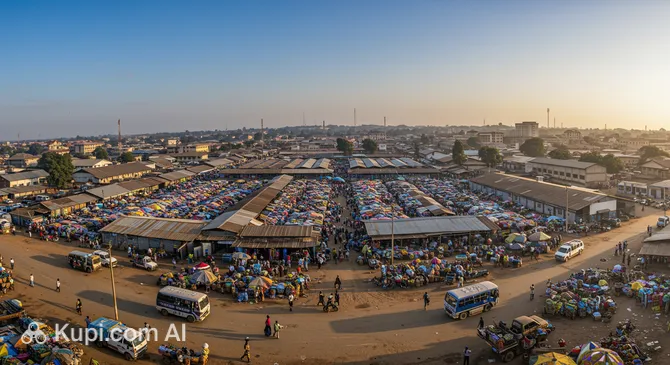
Aba is a dynamic and energetic commercial center located in Abia State in southeastern Nigeria. The city is rightfully considered the industrial heart of the region, where the traditional African way of life is harmoniously intertwined with a modern entrepreneurial spirit. With a population of over 1.5 million people, Aba pulses to the rhythm of endless trade and artisanal production, creating the unique atmosphere of a "city that never sleeps."
Geographically, the city stretches across a picturesque plain surrounded by tropical vegetation. Thanks to its location, Aba has historically developed as a major transport hub. If you delve into the history of the city's development, you will discover how a small settlement transformed into a powerful economic hub, known far beyond the country's borders for its production of footwear, textiles, and leather goods.
Aba. Illustration.
Source: Kupi.com AI
For the traveler, Aba is primarily interesting for its authentic flavor. There are no sterilized tourist facades here; instead, there is real, bustling life: huge markets where you can see the process of creating things with your own eyes, and welcoming locals always ready to share stories. We invite you to visit this amazing city to experience the genuine rhythm of modern West Africa.
Weather Overview
The climate in Aba is classified as tropical monsoon, which means stable warmth and high humidity throughout the year. If you are planning a visit, be sure to study detailed information about the weather in the city to choose the right wardrobe and time for walks. The temperature regime here is quite steady: during the day, the thermometer usually stays between +28...+33°C, and at night it rarely drops below +22°C.
The year in the region is clearly divided into a dry season and a rainy season. The period from March to October is characterized by heavy rainfall, with peaks in June, July, and September, when it can rain almost daily. During this time, the city becomes particularly fresh and green, but one should be prepared for a muggy atmosphere due to high moisture evaporation.
The dry season lasts from November to February and is considered the most comfortable time to visit. During these months, there is very little precipitation, and air humidity decreases, making the heat more bearable. However, keep in mind that even during the dry period, it can be cloudy, and the sun remains very active, so UV protection is necessary year-round.
Average monthly temperature
Average monthly precipitation
Interesting Facts
Aba is a city of contrasts and surprising records that can amaze even an experienced traveler:
The city is often called the "Taiwan of Africa" due to its incredible concentration of small-scale manufacturing and the ability of local artisans to recreate almost any product—from designer bags to complex machinery.
A unique apprenticeship system operates in Aba: young people come to masters as apprentices for several years to later open their own businesses after receiving a blessing and start-up capital.
Geographically, the city is located at an altitude of about 64 meters above sea level, and the surrounding area is an almost perfect plain within a 10-kilometer radius.
Aba is one of the most densely populated cities in Abia State, occupying an area of only 72 square kilometers, which creates an incredible density of events and business activity on every meter of land.
How to Get There
Aba's transport accessibility is due to its status as a key trading hub. Although the city does not have its own airport, getting here from other countries or regions of Nigeria is easy thanks to a developed network of land connections and the proximity of major aviation centers. When planning your route, it is worth exploring all the ways of how to get to the city most comfortably.
The main air gateway for visiting Aba is Port Harcourt International Airport (PHC). It is located approximately 80–100 kilometers from the city. This is a modern terminal receiving flights from Lagos, Abuja, and some international destinations. From the airport to the center of Aba, you can take a taxi, a rental car, or use intercity buses; the trip takes about 1.5–2 hours.
Railway communication in the region is currently undergoing modernization. Although there are tracks in the city connecting it to Port Harcourt and cities in the north of the country, federal highways remain the primary mode of travel. Traveling on buses from major companies, such as GUO Transport, allows you to reach Aba comfortably from most large Nigerian cities.
Station
Passenger traffic
Distance
Port Harcourt Railway station
1
55 km
Enugu Railway Station
1
147 km
Alfred Rewane Station
1
177 km
Bessengue train station
2
285 km
Main Attractions
The main magnet for visitors is the famous Aba Main Market (Ariaria Market). It is not just a marketplace but a real "city within a city," where thousands of craftsmen create handmade clothing and footwear. A stroll through its rows allows you to see a unique production cycle and purchase leather goods that rival many global brands in quality.
In addition to the retail giants, Aba offers a chance to get to know local craft workshops. Entire dynasties of shoemakers and tailors are concentrated in small quarters of the city. Visiting such workshops is a rare opportunity to order a custom-made traditional Nigerian outfit or accessories while watching the masterful work of the craftsmen.
Religious architecture also holds an important place in the city's landscape. Various Christian churches and cathedrals reflect the region's rich spiritual heritage. These majestic church buildings often become centers of social life, and their architecture is of interest as an example of the combination of modern and traditional motifs in the development of Abia State.
Local Cuisine
The cuisine of Aba is a true feast of flavor for lovers of spicy and hearty dishes. The diet is based on products traditional to southeastern Nigeria: yam, cassava, and tropical vegetables. One of the main dishes to try is fufu (a thick cassava mash), which is usually served with aromatic egusi soup—a soup made from melon seeds with the addition of greens, meat, or fish.
Street food in the city is a separate form of gastronomic art. At every turn, you can find vendors of fried fish, seafood, and the famous jollof rice. Proximity to water bodies ensures an abundance of fresh ingredients, while local spices give dishes a unique fiery character that is highly valued by residents of the region.
For drinks, you must try palm wine—a traditional low-alcohol beverage that is best enjoyed fresh. Exotic fruit juices and local beers are also widely available. The food culture in Aba is very democratic: the best culinary discoveries often await you not in expensive restaurants, but in cozy eateries right within the markets.
Travel Tips
A trip to Aba promises to be rich and colorful. To make your journey go smoothly, we have prepared some practical tips to help you settle into this energetic city more quickly.
Clothing and Essentials: Choose lightweight clothing made from natural fabrics (cotton, linen), as it is hot and humid in Aba year-round. Don't forget comfortable closed-toe shoes for walking through markets and insect repellent.
Transport: The best way to travel short distances is by keke motor rickshaws. For trips to other cities, choose reliable bus companies like Peace Mass Transit.
Finances: The main currency is the Nigerian Naira. Always carry cash, as cards are only accepted in large hotels and some supermarkets. Be prepared to bargain actively in the markets.
Health and Safety: Drink only bottled water and avoid ice in drinks. For safety reasons, try to plan all movements during daylight hours and use official transport services.
Communication: The official language is English, but locals often communicate in Pidgin English and the Igbo language. Knowing a few phrases in Igbo (e.g., "Ndeewo" — hello) will immediately endear you to the locals.
Local Etiquette: Greetings are very important. Always say hello to a vendor or driver before starting a conversation. Respect for elders is a foundation of local behavior.
What to Avoid: Do not photograph people, military sites, or government buildings without explicit permission. This can cause serious dissatisfaction or legal trouble.
Connectivity: Purchase a local SIM card (MTN or Airtel) immediately upon arrival, as access to free Wi-Fi is extremely limited.
By following these simple rules, you will be able to fully immerse yourself in the atmosphere of Aba and get only positive emotions from your trip!
Entertainment & Nightlife
Entertainment in Aba is inextricably linked with its commercial and cultural energy. The city's evening life often begins in local markets and commercial districts, where numerous street cafes and bars open after sunset. Here you can hear live music—from modern African Afrobeats rhythms to traditional Igbo melodies, creating a unique backdrop for socializing.
For fans of active recreation and sports, Aba offers football matches. Football is a true passion here, and the city's stadiums often become the arena for heated competitions between local teams. The emotions of the fans and the general festive atmosphere make attending such games a vivid event for any tourist.
If you are looking for a quieter evening pastime, it is worth checking out the culture and recreation centers located in the Ogbor Hill area. More modern establishments with a comfortable setting are concentrated there, where you can try local drinks and enjoy street shows often organized by local creative groups.
Parks & Museums
Although Aba is primarily known as an industrial center, one can find pockets of nature for relaxation in and around the city. Green zones are often located along riverbanks and on the outskirts of the city, where tropical vegetation retains its original beauty. These places are ideal for escaping the market hustle for a while.
As for cultural institutions, the role of museums in Aba is often filled by cultural centers and exhibition halls at craft guilds. Here you can see the best examples of local decorative and applied arts, historical photographs of the city, and traditional Igbo masks. Such exhibitions allow for a deeper understanding of the symbolism embedded in the products of local craftsmen.
Walking along nature trails on the outskirts of the city is a great way to get acquainted with the region's flora. Despite the dense development, Aba retains the charm of a tropical land, where a majestic tree or a quiet backwater reflecting the bright Nigerian sky may be hidden behind every corner of an industrial block.
Getting Around
The transport system in Aba is characterized by high mobility and adaptation to narrow and busy streets. The most popular mode of travel is the three-wheeled motor rickshaws known as keke. They are maneuverable, inexpensive, and allow you to quickly reach a desired market or quarter. It is always worth agreeing on the fare before you get into the vehicle.
For traveling longer distances, locals use minibuses called danfo. These bright buses ply the main city arteries and connect residential areas with shopping centers. There is also a developed network of motorcycle taxis (okada) in the city, which are suitable for individual trips when you need to bypass traffic jams during peak hours.
Payment in all types of public transport is made in cash to the driver or conductor. There are no unified transit passes, so tourists are recommended to always have small denominations of local currency. Taxis and ride-sharing services are also available in central areas, providing a more comfortable, though more expensive, way to get around the city.
Accommodation
Accommodation options in Aba range from very simple budget guesthouses to modern business-class hotels. Most hotels are concentrated in the city center, which is convenient for business trips and those who want to be in the heart of the action. Prices for standard rooms start on average from 20–50 USD per night.
The most popular areas to stay are Ogbor Hill and the vicinity of School Road. Hotels here often offer additional amenities such as secure parking, restaurants with local and international cuisine, and air conditioning, which is essential in the tropical heat.
It is recommended to book accommodation in advance, especially if your trip coincides with major market days or local holidays. When choosing a hotel, be sure to pay attention to the presence of backup generators (to ensure uninterrupted electricity) and safety reviews, as comfort levels can vary significantly.
Nearby Cities
Aba serves as an excellent starting point for exploring the southeastern regions of the country, offering travelers many interesting destinations within a short trip. The city's surroundings are rich in cultural centers and picturesque landscapes that allow for a better understanding of life in Abia State.
Just an hour's drive away is the state's administrative center—you can head to Umuahia. This city attracts visitors with its green streets and government buildings. Another important destination is Port Harcourt, a major metropolis and oil capital, offering more developed urban infrastructure and access to the sea. Also of interest is neighboring Osisioma, which practically merges with the outskirts of Aba.
Exploring these nearby cities will allow you to see the diversity of Nigeria: from the bustling markets of Aba to the administrative calm of the state capital. For trips, it is best to use minibuses or private taxis that regularly run between these locations.
Shopping & Souvenirs
Shopping in Aba is a unique experience that cannot be compared to visiting ordinary shopping centers. The city lives on trade, and its main pride is locally produced goods. Here, it is worth buying leather shoes, bags, and belts, which are handmade and often have no equal in terms of price-to-durability ratio.
The center of attraction for all shoppers is the Aba Main Market. Here you will find endless rows of fabrics, traditional Nigerian Ankara clothing with vibrant prints, and unique jewelry. Remember that in the markets of Aba, bargaining is mandatory—it is an important part of the local communication culture that allows you to significantly reduce the initial price.
Shops and stalls usually operate from early morning until sunset. Cash remains the primary method of payment, as card terminals are not available everywhere. By bringing home souvenirs from Aba, you take with you a piece of the talent of local craftsmen, whose products are famous throughout West Africa.