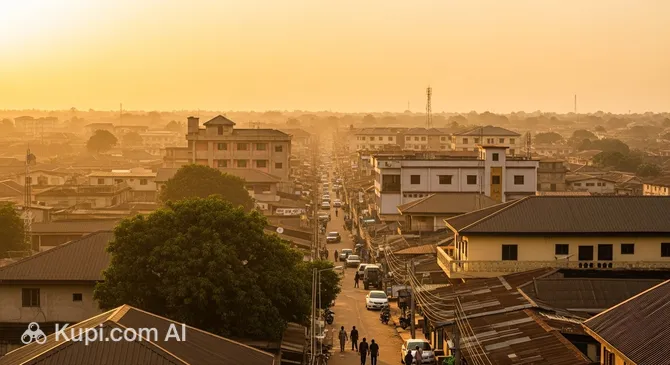
Umuahia is a vibrant administrative and commercial center located in the heart of southeastern Nigeria. As the capital of Abia State, the city harmoniously combines the dynamics of a major agricultural hub with the tranquility of a traditional Nigerian settlement. Its atmosphere is permeated with the scents of local markets and the rhythm of the railway, which has defined the life of this region for a century.
Umuahia. Illustration.
Source: Kupi.com AI
Geographically, Umuahia is situated in a strategically important location, connecting southern ports with northern states. The climate here is tropical, which promotes the flourishing development of agriculture—the primary pride of the local residents. According to current data, the metropolitan population is growing rapidly, turning the city into one of the state's key economic poles, where trade traditions are passed down from generation to generation.
The city's rich historical heritage is reflected in its architecture and educational institutions. Guests can visit famous agricultural markets or explore the grounds of Michael Okpara University, which is an important center of science for the entire country. Umuahia invites those who want to see the real, non-touristy life of Africa, full of authenticity and sincere hospitality.
Weather Overview
The weather in Umuahia is shaped by its tropical location, which guarantees warmth throughout the year. The typical city's climate is characterized by alternating between a distinct wet season and a drier period. The average annual temperature fluctuates within comfortable limits, rarely falling below 22°C at night and often reaching 35°C during the hottest daylight hours.
January is the driest and sunniest month, with virtually no precipitation and minimal humidity. However, the rainy season begins in March and reaches its peak in June and September—at this time, the city is literally enveloped in tropical downpours that bring freshness but make traveling on the roads more difficult. Expect a wet summer with frequent rain and a very warm, dry winter when clear skies predominate.
Travelers should take into account that high humidity during the rainy months can affect air quality and general well-being. When planning a visit, it is better to choose the period from November to February, when weather conditions are most favorable for walking through local markets and exploring the surrounding agricultural landscapes without the risk of getting caught in a prolonged downpour.
Average monthly temperature
Average monthly precipitation
Interesting Facts
In the late 1960s, Umuahia held strategic importance and temporarily served as the second capital of the Republic of Biafra.
Since 1916, the city has been a vital railway hub for the collection and export of yams, cassava, corn, and palm oil.
The population of Umuahia is showing phenomenal growth rates: over the last 70 years, the number of inhabitants has increased more than 75 times.
The city is home to Michael Okpara University, one of the leading specialized agricultural universities in Nigeria.
Administratively, the city is divided into two districts—Umuahia North and Umuahia South—each possessing its own unique character and market specialization.
How to Get There
The transport accessibility of Umuahia largely relies on its advantageous geographical position between major regional centers. The city is traditionally considered an important hub connecting the northern and southern territories of the state. For those planning a visit, detailed information on how to get to the city will help in planning a route that takes local climate and road conditions into account.
Currently, the city does not have its own airport, so travelers usually use the air hubs of neighboring cities, such as Port Harcourt or Enugu, followed by a transfer to ground transport.
The railway is a historical and practical way to reach Umuahia. The city is located on the main line connecting Port Harcourt in the south and Enugu in the north. Trains remain an important means of travel for both traders and travelers, offering a chance to see the region's picturesque agricultural landscapes from the carriage window. Road connections are also well-developed, though the quality of road surfaces can noticeably decline during the rainy season.
Station
Passenger traffic
Distance
Port Harcourt Railway station
1
98 km
Enugu Railway Station
1
102 km
Alfred Rewane Station
1
186 km
Makurdi Railway Station
1
269 km
Bessengue train station
2
295 km
Main Attractions
Although Umuahia is not a typical tourist center, the city offers a unique look at the authentic life of the region. One of the main points of interest here is the Railway Station. Built back in 1916, it still serves as the heart of the city's logistics and trade. For a traveler, it is the best place to feel the historical rhythm of the city, which has grown around this transport artery for decades.
The local agricultural markets deserve special attention. These are not just trading floors, but real living open-air museums where you can see the full variety of Abia State products: from giant yam tubers to high-quality palm oil. Observing traditional trading methods and communicating with local farmers allows for a deeper understanding of the lifestyle in modern Nigeria.
For those interested in education and science, a visit to the Michael Okpara University of Agriculture will be of interest. The university campus represents a significant territory where the city's intellectual life is concentrated. Also noteworthy is the Government College building, known for its strict academic reputation and historical significance to the state.
Local Cuisine
The culinary identity of Umuahia is a hymn to the generosity of the Nigerian land. Local cuisine is based on the freshest agricultural products for which the region is famous. The main ingredients of most dishes are yam, cassava, and taro. You should definitely try the traditional fufu—a thick yam mash served with a variety of aromatic soups based on palm oil and local herbs.
The gastronomy of the Igbo people, who inhabit these areas, is famous for its rich sauces. Ofe Akwu (palm fruit soup) and vegetable porridges with added corn are the dishes that best convey the domestic comfort of a Nigerian family. Among drinks, palm wine remains an absolute favorite; this traditional low-alcohol beverage is best enjoyed fresh at one of the city markets.
The city's restaurant scene is mostly represented by small family establishments where they cook "as if for their own." There are no pretentious Michelin-starred restaurants here, but there is an abundance of genuine flavor and huge portions. Visiting local "bukkas" (street eateries) will allow you to join the food culture of the local residents, for whom food is not just sustenance, but an important social ritual.
Travel Tips
A visit to Umuahia promises to be a unique experience of immersion into real Nigerian life, and these practical tips will help make your trip comfortable and safe.
Clothing and Essentials: Choose lightweight cotton clothing, as humidity here is high. Be sure to bring an umbrella or raincoat if you are traveling between May and October. Closed and comfortable shoes are necessary for walking through the markets.
Transport: Use taxis or minibuses to get around the city. Always confirm the fare with the driver in advance, as taxi meters are rare.
Finances: Cash is your main tool. ATMs are available in the center, but they do not always accept international cards. A tipping culture is welcomed but remains at your discretion.
Health and Safety: Drink only bottled water. Pharmacies can be found in central areas, but it is better to bring specific medications with you. Try not to plan walks for late evening hours.
Communication: The official language is English, but knowing a few phrases in Igbo (for example, "Nnoo" — welcome) will help you win over the locals. Wi-Fi in hotels can be unstable, so it is better to buy a local SIM card.
Local Etiquette: Greeting is very important—always say hello before asking for something. Residents of Umuahia are very friendly but value politeness and a calm tone of communication.
What to Avoid: Do not photograph government installations, bridges, or official personnel without explicit permission. Also, avoid openly displaying expensive jewelry or large sums of money in crowded places.
May your introduction to this agricultural heart of Abia State be filled with bright discoveries and warm encounters with hospitable people.
Entertainment & Nightlife
Nightlife in Umuahia is characterized by its calm and local nature, catering primarily to the city's residents. Unlike bustling megacities, you won't find massive night clubs with international DJs here. Instead, the city offers cozy local bars and cafes where locals gather in the evenings to discuss the day's news over a glass of palm wine or refreshments.
The main entertainment venues are concentrated in the central part of the city. The atmosphere in these establishments is usually relaxed, without a strict dress code, and the music mostly consists of contemporary African hits and traditional melodies. It is safest to reach evening leisure spots by taxi, having previously agreed on a return time, as public transport can be inconsistent during late hours.
For those seeking large-scale entertainment, theaters, or major concert venues, residents of Umuahia recommend taking a trip to neighboring Enugu or Port Harcourt. During the day, the main entertainment for a tourist remains exploring the colorful markets, which take on a special pre-sunset aesthetic in the evening, becoming a center of social life.
Parks & Museums
The park and museum culture of Umuahia is in a developmental stage, reflecting the city's agricultural and industrious character. You won't find massive landscaped gardens with fountains here, as most available land is used for agricultural purposes. Nevertheless, the grounds of Michael Okpara University offer quiet green zones and shaded alleys that serve as a place of relaxation for students and residents of nearby areas.
For those who want to get acquainted with the intellectual heritage of the region, visiting university libraries or exploring the campuses of local colleges may be of interest. These places preserve the atmosphere of Abia State's academic achievements. Despite the absence of large state museums, the architecture of the old quarters and the preserved railway station can serve as living witnesses to the city's past.
The nature surrounding the city is its main wealth. Instead of man-made parks, tourists are recommended to turn their attention to the surrounding farms and groves, where you can see how cocoa and oil palms grow in their natural environment. This provides a much fuller picture of regional life than any artificially created square.
Getting Around
The public transport system in Umuahia is fully adapted to the needs of the local population and traders. The primary way to get around the city streets is by microbuses, which locals call "transit." They run between the main markets, residential neighborhoods, and the station. Payment is made in cash to the driver or conductor, and there are often no fixed stops—transport stops on request.
An alternative to buses are numerous taxis, which can be hailed directly on the street. This is a more comfortable and faster way to travel, especially for tourists with luggage. There is no metro or tram system in the city, but their absence is compensated for by the high density of private carriers. Bicycle rentals are not developed here, and car sharing remains an exotic concept for the region.
The railway holds a special place in the transport system. For travelers, it is not only a way to reach the city but also an opportunity to take a trip to Enugu or Port Harcourt. When planning trips within the city, it is worth considering peak hours around major markets, when traffic can be significantly congested. It is recommended to carry small cash for convenience when paying for public transport.
Accommodation
Accommodation for guests in Umuahia is primarily represented by small hotels and cozy guest houses. The majority of lodging options cater to business people, traders, and government officials visiting the capital of Abia State. Most hotels are concentrated in the central part of the city, providing convenient access to transport links and key markets.
When choosing a place to stay, it is worth looking at areas near the Railway Station or administrative quarters. Here you can find mid-range hotels offering a basic set of services: air conditioning, secure parking, and breakfast. Luxury chain hotels are virtually absent in the city, so travelers should expect simple but functional Nigerian-style service.
When planning a trip, it is strongly recommended to book a room in advance through reliable services, as vacancies in the best guest houses fill up quickly during major fairs or regional events. If you are planning a long stay, you might consider renting an apartment, which is particularly popular among expats and employees of international organizations.
Nearby Cities
Thanks to its location at the intersection of important transport routes, Umuahia serves as an excellent starting point for exploring the southeastern regions of the country. Neighboring cities offer more developed tourist infrastructure and allow for a deeper immersion into the culture of the Igbo people.
Just a few dozen kilometers away is Aba—the largest commercial and industrial center of the state, known for its massive markets and artisanal production. It is also worth considering a trip to Owerri, which is considered the entertainment capital of the region with a more active nightlife and modern parks. For those seeking peace, the small town of Amawom, located in the immediate vicinity, is a good choice.
Traveling to neighboring cities allows you to see the contrasts of Nigeria: from the agricultural tranquility of Umuahia to the bubbling energy of commercial metropolises. Most of these destinations are accessible for day trips, making a stay in the capital of Abia State rich and varied.
Shopping & Souvenirs
Shopping in Umuahia is an adventure for those seeking authentic goods and wanting to feel the rhythm of real Nigerian trade. There are almost no Western shopping malls in the city, but it is home to some of the region's best agricultural markets. It is here that farmers from all around flock to offer the freshest yam tubers, corn, aromatic spices, and high-quality palm oil.
The main trading arteries are the areas around the railway station and the central market squares. Here you can purchase not only food but also traditional Igbo fabrics, woven goods, and local crafts. If you are looking for an unusual souvenir, pay attention to wood carvings and local ceramics, which are characterized by their simplicity and durability.
Shops and market stalls typically open early in the morning and work until sunset. It is important to remember that most retail outlets only accept cash (Naira), and the ability to politely bargain is considered a sign of respect for the seller. Tax Free is not available in local shops, but prices for local products remain very affordable for most travelers.