Support

D. Z. Romualdez Airport

About the Airport

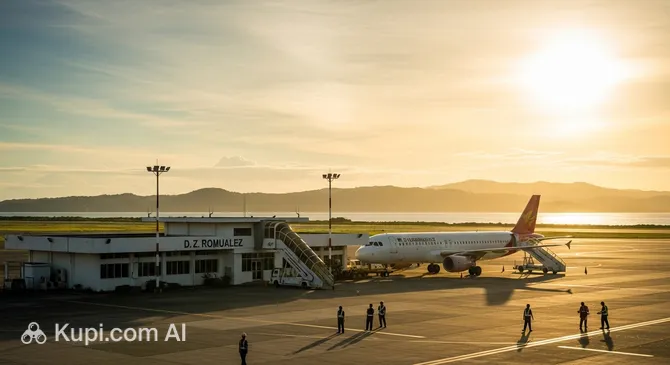
D. Z. Romualdez Airport. Source: Kupi.com Binoculars

Daniel Z. Romualdez Airport is not merely a transport hub, but the true aerial gateway to the Eastern Visayas, welcoming travellers with breathtaking views. Located on a picturesque peninsula in the San Jose district, the runway stretches along the very edge of the sea, turning every landing into a brief excursion over the azure waters of the bay. This air harbour connects the province of Leyte with key cities in the Philippines, serving as a starting point for those eager to see the famous San Juanico Bridge or immerse themselves in the atmosphere of hospitable Tacloban.

IATA Code TAC
ICAO Code RPVA
City Tacloban
Distance to Centre ~10 km
Status Domestic
Annual Passengers ~1.69 million (2024 data)
Schedule Online Board

Features and Advantages of the Airport:

The main highlight of the airport is its unique location. The runway is situated literally a few metres from the water's edge, offering passengers unforgettable impressions during takeoff and landing, especially in clear weather. Furthermore, the airport stands as a symbol of the region's resilience and renewal: following extensive reconstruction, it continues to develop, with new terminals being built to make waiting for flights as comfortable as possible.

Travellers also appreciate the airport for its strategic proximity to main attractions. Only a short drive separates you from the city centre and the architectural marvel — the San Juanico Bridge, connecting the islands of Leyte and Samar. It is the ideal start for those planning a grand journey across the region.

Contact Information

To contact representatives of Daniel Z. Romualdez Airport (TAC) or to obtain necessary reference information, please use the following contacts. We recommend verifying the accuracy of data on official resources, as they are subject to change.

  • Official Website: The airport is managed by the Civil Aviation Authority of the Philippines (CAAP). The most up-to-date information regarding airport operations should be sought on their official portal.
  • Inquiry Service Phone: To obtain precise telephone numbers for airport services, it is recommended to visit the official CAAP website, as a single public number may not be available.
  • Airport Address: Airport Road, San Jose, Tacloban, Leyte, Philippines (Airport Rd, San Jose, Tacloban City, Leyte, Philippines).
  • Email: For communication with the administration, it is best to use contact forms on the official CAAP website or airline websites, as a direct email for general inquiries may not be published.
  • Lost Luggage Information: For issues regarding lost or damaged luggage, please contact the representative of the airline you flew with directly. Airline offices are located within the terminal building.
  • Passenger Support Contacts: For questions related to tickets, flight schedules, and check-in, please contact your airline. For general questions about airport services, you may approach the information desk in the terminal.

How to Get to the Airport

Getting to Daniel Z. Romualdez Airport (TAC), the main air hub of Tacloban city, is quite simple due to its proximity to the city centre. The journey from the centre will take between 20 to 40 minutes depending on the chosen transport and traffic conditions. Below are the main methods to help you plan your trip.

Public Transport. The most authentic and budget-friendly way to get to the airport is to use local public transport. In the Philippines, this primarily means jeepneys and multicabs. Look for vehicles with a sign indicating the route "San Jose - Airport". Departures take place from the city centre. This option is ideally suited for travellers with light luggage who wish to immerse themselves in the local atmosphere. The cost of the trip is minimal, but be prepared that transport may be crowded during peak hours.

Taxi and Private Transfer. For those who value comfort and are travelling with a large amount of luggage, a taxi is the optimal choice. A car can easily be found anywhere in the city or ordered via mobile apps. The trip from the centre of Tacloban to the airport will take about 20-30 minutes. It is recommended to agree on the fare with the driver in advance or ensure they have switched on the taximeter to avoid misunderstandings. You can also book a private transfer in advance, which is particularly convenient for groups or families.

Car Rental. If you plan to actively explore the island of Leyte and its surroundings, renting a car will be an excellent solution. There are several local and international rental agencies in the city. By renting a car, you gain complete freedom of movement and can easily reach the airport at a time convenient for you. It is recommended to book a car in advance, especially during the tourist season, and to be prepared for the specifics of local traffic.

Airport Parking. Parking for vehicles is provided on the grounds of Daniel Z. Romualdez Airport. It is suitable for both short-term parking, if you are seeing someone off or picking them up, and for long-term storage of your vehicle during your absence. The cost depends on the duration of parking.

Terminals and Map

Daniel Z. Romualdez Airport (TAC) in Tacloban City is a compact and easy-to-navigate transport hub. It primarily serves domestic flights, connecting the island of Leyte with key cities in the Philippines, such as Manila and Cebu.

The airport operates one passenger terminal, which simultaneously serves both departing and arriving flights. Thanks to this, passengers do not need to worry about transferring between different buildings — all procedures take place in one location. The terminal layout is linear and intuitive: after entering, you find yourself in a general area with several airline check-in counters. After completing check-in and dropping off luggage, passengers proceed to pre-flight security screening, followed by a small waiting hall with boarding gates.

Departure and arrival zones are clearly separated. The Departure Zone includes check-in counters and the waiting lounge after security control. The Arrival Zone is located in another part of the building and consists of a baggage claim belt and a hall for greeters. Due to the airport's small size, navigation causes no difficulties, and all necessary zones are within walking distance of each other.

To avoid rushing, it is recommended to arrive at the airport 1.5-2 hours before the departure of a domestic flight. Although check-in and security screening usually take little time, queues may arise during peak hours or when several flights depart simultaneously. For comfortable navigation, simply follow the signs that will guide you from the terminal entrance to the necessary boarding gate.

Airport History

Daniel Z. Romualdez Airport (TAC), the main air hub of Tacloban city and the Eastern Visayas region, possesses a rich and dramatic history closely tied to key events in the history of the Philippines. Its story is not just a chronicle of infrastructure development, but a reflection of the resilience and revival of an entire region.

The airport's history begins during World War II, when it was known as the San Jose Airstrip. It was built and used by the Imperial Japanese Army. In 1944, the airfield became the epicentre of historic events, playing a key role during the landing of American forces under the command of General Douglas MacArthur, which marked the beginning of the liberation of the Philippines. After being captured by the Allies, it was quickly modernized and became an important airbase until the end of the war.

After the war, the airfield was converted into a commercial airport to serve domestic flights. Later, it was named in honour of Daniel Z. Romualdez, a prominent Filipino politician who served as Speaker of the House of Representatives. Over the decades, the airport gradually developed, serving a growing passenger flow and becoming a vital gateway for tourism and trade on the island of Leyte.

The most tragic and simultaneously pivotal moment in the airport's modern history was Super Typhoon Haiyan (Yolanda) in 2013. The natural disaster practically completely destroyed the terminal building and navigation equipment. However, the airport demonstrated incredible resilience: within just a few days, it became the main centre for receiving international humanitarian aid. The subsequent large-scale reconstruction transformed it into a modern facility more resistant to natural disasters, becoming a symbol of the entire city's rebirth.

Today, Daniel Z. Romualdez Airport continues to undergo modernization. Works are underway to further expand and improve infrastructure with the aim of achieving international status. Its history, from a military airstrip to a modern transport hub that survived one of the most destructive natural disasters, makes it not merely an airport, but a true monument to resilience and hope.

Services and Amenities

Daniel Z. Romualdez Airport (TAC) offers passengers all necessary services for a comfortable wait for their flight. Despite its relatively small size, the terminal is equipped with essential amenities that will make your journey through the Philippines more pleasant.

Within the airport grounds, you will find several small cafés and snack bars where you can have a bite before departure, ordering local dishes, sandwiches, and beverages. There are also souvenir shops where you can purchase traditional Filipino gifts and delicacies (pasalubong) for loved ones. The general waiting hall has sufficient seating for rest, and special stations are provided for charging electronic devices. Free Wi-Fi is available to passengers, allowing you to stay connected.

ATMs are installed in the terminal for financial transactions. Should first aid be required, you may visit the airport's medical unit. For the convenience of passengers with small children, a mother and child room is equipped where you can feed and change your baby in a quiet environment. The airport also provides basic amenities for passengers with reduced mobility, including ramps and specially equipped restrooms. It is recommended to notify your airline in advance if you require additional assistance.

Although there are no hotels directly on the airport grounds, numerous accommodation options are located in the immediate vicinity, in the city of Tacloban. A trip to the nearest hotels will take just a few minutes by taxi. Specialized business centres and conference rooms are absent in the airport, however, such services can be found in major hotels in the city.

Dining

Daniel Z. Romualdez Airport (TAC) in Tacloban is a regional airport, so the choice of dining establishments here is quite modest, yet sufficient for a snack before departure. The main cafés and kiosks are concentrated in the main terminal building, primarily in the general area before passing through security control.

Most establishments are located in the landside zone (before screening). Here you will find several small cafés where you can order coffee, pastries, sandwiches, and soft drinks. This is the best place for a full lunch or a leisurely wait for your flight. In the airside zone (after screening), the selection is typically very limited and may be reduced to a single kiosk with packaged snacks, crisps, and beverages. Therefore, if you are hungry, it is recommended to eat before passing through control.

Menus in local cafés often include Filipino cuisine dishes. This is an excellent opportunity to try something local. Look out for silog (a breakfast dish with rice, egg, and meat) or various types of pastries, such as ensaymada. Fresh buns and coffee are ideal for a quick snack. Prices at the airport are moderate, slightly higher than in the city, but quite affordable.

Passengers with special dietary requirements (vegetarians, vegans, gluten-free diet) may find it difficult to find guaranteed options. There are no specialized establishments here. It is recommended to clarify ingredients directly with vendors or, for reliability, to bring food with you. Most food outlets operate according to the flight schedule — from early morning until the departure of the last aircraft.

Travel Tips

To ensure your journey through the airport of Tacloban city goes smoothly, please make use of our tips. Daniel Z. Romualdez Airport mainly serves domestic flights, so navigation here is quite simple, but preparation is never amiss.

Arrival Time and Check-in: For domestic flights within the Philippines, it is recommended to arrive at the airport 2 hours before departure. This time is usually sufficient to drop off luggage, check in, and pass security control without rushing. To save time, use online check-in if your airline provides such an option. Keep your passport and boarding pass handy for quick verification.

Seat Selection and Hand Luggage: If you wish to enjoy views of the islands during takeoff or landing, choose a window seat. An aisle seat will provide more legroom and allow you to leave the cabin faster upon arrival. Liquids in containers up to 100 ml, packed in a transparent bag, are permitted in hand luggage. Electronic devices, such as laptops and power banks, are usually requested to be removed for separate scanning. Sharp objects and flammable substances are prohibited from carriage.

Customs Control and Transfers: Since the airport is primarily domestic, strict customs control is undergone only by passengers of rare international charter flights. For most travellers, the procedure will be limited to standard security checks. If you have a connecting flight, clarify whether you need to collect your luggage. The small terminal has basic amenities, including cafés and waiting areas, where you can spend time until your next flight.

Savings and Unforeseen Situations: To save money, bring an empty reusable water bottle, which can be filled after screening, and light snacks. In the event of a flight delay, which sometimes happens due to weather conditions, first contact your airline representative. Remain calm and clarify information regarding the new departure time and the possibility of providing meals or accommodation.

Reached the end of the page?

That means the route is fully explored