Support

Polish Aviation Museum

About

The Polish Aviation Museum in Krakow is a true treasure trove for everyone fascinated by the history of flight and technology. As the largest aviation museum in Poland, it offers visitors a unique opportunity to trace the development of aviation technology. The museum is registered in the State Register of Museums and is rightfully considered one of the city's most important tourist sites.

The museum's location adds a special atmosphere. It is situated on the site of the former "Krakow-Rakowice-Czyżyny" airfield, which is one of the oldest in Europe. This historic site, where military aircraft were once based, now serves as home to an impressive collection of flying machines, immersing visitors in the history of conquering the skies.
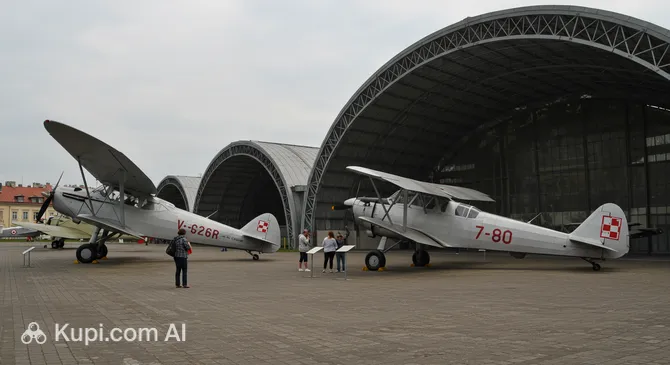
Polish Aviation Museum. Illustration.
Source: Kupi.com AI

Traveler photos:

The museum's collection includes over 200 airplanes, gliders, and helicopters, as well as an extensive collection of aircraft engines. Many exhibits are true relics, and some are the only surviving examples in the world. A visit to the museum will be an educational and exciting experience not only for aviation experts but also for families with children and anyone interested in the history of technology.

Contacts

To plan your visit and check current opening hours and ticket prices, it is recommended to contact the museum directly. All necessary visitor information, including details about temporary exhibitions and special events, is available on the museum's official website, which has versions in Polish and English.

How to contactContact
Addressal. Jana Pawła II 39, 31-864 Kraków, Poland
Phone number+48 12 642 87 00
Websitewww.muzeumlotnictwa.pl

What to Do

A visit to the Polish Aviation Museum is an exciting journey through the history of flight. The exhibition is housed not only in the main building but also in several spacious hangars and the open area of the former airfield. Guests can take a close look at dozens of airplanes and helicopters from different eras while walking through the museum's vast grounds.

In the main museum building, a large hall awaits visitors where the basics of aviation physics are explained clearly and the work of air traffic controllers is demonstrated. This makes the visit not only exciting but also educational. A particular highlight, especially for young visitors, is the mini-flight simulator, allowing you to feel like a pilot for a moment.

The museum's collection is impressive in its diversity. It features not only Polish aircraft but also foreign models, including unique German aircraft from the Second World War. In addition to airplanes and helicopters, the museum features an extensive collection of aircraft engines that illustrates the evolution of technology in detail. Many exhibits are rare or even unique in the world, giving the collection special historical value.

Getting There

Getting to the Polish Aviation Museum in Krakow is quite easy, especially using the city's extensive public transport network. From central Krakow, trams run regularly to the museum. You can take routes No. 4, 5, 9, 10, or 15 and get off at the "AWF" stop. You can also take trams No. 52 and 64 to the "Muzeum Lotnictwa" stop.

From the "AWF" stop, it's a short walk. First, you need to cross the road and walk about half a kilometer in the opposite direction of the tram traffic. The turn leading to the museum is located between the "ul. Wieczysta" and "AWF" stops. A key landmark on the way is the monument to Polish aviators, where you should turn right.

After turning, you will find yourself on a small road that leads directly to the museum entrance. One side of the path is lined with bushes, while the other features low-rise residential buildings. The entire route from the tram stop is intuitive and won't take much time. Additionally, for greater convenience, especially if you are traveling with family, you can always use taxi services.

Nearest city: Krakow

History & Facts

The history of the Polish Aviation Museum is inextricably linked to the site where it is located. The museum is situated on the grounds of the former "Krakow-Rakowice-Czyżyny" airfield, which was founded back in 1912 during the era of the Austro-Hungarian Empire. At that time, on the eve of the First World War, aviation was developing rapidly, and this airfield became one of its important centers.

After the Second World War, the airfield was used for civil aviation for a time, but its fate changed dramatically in 1963. Due to the rapid expansion of Krakow's residential areas, the airport was closed. However, this historic site was not abandoned: that same year, by decision of the Minister of National Defense, the territory and hangar were handed over to an aeroclub. This served as the catalyst for the creation of the Aviation Technology Exhibition Center, which became the predecessor of the modern museum.

Just a year later, in 1964, the exhibition center was transformed into a full-fledged museum, opening its doors to the public. The institution became officially known as the Krakow Aviation Museum in 1967. The first director, Marian Markowski, made a significant contribution to its development. It was his efforts and dedication that helped the museum grow into one of the largest and most authoritative aviation museums in Europe.

Time Needed

When planning a visit to the Polish Aviation Museum, it is worth setting aside at least 2–3 hours for exploration. This time will be enough for a brief look at the main exhibitions located in the main building, several hangars, and the adjacent outdoor area. During this period, you will have time to see the most iconic exhibits and get a general impression of the scale of the collection.

However, if you are a true aviation enthusiast or simply want to dive deeper into the subject, feel free to plan for half a day or even more. To carefully study rare aircraft, read the information plaques, explore the collection of aircraft engines, and fully enjoy the vast outdoor exhibition, you will need at least 4–5 hours. For visitors with children, additional time will be spent on interactive areas and the flight simulator, making the visit even more fulfilling and memorable.

Working Hours

The Polish Aviation Museum is open to visitors from Tuesday to Sunday from 9:00 AM to 5:00 PM. It is closed on Mondays. For budget-conscious travelers, there is a nice bonus: on Tuesdays, admission to the museum's permanent exhibition is free. This is a great opportunity to explore the rich collection of aviation technology without spending extra.

The museum is open year-round. Although advance booking for individual visitors is usually not required, tickets can be purchased online on the official website to avoid queues. Before your visit, especially on public holidays, it is recommended to check the official website for current information on opening hours and any potential schedule changes. Last entry is 30 minutes before closing.

DayOpening hours
MondayClosed
Tuesday9:00 – 17:00
Wednesday9:00 – 17:00
Thursday9:00 – 17:00
Friday9:00 – 17:00
Saturday9:00 – 17:00
Sunday9:00 – 17:00

Nearby

A visit to the Polish Aviation Museum is just one facet of exploring Krakow, a city rich in attractions. Exploring the museum's surroundings can significantly enrich your travel experience. In the immediate vicinity of this unique technical site are other interesting places that allow you to diversify your leisure time and see the city from different perspectives.

Just a few kilometers from the museum, you'll find modern entertainment centers, parks, and other museums. This makes the area attractive not only for aviation enthusiasts but also for families with children, as well as those who want to combine a cultural program with active recreation or shopping. Below is a list of nearby attractions that are easy to reach on foot or by public transport.

NameDistance
Krakow Water Park1.5 km
Fabryczna 132 km
Hala Centralna Activity & Food2 km
Krakow Arcade Museum2 km
Altum Aquarium2.4 km
Kraków Barbican3.7 km
Wilczy Dół Tavern3.8 km

Have you reached the end of the page?

So the route has been studied inside and out