Support

Lonsky Prison National Memorial Museum

About

Located in the ancient and majestic city of Lviv, the National Museum-Memorial “Lonsky Prison” is a unique monument of 20th-century history. This site, which once housed the largest prison in Western Ukraine, today serves as an important reminder of the struggle and resilience of the human spirit in a country like Ukraine.
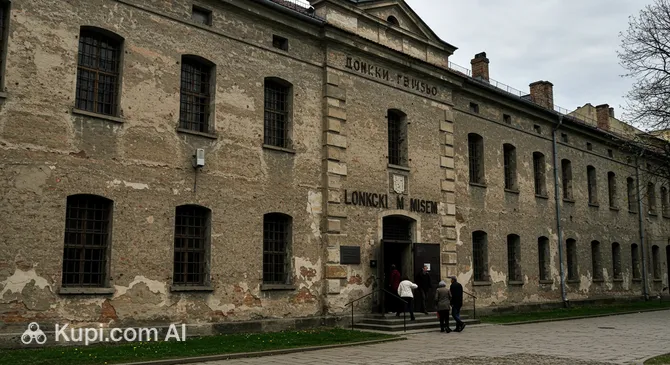
Lonsky Prison National Memorial Museum
Lonsky Prison National Memorial Museum. Иллюстрация. Источник: Kupi.com AI

The museum building, constructed in the late 19th century in the Neo-Renaissance style, originally served the gendarmerie but later became a detention center under several successive regimes. Today, it is the largest memorial complex in the region dedicated to the memory of the victims of occupation systems. The museum functions not only as an exhibition space but also as a serious academic institution engaged in the rehabilitation of historical figures and the study of archives.

Visitors come here to see authentic interiors and connect with the complex history of the region. The museum's atmosphere allows for a deeper understanding of the tragic pages of the past while maintaining respect for the memory of those whose fates were tied to this somber place.

Contacts

For more information about visiting, group tours, or working with the archives, you can use the museum's official contact details.

The National Museum-Memorial “Lonsky Prison” maintains active communication with visitors through its website and by phone.

How to contactContact
AddressStepana Bandery St, 1, L'viv, L'vivs'ka oblast, Ukraine, 79000
Phone+380 94 847 4220
Websitewww.lonckoho.lviv.ua

What to Do

Within the museum walls, visitors can walk through authentic prison corridors and look into the cells where political prisoners were held at various times. Exploring the exhibition allows you to witness firsthand the everyday life and detention conditions that have preserved the atmosphere of past decades. You will be able to study numerous documentary materials, photographs, and artifacts found during research on the territory.

Particular attention should be paid to the rooms that were occupied by the security services of various countries over the years. The museum offers a rare opportunity to see the internal workings of the punitive system of the past. In addition to the internal halls, there is a large memorial cross on the territory of the memorial, installed in 2006, where visitors can pay their respects to the deceased.

For those who want to dive deeper into the context, the museum offers educational programs and access to archival records. This place is ideal for researchers, historians, and tourists seeking a profound understanding of the historical development of the city and the region as a whole.

Getting There

Finding the National Museum-Memorial “Lonsky Prison” is quite easy, as it is located in the central part of the city at 1 Stepana Bandery Street. Thanks to this location, the memorial is easily accessible on foot from most major tourist routes and iconic city squares.

If you prefer public transport, take the trams or buses that pass through the center. You should get off at stops located near Lviv Polytechnic or Ivan Franko Park. The museum is also conveniently reachable by taxi — a ride from the city center will take no more than 5–10 minutes.

For those traveling by private car, parking spaces are available near the museum building. For precise navigation, you can use the GPS coordinates: 49.834389, 24.0185951. The museum is visible from a distance due to its characteristic Neo-Renaissance architecture.

Ближайший город: Lviv

History & Facts

The history of the building began in 1889–1890, when it was erected according to the design of the architect Jozef Kajetan Janowski. Initially, this Neo-Renaissance complex was intended for the Austro-Hungarian gendarmerie; however, in the 20th century, its fate changed dramatically, turning the building into a symbol of political repression.

The prison section was completed between 1918 and 1920, when the city was part of the Second Polish Republic. In the 1930s, it served as a pretrial detention center where, in 1936, prominent historical figures such as Stepan Bandera and Yaroslav Stetsko were held. Over time, the building passed from one authority to another: it housed the structures of the NKVD and, during the occupation years, the Nazi Gestapo.

From 1944 until the collapse of the Soviet Union in 1991, the complex was used by Soviet security agencies. It was only in 2009, thanks to public initiative and the support of the city council, that the museum was officially opened. Today, this academic institution is dedicated to researching archives and preserving the memory of those who passed through these harsh prison walls.

Time Needed

To thoughtfully explore the exhibition of the National Museum-Memorial “Lonsky Prison”, an average visitor typically needs 2 to 3 hours. This site is filled with archival documents and personal stories that require time for reflection.

If you plan to study each display in detail, examine the artifacts in the cells, and read the informational materials, the visit may take half a day. The museum carries a powerful emotional component, so rushing would be inappropriate. It is recommended to plan your visit for the first half of the day to leave time for a walk around the city after the tour.

Working Hours

When planning your visit to the National Museum-Memorial “Lonsky Prison”, it is important to consider the specific operating schedule and the presence of a break. The museum is open to visitors from Tuesday to Friday, as well as on Sunday.

The opening hours on these days are from 10:00 AM to 1:00 PM and from 2:00 PM to 7:00 PM. Please note that Monday and Saturday are closed days when the museum is not open to visitors. A daily one-hour break in the middle of the day allows the staff to prepare the halls for new guests.

DayWorking hours
ПонедельникЗакрыто
Вторник10:00 – 13:00, 2:00 – 19:00
Среда10:00 – 13:00, 2:00 – 19:00
Четверг10:00 – 13:00, 2:00 – 19:00
Пятница10:00 – 13:00, 2:00 – 19:00
СубботаЗакрыто
Воскресенье10:00 – 13:00, 2:00 – 19:00

Nearby

A visit to the memorial museum can be combined with a walk through the surrounding area, which is rich in both historical sites and modern entertainment centers. Exploring this part of the city will allow you to better feel the contrast between the past and the present, as well as take a short break after visiting a serious exhibition.

The following interesting places are within walking distance or a short ride away:

NameDistance
Potocki Palace0.7 km
House of Scientists0.8 km
Dobryi Druh 4 Pub0.9 km
Lviv Oceanarium1 km
Taras Shevchenko Monument1 km
Mykhailo Hrushevskyi Monument1 km
King Danylo Monument1.1 km

Reached the end of the page?

That means the route is fully explored