Support

St. John the Baptist Cathedral, Lublin

About

Among the historic streets for which Lublin is famous, the St. John the Baptist Cathedral rises proudly—a magnificent example of Baroque architecture and the largest church in the city. Built at the turn of the 16th and 17th centuries for the Jesuit Order, this cathedral is one of the most significant religious sites that Poland prides itself on.
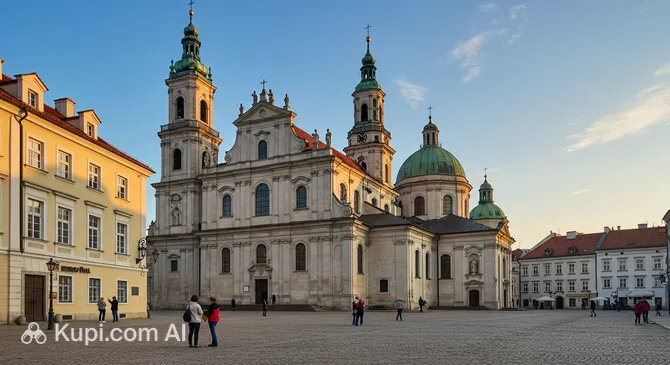
St. John the Baptist Cathedral
St. John the Baptist Cathedral. Иллюстрация. Источник: Kupi.com AI

This majestic single-nave basilica impresses with its austere classical facade and its incredibly rich interior. Inside the cathedral lie true treasures: unique frescoes by Józef Meyer dating back to the 18th century and a monumental ebony main altar decorated with golden statues of saints. The combination of Renaissance elements and lush Baroque creates an atmosphere of solemnity and deep history.

The cathedral occupies a central spot on Cathedral Square and serves as an important cultural landmark in the Old Town. Its popularity among travelers is reflected in its high ratings, while the Trinitarian Tower adjoining the complex serves as a spectacular observation deck, offering breathtaking views of the tiled roofs and historic quarters.

Contacts

For more information regarding upcoming services, concerts, or group tours, you can use the official communication channels. The Cathedral is always open to parishioners and travelers seeking to connect with the region's spiritual heritage.

Below are the current contact details and the exact location of this holy site in the historical city center.

How to contactContact
AddressKrólewska 10, 20-109 Lublin, Poland
Phone+48 81 532 11 96
Websitearchikatedra.kuria.lublin.pl

What to Do

The main reason to step inside the cathedral is to explore the magnificent frescoes. The vibrant paintings by artist Józef Meyer cover the walls and ceiling, depicting biblical scenes with incredible detail. Pay special attention to the 17th-century main altar: its dark wood combined with gilding creates a mystical contrast, especially when sunlight streams through the windows.

Be sure to set aside time to climb the Trinitarian Tower. From its height, you can enjoy one of the best views of the Lublin skyline and the labyrinthine streets of the Old Town. In the square in front of the cathedral, you can admire the architecture of the Neoclassical portico with its massive columns and elegant moldings, which provides a beautiful backdrop for souvenir photos.

The cathedral frequently hosts organ music concerts; the acoustics here are simply stunning, turning a simple listening experience into a deep emotional journey. If you are lucky enough to join a guided tour, the guides will reveal the secrets of hidden paintings in the side chapels, such as "The Last Supper," and share fascinating facts about the restoration of this monument.

Getting There

Finding this architectural masterpiece is easy, as it is located at Królewska 10, in the immediate vicinity of the main gates to the Old Town. If you are arriving from the airport, which is about 10 kilometers away, it is most convenient to take a taxi (the trip takes about 20 minutes) or catch bus No. 19 or 39 to the "Plac Litewski" stop.

From the main railway station, Lublin Główny, which is about 1.5 km away, you can enjoy a 20-minute walk along Lipowa Street. Additionally, trams No. 2 and 4 run from the station, and buses No. 1, 7, 10, and 13 stop near the cathedral. The public transport system here is well-developed, making access to the landmark as simple as possible.

For those already in the Old Town, the walk from the Kraków Gate takes no more than 5 minutes at a leisurely pace. If you are traveling by car, please note that parking is available directly on Cathedral Square, though spaces may be limited on weekends.

Ближайший город: Lublin

History & Facts

The history of this majestic building began on April 20, 1586, when the first stone was laid according to the designs of talented Italian masters Giovanni Maria Bernardoni and Giuseppe Brizio. The land for the construction was generously donated to the Jesuit Order by the Voivode of Kraków, Andrzej Tęczyński. The church was consecrated in 1604, and the entire ensemble, including the adjacent college, was completed by 1625.

The building has faced many trials throughout its existence: in 1752, a devastating fire almost completely destroyed the interior. The restoration was led by Franciszek Koźmiński, and it was during this time that the artist Józef Meyer created the famous frescoes that visitors admire today. After the dissolution of the Jesuit Order, the church briefly served as a warehouse before gaining the status of a cathedral for the new diocese in 1805.

In the 19th century, the cathedral's appearance was modified toward Classicism under the direction of architect Antonio Corazzi. This brought the recognizable six-column portico, which was later replaced by a four-column version with a tympanum. Past historical events left their marks on the facade, including the loss of one of its towers, but thanks to an extensive restoration carried out under the patronage of Cardinal Stefan Wyszyński, the architectural monument was fully restored.

A special date in the cathedral's modern history is 1987. During this year, Pope John Paul II visited the cathedral, a landmark event for both the faithful and the residents of the city, cementing the cathedral's status as a vital spiritual and cultural center of the region.

Time Needed

To leisurely explore the rich interior, examine the detailed frescoes, and feel the grandeur of the main altar, most visitors need between 1 and 2 hours. This is quite sufficient for a thoughtful tour of the main basilica and the side chapels.

If you plan to climb the Trinitarian Tower to enjoy panoramic views of the city or linger in Cathedral Square for a photo session, you should set aside an additional 30-40 minutes. A visit to the cathedral fits perfectly into an Old Town walking itinerary without overcrowding a traveler's schedule.

Working Hours

The doors of the cathedral are open to worshippers and tourists daily from early morning until late evening. From Monday to Saturday, the church is open from 06:30 to 20:00, and on Sunday, visits are possible from 06:00 to 20:00.

Please note that during holiday services or solemn masses, access to view some of the artistic details may be restricted out of respect for those praying. Plan your visit during the intervals between services to fully enjoy the silence and grandeur of the interior.

DayWorking hours
Понедельник6:30 – 20:00
Вторник6:30 – 20:00
Среда6:30 – 20:00
Четверг6:30 – 20:00
Пятница6:30 – 20:00
Суббота6:30 – 20:00
Воскресенье6:00 – 20:00

Nearby

The cathedral's location in the heart of the historic district allows tourists to easily combine their visit with other iconic sites. A walk through the surrounding streets offers the chance to see magnificent architecture from various eras and immerse yourself in the atmosphere of antiquity.

Just a few minutes' walk from Cathedral Square, you will find ancient gates, market squares, and even a medieval castle. Below is a list of nearby attractions that are certainly worth your attention during your visit.

NameDistance
Trinitarian Tower – Archdiocese Museum of Lublin0 km
Lublin Old Town Market Square0.1 km
Lublin Underground Route0.1 km
Kraków Gate0.2 km
Plac po Farze0.2 km
Pelier Bistro0.3 km
Perłowa Beer Hall0.3 km

Reached the end of the page?

That means the route is fully explored