Support

Shoes on the Danube Bank

About

On the Danube embankment in Budapest, the capital of Hungary, sits one of the city's most poignant and moving monuments — Shoes on the Danube Bank. This memorial, installed in 2005, consists of 60 pairs of men's, women's, and children's shoes cast in iron and placed at the very edge of the water. The monument leaves an indelible impression and is one of the most significant Holocaust memorials in the world.
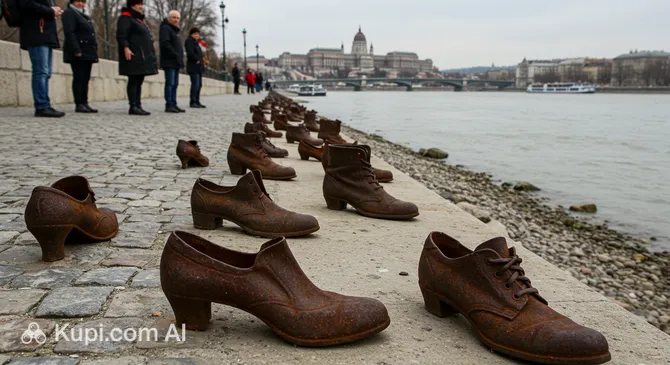
Shoes on the Danube Bank. Illustration.
Source: Kupi.com AI

Traveler photos:

The composition is dedicated to the memory of the thousands of Jews who were shot on the banks of the Danube by members of the Hungarian Arrow Cross fascist party in 1944–1945. Before the execution, the victims were forced to remove their shoes, which were considered valuable during wartime. Behind the row of shoes is a stone bench with memorial plaques in Hungarian, English, and Hebrew, which serve as a reminder of these tragic events.

The concept for the memorial was envisioned by director Can Togay and realized by sculptor Gyula Pauer. Each pair of shoes is a precise replica of 1940s models, created with historical accuracy. The worn-down heels, battered boots, and tiny children's sandals silently tell the tragic stories of their owners. This monument serves as a powerful reminder of past tragedies and the importance of preserving their memory.

Contacts

The Shoes on the Danube Bank memorial is a public open-air monument, so it has no specific contact details, administration, or ticket offices. The monument is located on the Pest embankment of the Danube, near the Hungarian Parliament Building. You can reach it by metro (line M2 to Kossuth Lajos tér station), tram No. 2, or buses No. 15 and 115. For additional tourist information about Budapest, you can contact the city's visitor information centers.

How to contactContact
AddressBudapest, 1054 Hungary

What to Do

A visit to the Shoes on the Danube Bank memorial is an opportunity to connect with history and pay tribute to the victims. While walking along the shore, visitors can examine each of the cast-iron pairs of shoes in detail. There are men’s boots, women’s shoes, and very small children’s sandals, each pair with its own unique, worn look, making the monument even more touching.

There is a bench on the embankment where you can sit to reflect in silence and read the memorial plaques in three languages. This is a place for quiet contemplation. Many visitors follow a long-standing tradition by leaving flowers or small stones at the monument, or lighting candles as a sign of remembrance and grief.

The memorial looks particularly striking at sunset, when the rays of the setting sun reflect off the metal shoes and the waters of the Danube. This time is also a great opportunity for photography, allowing you to capture one of the most famous and evocative monuments in Budapest. From the memorial’s location, there is also a picturesque view of the river and the opposite side of the city.

Getting There

The Shoes on the Danube Bank memorial is located in the heart of Budapest, on the Pest side, right at the water's edge. Its location is very convenient for tourists — the monument is just a few hundred meters from the majestic Hungarian Parliament Building. This makes it an easily accessible stop on a walking route through the city center.

The memorial is easy to reach by public transport. The nearest metro station is Kossuth Lajos tér (line M2), from which the embankment is just a 5–10 minute walk. Another scenic way is to take trams No. 2 or No. 2A, which run directly along the Danube, allowing you to enjoy the views during the trip. Buses No. 15 and 115 also stop near Kossuth Lajos Square, which is adjacent to the monument.

If you prefer to take a taxi, simply tell the driver your destination is the Danube Embankment (Dunakorzó) near the Parliament. The monument is situated between two famous bridges — Margaret Bridge and the Széchenyi Chain Bridge — so it is almost impossible to miss while exploring the historic part of Budapest.

Nearest city: Budapest

History & Facts

The Shoes on the Danube Bank memorial was unveiled on April 16, 2005, a date chosen for its profound significance. It coincides with International Holocaust Remembrance Day and was timed to the 60th anniversary of the end of World War II. This choice highlighted the monument's international importance as a symbol of grief and an eternal reminder of the tragic events of the past.

The creation of this poignant memorial involved meticulous work. The idea came from film director Can Togay, who conducted extensive research to recreate the details of that era with historical accuracy. Sculptor Gyula Pauer brought the vision to life, focusing on authenticity. Instead of casting abstract shoes, he worked from actual 1940s photographs and shoe models worn in Hungary at the time. Each pair is a precise replica, giving the composition striking realism.

It is this level of detail that gives the monument its unique emotional power. Among the 60 pairs of cast-iron shoes, no two are the same: you can see worn-out women's heels, battered men's boots, and tiny children's sandals. The individuality of each pair prompts visitors to reflect on the personal stories and fates of those whose lives were cut short on the banks of the Danube in Budapest. This artistic approach transforms the memorial from a simple monument into a silent but incredibly powerful narrative of lost lives.

Time Needed

A visit to the Shoes on the Danube Bank memorial won't take much time, but it will undoubtedly leave a lasting impression. 15 to 30 minutes is usually enough for a brief viewing and to learn about its history. During this time, you can closely examine the 60 pairs of cast-iron shoes, read the memorial plaques in three languages, and take a few commemorative photos. This is sufficient to form a general impression of one of the most poignant monuments in Budapest.

If you want to more deeply absorb the atmosphere of this place, it’s worth setting aside a bit more time. Many visitors come here specifically in the evening when the memorial is illuminated, creating a special environment conducive to reflection. By allowing yourself to linger, you can truly feel the power of this monument, perhaps sitting on a bench in silence to pay tribute to the victims of the tragic events.

Working Hours

The Shoes on the Danube Bank memorial is an open-air monument, so it has no official opening hours. It is accessible to everyone 24/7, year-round. Visiting the memorial is completely free, so there is no need to purchase tickets or book a visit in advance.

While the memorial is accessible 24/7, it is recommended to visit during daylight hours for the best views and photographs. A particularly poignant atmosphere is created at sunset when the city lights begin to flicker on. In the evening, the memorial is illuminated, which adds an extra emotional layer and allows for a deeper experience of the site.

Open 24 hours

Nearby

After visiting such an emotionally powerful site as the Shoes on the Danube Bank, a walk through the surrounding area can help you decompress while discovering more of Budapest. The memorial is located in the heart of the city, surrounded by many other iconic landmarks, making it an ideal starting point for further exploration of the capital of Hungary.

Just a few steps from the embankment, you will find world-famous architectural masterpieces, historic squares, and picturesque bridges. Exploring these sites will provide a more complete picture of the city's rich history and culture, complementing the deep impressions left by the memorial.

NameDistance
Hungarian Parliament Building0.4 km
Kossuth Lajos Square0.4 km
Cookie Beacon Brunch0.6 km
Fisherman's Bastion0.8 km
Budapest Eye0.8 km
Buda Castle0.9 km
Vörösmarty Square0.9 km

Have you reached the end of the page?

So the route has been studied inside and out