Support

Wroclaw Market Square

About

Wrocław Market Square (Rynek we Wrocławiu) is the historical and cultural heart of Wrocław, a living testimony to its centuries-old history. Founded in the 13th century, it still impresses today with its scale, being one of the largest medieval market squares in Europe. It is not just a landmark but the central part of a pedestrian zone where the past is harmoniously interwoven with the present.
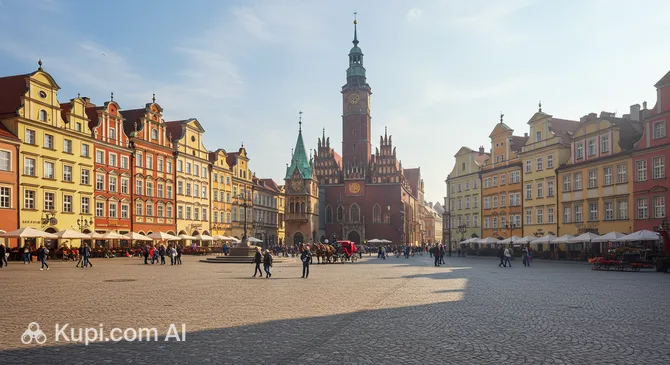
Wroclaw Market Square. Illustration.
Source: Kupi.com AI

Traveler photos:

The architectural jewel of the square is its unique central block. Two town halls are located here—the Gothic Old Town Hall and the later New Town Hall—which are considered the largest in Poland. They are surrounded by rows of colorful old houses known as "kamienice." Every building here has its own story and unique appearance, creating a singular architectural ensemble that was carefully restored after the Second World War.

Today, the Market Square is a magnet for both locals and tourists. Ten streets lead to this bustling space filled with a festive atmosphere. You can spend hours walking here, admiring the architecture, relaxing in one of the many cafes, listening to street musicians, or simply watching the city life. Nearby are other interesting sites, such as Salt Square (Plac Solny), making this place an ideal starting point for exploring Wrocław.

Contacts

Wrocław Market Square is a public space and the heart of the Old Town; therefore, it is accessible 24/7 and does not have a single central contact point for tourists. Getting there is very easy, as it is located in the central pedestrian zone of Wrocław. Eleven streets lead to the square, and the nearest public transport stop is simply called "Rynek," which can be reached, for example, by tram.

How to contactContact
AddressRynek, 11-400 Wrocław, Poland

What to Do

At the Wrocław Market Square, everyone will find something to enjoy. The main activity here is, of course, getting to know the magnificent architecture. Guests can spend hours examining the facades of old buildings representing a mix of styles from Gothic to Renaissance. Special attention should be paid to the two town halls: the Old Town Hall, which is a masterpiece of Gothic architecture and a symbol of the city, and the New Town Hall. The latter still houses the Mayor's office and hosts city council meetings today.

To dive deeper into the historical atmosphere, take a leisurely stroll through the small streets adjacent to the square. Among them are Przejście Garncarskie (Pottery Pass), Przejście Żelazne (Iron Pass), and Sukiennice Street, as well as the small but cozy Jerzy Grotowski cul-de-sac. These spots allow you to feel the spirit of an old European city and take wonderful photographs. Additionally, the square is a hub of cultural life: street musicians and performers often play here, creating a unique festive atmosphere.

Beyond architectural beauty, one of the most exciting activities is hunting for the famous Wrocław dwarfs (krasnale). These small bronze figures are scattered throughout the city center, and many can be found right on the Market Square. Searching for them turns into a real quest for both children and adults. After a busy walk, you can relax in one of the many cafes or restaurants located directly on the square, enjoying the views and the lively urban life.

Getting There

Getting to Wrocław Market Square is easy, as it is situated in the very heart of the Old Town and serves as the center of the pedestrian zone. Thanks to this location, the square is a perfect destination for a walk. If you are arriving in Wrocław by train, you can walk from the main railway station (Wrocław Główny) to the square in about 15–20 minutes, covering a distance of approximately two kilometers. The walk allows you to immediately immerse yourself in the city's atmosphere and see its picturesque streets.

For those who prefer public transport, there are many convenient routes. Several tram and bus stops are located in the immediate vicinity of the Market Square. The nearest stop is called Rynek, and it can be reached via tram lines 15 or 24. Large transport hubs like Galeria Dominikańska and Świdnicka are also nearby, through which most city routes pass, making it easy to reach the center from almost any part of Wrocław. From there, the square is just a few minutes' walk away.

If you are traveling by car, it is important to remember that the Market Square itself is a pedestrian zone, and vehicle entry is prohibited. The best solution is to leave your car in one of the paid parking lots located around the Old Town. Both street parking zones (paid) and multi-level or underground parking garages, such as those at the National Forum of Music or on neighboring streets, are within walking distance. After parking your car, you can enjoy a leisurely stroll to the city's main attraction.

Nearest city: Wroclaw

History & Facts

The history of Wrocław Market Square dates back to the 13th century. It was founded between 1214 and 1232 by decree of the Polish Prince Henry I the Bearded, in accordance with Magdeburg Rights, which defined urban self-governance. From the very beginning, the square became the center of social and commercial life in the medieval city. A unique feature was the development of its central part, where the Town Hall and commercial buildings were located, forming a kind of "island" within the square.

Over the centuries, the architectural appearance of the square changed constantly, reflecting the city's history and prosperity. Initially, Gothic features predominated, but by the 16th century, elegant Renaissance forms began to appear. Radical changes occurred in the 19th century when Wrocław became a major industrial center. In 1821, a decision was made to demolish the old cloth halls, which fundamentally altered the central part of the square and gave it a more formal and administrative character.

The tragic events of the 20th century did not spare the Market Square. It was seriously damaged during the Second World War, particularly in its final stages in 1945. However, thanks to extensive and meticulous restoration work, this unique architectural ensemble was rebuilt, returning the historical heart to the city. In recognition of its immense cultural and historical value, the square was officially added to Poland's register of cultural heritage sites in 1962 and 1977.

Time Needed

When planning a visit to Wrocław Market Square, it is worth setting aside two to three hours for exploration. This will be enough time to leisurely walk around the perimeter, admire its scale, take photos of the famous Gothic Old Town Hall and the bright, gingerbread-like tenement houses (kamienice). During this time, you will be able to feel the vibrant atmosphere of the place, listen to street musicians, and, of course, find several of the famous Wrocław dwarfs hiding in the most unexpected corners.

If you want to delve deeper into history and culture, your visit could easily take half a day or even more. For example, the Museum of Bourgeois Art is located inside the Old Town Hall, and exploring its exhibits will take at least an hour. An exciting "hunt" for the bronze dwarfs can also take extra time, turning your walk into a fun quest. Additionally, the Market Square is a perfect place for a gastronomic break: lunch or dinner in one of the many restaurants overlooking the historical buildings will add another couple of hours to your stay.

Ultimately, the length of your stay on the square depends on your travel style. It can be used as a starting point for further exploration of Wrocław by spending about an hour there, or it can be the central event of your day. Thanks to its location, you will likely return here again and again, discovering something new in the architectural details or the lively atmosphere of the heart of Poland.

Working Hours

Since Wrocław Market Square is an open public space, it is accessible for visiting at any time of day or night, all year round. No tickets or reservations are required for walking around the square itself; entry is absolutely free. You can come here early in the morning to enjoy the quiet and take photos without the tourist crowds, or dive into the lively atmosphere in the evening when the lights come on and numerous restaurants open. The square is beautiful in any season, but it becomes especially magical in winter during the famous Christmas Market.

It is important to remember that while the square itself is open 24/7, the establishments located on it—museums, restaurants, souvenir shops, and cafes—operate on their own schedules. For example, to visit the Museum of Bourgeois Art, located in the Old Town Hall, you will need to check its opening hours and possibly purchase a ticket. Therefore, if you are planning a visit to a specific place on the square, it is highly recommended to check the current information on opening times and visiting conditions in advance on the official website or at the tourist information centers of Wrocław.

Open 24 hours

Nearby

A visit to Wrocław Market Square is just the beginning of a fascinating journey through the city's historical center. The area surrounding the square is a true labyrinth of picturesque streets, each holding its own secrets and ready to surprise travelers. A walk through the adjacent quarters allows you to dive deeper into the atmosphere of old Wrocław and feel its unique character.

Many iconic sites and hidden gems of the city are just a few steps away from the Market Square, making it an ideal starting point for exploration. From medieval churches and museums to cozy cafes and unusual monuments—all the most interesting spots are within walking distance. Below is a list of nearby attractions that will help enrich your impressions of the city.

NameDistance
Wroclaw Old Town Hall0.1 km
Museum of Bourgeois Art0.1 km
Three Broomsticks Pub0.2 km
Konspira0.2 km
New Horizons Cinema0.3 km
Pixel XL0.4 km
Museum of Illusions Wroclaw0.8 km

Have you reached the end of the page?

So the route has been studied inside and out