Support

Ephesus Archaeological Site

About

The Ephesus Archaeological Complex is one of the most significant and excellently preserved ancient cities of the Mediterranean, located near the modern town of Selçuk in Turkey. This ancient metropolis, once a thriving center of Greek and Roman civilizations, is today an impressive open-air museum. Since 2015, Ephesus has been rightfully included in the UNESCO World Heritage list, attracting researchers and tourists from all over the world with its rich history and unique atmosphere.
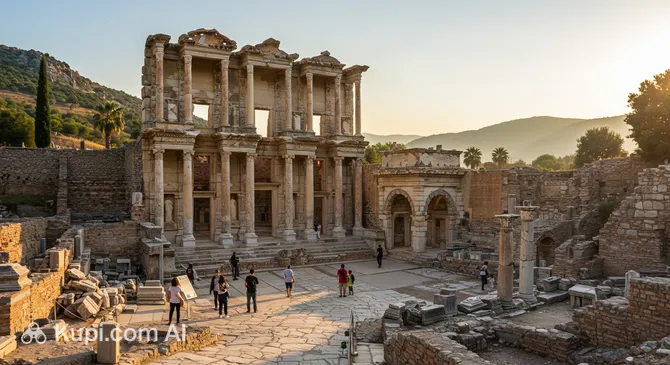
Ephesus Archaeological Site. Illustration.
Source: Kupi.com AI

Traveler photos:

The complex covers about 8 square kilometers and holds countless treasures of the past. Visitors can walk along ancient paved streets, see the ruins of grand theaters, temples, public baths (thermae), and residential houses that provide a glimpse into the daily lives of its inhabitants. Among the most famous structures are the legendary Library of Celsus, whose facade is one of the symbols of Ephesus, and the remains of the Temple of Artemis, once one of the Seven Wonders of the Ancient World.

A visit to Ephesus is not just an excursion, but a true immersion in history. Here, every stone breathes antiquity, and the scale and preservation of the ruins allow you to visualize the former greatness of this city. It is a must-visit for anyone interested in ancient culture, architecture, and archaeology, who wishes to touch the legacy of great civilizations.

Contacts

As the Ephesus Archaeological Complex is an extensive open-air historical site, direct phone contacts are generally unavailable. It is recommended to check the official tourism websites of Turkey or refer to the information boards at the complex entrance for up-to-date information on opening hours, ticket prices, and available tours.

The most convenient way to reach Ephesus is from the nearby town of Selçuk, which is located just a few kilometers away. You can use local minibuses (dolmush), take a taxi, or join an organized excursion.

How to contactContact
AddressAtatürk, Efes Harabeleri, 35920 Selçuk/İzmir, Türkiye
Phone number+90 232 892 60 10
Websitemuze.gov.tr

What to Do

A visit to the Ephesus Archaeological Complex is a true journey through time. You can walk along ancient streets paved with marble, feeling thousands of years of history beneath your feet. One of the main highlights is the excellently preserved Great Theatre, capable of seating up to 25,000 spectators. Imagine the spectacles that once unfolded in its arena! Equally impressive is the facade of the Library of Celsus, a symbol of Ephesus and a masterpiece of Roman architecture. Walk along the Marble Road, which once connected the port to the city center, and explore the ruins of ancient baths and noble houses, gaining an insight into the luxury and lifestyle of that era.

Of particular interest are the Terrace Houses of wealthy Ephesians, where you can see stunning frescoes and mosaics that tell stories of the daily lives and beliefs of ancient residents. These detailed images provide a unique opportunity to peek into the past. On the grounds of the complex, you will also find the ruins of the legendary Temple of Artemis, one of the Seven Wonders of the Ancient World; although little remains of its former grandeur, the site itself possesses a special energy. Nearby, you can also explore the ruins of the Basilica of St. John, an important Christian pilgrimage center.

In addition to independent exploration, themed guided tours are often held within Ephesus, which help to provide a deeper understanding of the history and significance of each site. It is an ideal place for history and archaeology enthusiasts, as well as for those looking to take unforgettable photos against the backdrop of ancient settings. Occasionally, cultural events are held here, adding even more charm to the site and allowing you to feel its living connection to the present.

Getting There

The easiest way to reach the Ephesus Archaeological Complex is from the town of Selçuk, located just a few kilometers from the ancient ruins. Taking a taxi from Selçuk to Ephesus is the fastest option. Local minibuses (dolmush) also run regularly and will drop you off right at the entrance to the archaeological zone. For those who enjoy walking, the distance from the center of Selçuk to Ephesus is quite manageable on foot, taking about 30-40 minutes and allowing you to enjoy the surrounding scenery.

The town of Selçuk itself serves as a convenient transportation hub. It is connected by regular bus and train services to Izmir—one of the largest cities on Turkey's Aegean coast and a major transport hub. If you are arriving at Izmir International Airport (Adnan Menderes Airport), you can easily reach Selçuk by train or bus. Trains usually run several times a day, offering a comfortable and scenic route.

Additionally, for tourists staying in popular resorts like Kusadasi or Izmir itself, there are many offers for organized guided tours to Ephesus. This is a convenient option that includes transfers and often the services of a guide. If you prefer independent travel and plan to rent a car, the Ephesus Archaeological Complex provides parking on-site, making this mode of transport very comfortable as well.

Nearest city: Selcuk

History & Facts

The history of the Ephesus Archaeological Complex is rooted in deep antiquity. Researchers believe the first settlements in this area appeared as early as the Neolithic era, around 6000 BC. Later, in the 10th–11th centuries BC, Ionians founded a city here that eventually became one of the twelve cities of the Ionian League during the Classical Greek period. Ephesus was rebuilt and expanded many times, but it reached its peak of power and prosperity during the Roman era, becoming one of the largest and wealthiest cities of the Roman Empire in the East.

For many centuries, Ephesus played a key role as an important commercial, cultural, and religious center of the ancient world. Its strategic location at the crossroads of sea and land routes fostered active trade and cultural exchange. The city gained particular fame from the grand Temple of Artemis at Ephesus, recognized as one of the Seven Wonders of the Ancient World. This majestic temple attracted pilgrims from all over the Mediterranean, making Ephesus not only economically significant but also one of the primary spiritual centers of its time.

However, like many great cities of the past, Ephesus eventually began to lose its former glory. It is believed that one of the significant reasons for its decline was the gradual silting of its once-busy harbor by the Kaystros (Little Maeander) River, which severely hindered maritime trade. During late antiquity and the Middle Ages, the city steadily lost its importance. By the 15th century, the once-thriving metropolis was finally abandoned by its inhabitants. It was only in the 19th century that large-scale archaeological excavations, initiated by European researchers, began here. These excavations continue actively to this day, revealing new treasures and secrets of ancient Ephesus and allowing us to touch its incredible history.

Time Needed

When planning a visit to the Ephesus Archaeological Complex, it is worth setting aside enough time to fully enjoy this unique site. For a general overview of the main attractions, such as the Library of Celsus, the Great Theatre, and the ancient streets, most visitors will need at least 3-4 hours. This will allow for a leisurely stroll through the grounds, time to take photos, and a chance to soak in the atmosphere of the ancient city.

If you are a big fan of history and archaeology, or simply want to explore every corner of Ephesus in more detail—including the Terrace Houses with their stunning mosaics and the nearby museums—it is better to plan for half a day or even a full day. This approach will provide the opportunity to see all the sites of interest without rushing, perhaps use the services of a guide or an audio guide, and dive deeper into the rich history of this ancient metropolis.

Working Hours

The Ephesus Archaeological Complex is generally open to visitors daily, making it possible to plan a visit at any time of year. Standard operating hours usually vary depending on the season: in summer, the complex typically operates from 08:00 to 18:30, and in winter, from 08:00 to 17:00. These timeframes provide ample opportunity to explore the ancient city.

However, it is very important to remember that opening hours may change due to public holidays, special events, or seasonal adjustments. Therefore, to avoid unpleasant surprises, it is highly recommended to check the current schedule on the official website of the landmark or at local tourist information centers before your trip. There, you can also find out if advance ticket booking is required, especially during the peak tourist season.

8:00 – 17:30

Nearby

Visiting such a significant landmark as the Ephesus Archaeological Complex is an unforgettable experience in itself. However, to truly immerse yourself in the atmosphere of this historical site and broaden your horizons, it is worth exploring what lies nearby. Studying the surroundings often reveals new facets of history and culture, complementing your main impressions and providing a more complete picture of the region.

There are many other interesting sites in the vicinity of the Ephesus Archaeological Complex in the town of Selçuk that deserve attention. They will help you better understand the scale and significance of the ancient city and see other important monuments of history and architecture. Below is a list of some of them, along with the approximate distance from the Ephesus Archaeological Complex.

NameDistance
Odeon of Ephesus0.2 km
Hercules Gate0.3 km
House of the Virgin Mary0.5 km
Library of Celsus0.6 km
Ephesus0.7 km
Ephesus Theatre0.7 km
Church of Mary1.2 km

Have you reached the end of the page?

So the route has been studied inside and out