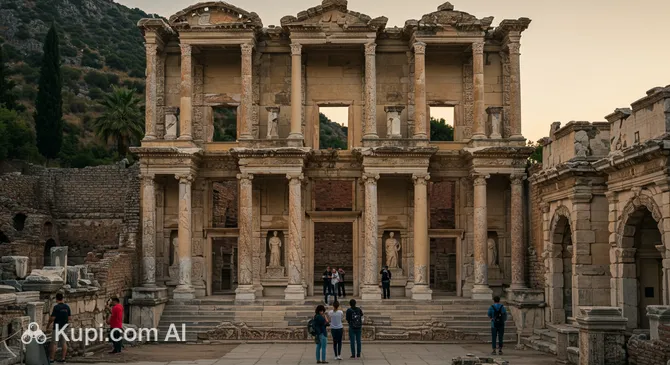
The Library of Celsus is not just ancient ruins but a true portal to the world of ancient knowledge, located within the ancient city of Ephesus, very close to the modern town of Selçuk in Turkey. It is one of the most impressive and superbly preserved examples of Roman architecture, serving as a prominent historical site and a symbol of the enlightenment of its era. A visit to this place allows you to touch the greatness of the past and imagine Ephesus in its heyday.
Traveler photos:
Built in the 2nd century AD, roughly between 114 and 135 AD, the library was erected in honor of Tiberius Julius Celsus Polemaeanus, a former Roman proconsul of the Province of Asia. The construction was initiated by his son, Gaius Julius Aquila, who wanted to immortalize his father's memory and gift the city an important cultural and educational center. The library's facade, decorated with elaborate columns and niches with statues symbolizing Wisdom (Sophia), Virtue (Arete), Thought (Ennoia), and Knowledge (Episteme), still impresses today with its elegance and monumentality.
The uniqueness of the Library of Celsus lies not only in its architectural splendor and presumably rich collection of thousands of scrolls. This structure also performed another function, quite rare for libraries of that time: beneath the central part of the building, in a specially constructed crypt, lay the sarcophagus containing the remains of Celsus himself. Such an honor—to be buried within the city limits, and in such a significant public building—was exceptional and underscored his high status and immense contributions to Ephesus.