Support

Fort Monroe National Monument

About

Fort Monroe National Monument is an outstanding historical fortification located on the scenic Old Point Comfort, near the mouth of the Hampton Roads waterway in Norfolk, Virginia, USA. This massive stone fort was strategically built to protect the vital navigation channel connecting Hampton Roads to inland waterways and played a key role in the region's maritime defense for many years.
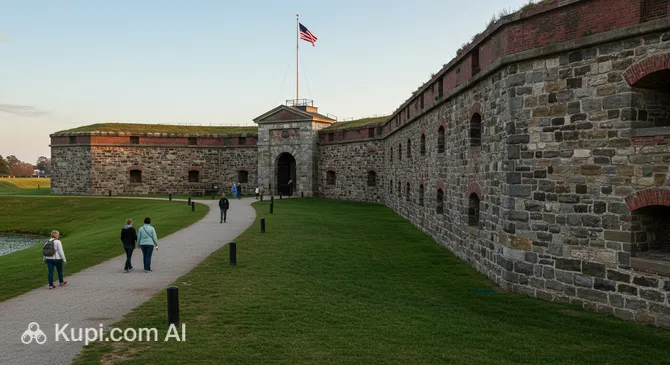
Fort Monroe National Monument. Illustration.
Source: Kupi.com AI

Traveler photos:

Thanks to its rich historical and cultural heritage, Fort Monroe has received well-deserved recognition. In 1960, it was designated a National Historic Landmark and listed on the U.S. National Register of Historic Places. Visitors can explore its massive walls, bastions, and interior buildings, immersing themselves in the atmosphere of the past and learning about the significant events this fort witnessed.

Fort Monroe gained particular fame as "Freedom's Fortress." During the American Civil War, it became a symbol of hope and a haven for many escaped slaves seeking freedom. This aspect of its history gives the site deep humanistic meaning and makes a visit especially educational for those interested in American history and the struggle for civil rights. Today, the fort attracts tourists with its unique architecture, breathtaking views, and the opportunity to experience important chapters of the past.

Contacts

To find the most up-to-date information on opening hours, special events, and visiting policies for Fort Monroe National Monument, it is highly recommended to consult official sources. This will help you plan your visit effectively and avoid any potential inconvenience.

Contact information and further details can be found here:

How to contactContact
AddressFort Monroe, VA 23651, USA
Phone number+1 757-722-3678
Websitewww.nps.gov

What to Do

Fort Monroe National Monument offers visitors a unique opportunity to immerse themselves in the rich history of the United States. The main draw is the fort itself with its impressive fortifications available for exploration. Inside the fort is the Casemate Museum, where exhibits detail the various stages of the site's history. Special attention is given to the fort's role during the Civil War, as well as the period when the former Confederate President was held here after the war's conclusion.

Beyond historical heritage, Fort Monroe offers many opportunities for active and cultural recreation. Fitness enthusiasts will appreciate the beach and tennis courts. The scenic surroundings are perfect for leisurely walks, during which you can admire the architecture and breathtaking bay views.

For those who prefer a quieter pace, there are two libraries on-site for a peaceful reading break. There is also a cinema showing modern films, adding variety to your visit to this historical site. Thus, Fort Monroe offers activities for every taste, combining historical education with diverse leisure options.

Getting There

Fort Monroe National Monument is located in close proximity to the city of Norfolk, Virginia. The most convenient way to reach this historic landmark is by car. You can follow the road signs leading directly to Fort Monroe or use a GPS navigator to plot your route by setting the fort itself as your destination.

If you are planning to travel by public transport, you can also reach the fort from Norfolk. However, keep in mind that this option may take more time compared to driving. Before your trip, it is strongly recommended to check current routes and schedules for buses or other available public transportation heading toward Fort Monroe. This will help you plan your journey more efficiently.

Nearest city: Norfolk

History & Facts

The history of Fort Monroe National Monument dates back to the very beginning of the colonial era in North America. As early as 1607, English colonists landing at Old Point Comfort recognized the strategic importance of this site. Captain John Smith, a key figure in early American history, described it as "an island fit for a castle." By 1609, fearing attacks from the Spanish or the Powhatan Confederacy, the colonists built the first fortification here — Fort Algernon. By 1614, this fort was armed with seven cannons and garrisoned by 50 men, though it was decommissioned and abandoned by 1622.

Attempts to fortify Old Point Comfort continued. In 1632, a new defensive structure was built, though its name has unfortunately been lost to history. It remained until 1665 before being abandoned, and two years later, in 1667, a powerful hurricane finally destroyed its remains. The construction of the modern Fort Monroe as we know it today began much later, in 1819, with the main work completed by 1834. This monumental structure has witnessed many key events in American history.

Fort Monroe played a special role during the American Civil War. It remained under Union control throughout the conflict and earned the symbolic name "Freedom's Fortress." Escaped slaves flocked here seeking refuge and liberation, giving the fort a unique status. Notably, it was in this very area that the first enslaved Africans were brought in the early 17th century. After the Civil War, the fort also made history as the place where the President of the Confederate States of America was imprisoned, highlighting its significance during pivotal moments for the country.

Time Needed

When planning a visit to Fort Monroe National Monument near Norfolk, you should expect the tour to take 2 to 4 hours. This is generally enough time to explore the fort's main historical sites, including its impressive walls and bastions, and to visit the Casemate Museum, which tells the rich story of the location.

This timeframe also includes a leisurely walk through the fort's extensive grounds, allowing you to appreciate its scale and architectural features. If you wish to combine the cultural program with relaxation on one of the nearby beaches or use the available sports facilities, you should set aside additional time. Thus, the duration of your visit will depend on how deeply you wish to dive into history and your leisure plans.

Working Hours

When planning a visit to Fort Monroe National Monument, it is important to check the current operating hours in advance. Typically, historical sites like this may have seasonal schedules or specific hours for certain exhibits. We recommend checking the official Fort Monroe National Monument website or contacting the information center for the latest updates on opening times and potential changes.

There is currently no information available regarding whether Fort Monroe is open year-round or only during certain seasons, or if advance ticket booking is required. Popular attractions often require pre-registration, especially for group tours or special events. Therefore, to ensure your visit goes smoothly, we strongly suggest verifying these details on official resources before your trip.

5:00 – 12:00

Nearby

A visit to Fort Monroe National Monument is an opportunity to touch the rich history of the USA. However, to make your trip to Norfolk even more fulfilling and memorable, it is worth exploring nearby attractions. Discovering the surroundings will allow you to dive deeper into the region's atmosphere, find interesting new spots, and gain a more complete understanding of its culture and heritage.

There are several notable sites near Fort Monroe National Monument that can complement your excursion. Below is a list of some of them, including distances.

NameDistance
Casemate Museum at Fort Monroe0.3 km
Outlook Beach0.6 km
Convocation Center2.7 km
Emancipation Oak2.9 km
Virginia Air & Space Science Center3.9 km
Buckroe Beach and Park4.3 km
Buckroe Beach4.5 km

Have you reached the end of the page?

So the route has been studied inside and out