Support

Duijiangyan

About

Dujiangyan is an amazing city with a rich history and a unique atmosphere, located in Sichuan Province in southwest China. The city is known worldwide primarily for its ancient irrigation system, a true marvel of engineering that has been successfully operating for over two millennia and playing a key role in the life of the region.
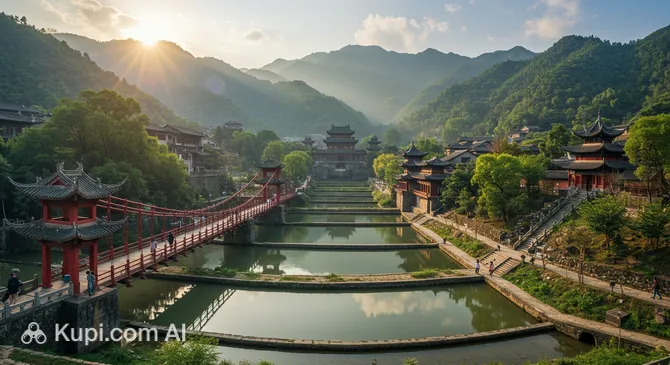
Duijiangyan. Illustration.
Source: Kupi.com AI

The city is nestled at the foot of picturesque mountains, giving it not only breathtaking scenery but also a pleasant, humid subtropical monsoon climate. Dujiangyan attracts travelers not only with its outstanding historical monuments but also with its special, calm, and peaceful aura, which sets it apart from noisy metropolises.
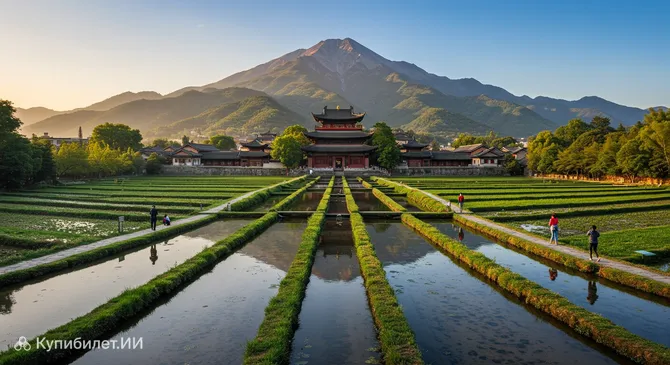
Dujiangyan

The main pride and magnet for tourists in Dujiangyan is undoubtedly the Dujiangyan Irrigation System. This UNESCO World Heritage site, built in the 3rd century BC, still effectively performs its functions, irrigating the vast agricultural lands of the Sichuan Basin. An equally significant attraction is Mount Qingcheng, also included in the UNESCO World Heritage list. This sacred mountain is considered one of the birthplaces of Taoism and offers visitors not only spiritual enrichment but also magnificent panoramic views and secluded paths for meditative walks.

Furthermore, Dujiangyan is famous for its proximity to giant panda conservation and research centers, making it an excellent choice for those who dream of getting to know these charming and rare animals better. A trip to Dujiangyan is a unique opportunity to combine immersion in ancient history and culture with enjoyment of natural beauty and, perhaps, a meeting with the symbol of China – the giant panda. This city will certainly leave bright and warm impressions in your memory.

You can find more interesting facts on the history of Dujiangyan page
Weather Overview

When planning a trip to Dujiangyan, it is worth considering the features of the local climate. Summer here is generally warm and quite humid. In the hottest months, July and August, the average temperature stays around +22°C, with daytime highs potentially reaching +25°C. This period is also characterized by the highest amount of precipitation. Winters in Dujiangyan are cool: the average January temperature is about +2°C, and night frosts are not uncommon. Although the total amount of precipitation in winter is small, the city typically sees a large number of overcast days with light rain or drizzle throughout the year. Spring and autumn offer more moderate temperatures and can be a comfortable time to visit.

To get a more detailed idea of the weather conditions, you can study the Dujiangyan climate by month.

Average monthly temperature

Average monthly precipitation

Interesting Facts

In addition to its world-famous attractions, Dujiangyan hides many amazing stories and little-known details that make it even more alluring for curious travelers. Here are just a few interesting facts about this unique city in China:

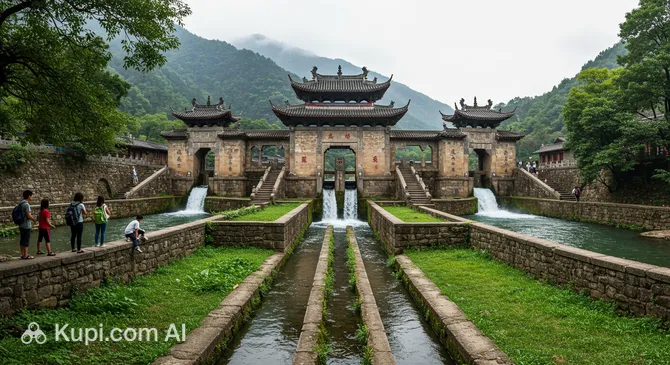
Dujiangyan Irrigation System. Illustration.
Source: Kupi.com AI

Traveler photos:

  • Did you know that the famous Dujiangyan Irrigation System is not just ancient, but is the oldest functioning irrigation system in the world built without the use of a dam? It has been successfully operating for over 2,270 years, splitting the Minjiang River into two streams and preventing floods while simultaneously irrigating vast areas.

  • Dujiangyan is not just about history; it is also an important center for giant panda conservation. Several breeding and research bases for these charming animals are located near the city, such as the Dujiangyan Panda Base, which specializes in caring for elderly and sick pandas, as well as rehabilitating rescued animals.

  • The creator of the irrigation system, Governor Li Bing, and his son are revered in Dujiangyan almost like deities. In their honor, the Two Kings Temple (Erwang Temple) was erected on the riverbank, where locals and tourists still pay tribute to their engineering genius and the labor that secured the region's prosperity for millennia.

  • The city of Dujiangyan and the surrounding Sichuan Basin are often referred to as the "Land of Abundance" (Tian Fu Zhi Guo). This nickname arose largely due to the success of the irrigation system, which transformed lands once prone to drought and flooding into one of the most fertile regions in China.

How to Get There

You can reach the city of Dujiangyan in several ways; however, the most common option for international and many domestic travelers is to fly to one of the major airports in neighboring Chengdu, and then continue the journey by ground transport. There is also an option to use rail services, although direct long-distance lines to Dujiangyan itself may be limited.

Dujiangyan does not have its own airport. The nearest and most convenient for most tourists is Chengdu Shuangliu International Airport (CTU). This is a very large international aviation hub located in Chengdu, approximately 54 km from Dujiangyan. A taxi ride from Chengdu Shuangliu Airport to the center of Dujiangyan will take approximately 1.5-2 hours. The airport serves many domestic and international flights.

Another major option is the new Chengdu Tianfu International Airport (TFU), also located in Chengdu. It is further away, about 107 km from Dujiangyan, and is one of the region's largest transport hubs. A taxi journey from Chengdu Tianfu Airport to Dujiangyan can take about 3 hours. From both Chengdu airports, Dujiangyan can also be reached by shuttle buses or a rental car, providing more flexibility in itinerary planning.

For convenience, here is summary information on the airports serving the Dujiangyan direction:

AirportPassenger trafficDistance
Chengdu Shuangliu International Airport30.1 mln54 km
Chengdu Tianfu54.9 mln107 km
Mianyang Nanjiao Airport3.1 mln115 km
Kangding Airport25 417205 km
Jiuzhai Huanglong Airport239 889207 km

Regarding rail connections, Dujiangyan might not have a major hub station receiving long-distance trains from all regions of China. However, you can consider arriving at one of the stations in neighboring cities. For example, Neijiang North Railway Station is located in Neijiang, about 205 km from Dujiangyan. This is a station with medium passenger traffic. From here, an additional transfer by bus or taxi to Dujiangyan is required, which can take over 5 hours. Therefore, such a route is worth planning only if it is part of a longer rail journey. It is recommended to check schedules and the availability of convenient local transport connections in advance.

Below is information about a railway station that can be considered for a trip to Dujiangyan:

StationPassenger trafficDistance
Neijiang North Railway Station2.2 mln205 km

Main Attractions

Dujiangyan, a city with a rich history and culture, offers travelers many fascinating places to visit. Among them are several key attractions that you should definitely include in your itinerary to fully experience the spirit of this amazing corner of China.

The crown jewel of the city is undoubtedly the Dujiangyan Irrigation System. This ancient engineering masterpiece, a UNESCO World Heritage site, was created more than two millennia ago, in the 3rd century BC. The uniqueness of the system lies in its ability to effectively control the water flows of the Minjiang River, preventing floods and irrigating the vast agricultural lands of the Sichuan Basin, all without a single dam! A visit to this site allows you not only to admire the genius of ancient engineers but also to enjoy picturesque views and learn about the centuries-old history of the region.

Dujiangyan Irrigation System. Illustration.
Source: Kupi.com AI

Traveler photos:

Not far from the irrigation system rises Mount Qingcheng, another UNESCO World Heritage site. This sacred mountain is considered one of the birthplaces of Taoism and is enveloped in an atmosphere of peace and spirituality. Travelers will find scenic trails leading through dense bamboo groves to ancient Taoist temples and pavilions, offering breathtaking panoramic views. It is an ideal place for those seeking solitude, interested in Chinese philosophy, or simply wanting to enjoy the beauty of nature.

For animal lovers, a mandatory part of the program is a visit to one of the giant panda conservation and research centers located in the vicinity of Dujiangyan, such as the Dujiangyan Panda Valley or the Dujiangyan Panda Base (China Conservation and Research Center for the Giant Panda). Here you can see these charming creatures up close in conditions as close as possible to their natural habitat and learn more about protection and rehabilitation programs. This is a unique opportunity to connect with the symbol of China and support important conservation work.

To gain a deeper understanding of the historical and cultural significance of the irrigation system, it is worth visiting the Two Kings Temple (Erwang Temple). This picturesque temple complex is dedicated to Li Bing, the genius governor who designed the system, and his son. Located on a hillside overlooking the river, the temple is a place of worship and gratitude for the wisdom and labor that ensured the region's prosperity for many centuries. In addition to its historical value, the temple attracts visitors with its traditional architecture and peaceful atmosphere.

Local Cuisine

The gastronomy of Dujiangyan is a vivid reflection of the rich culinary traditions of Sichuan Province, to which it belongs. Sichuan cuisine is world-famous for its bold, multi-faceted flavors, where the heat of chili harmoniously combines with the unique "numbing" effect of Sichuan pepper (huajiao), creating the famous ma-la (麻辣) flavor profile. Travelers here encounter an amazing world of aromas and textures capable of satisfying the most discerning gourmet.

Among the dishes you should definitely try in Dujiangyan are classic Sichuan hits. Be sure to order Kung Pao Chicken (Gongbao jiding) – pieces of chicken stir-fried with peanuts and chili peppers, Mapo Tofu – tender tofu in a spicy meat sauce, or fragrant Dan-Dan noodles. Don't miss the chance to taste dishes made from fresh river fish prepared with local herbs and spices. Of course, one cannot ignore the famous Sichuan hot pot (huoguo) – it is a whole gastronomic adventure where you cook thinly sliced meat, vegetables, and other ingredients in a boiling broth right at your table.

As for drinks in Dujiangyan, as in all of China, tea is very popular. You will be offered many varieties, from classic green to aromatic flower teas, which perfectly complement a meal. Among alcoholic beverages, it's worth mentioning baijiu – a strong Chinese spirit, as well as various local beers. Locals often accompany their food with light soups or simply hot water, which is considered beneficial for digestion.

The dining culture in Dujiangyan is diverse. You will find many restaurants offering both authentic Sichuan dishes and versions more adapted for tourists. However, to truly feel the local color, it is worth paying attention to street food (xiaochi – "small snacks"). Numerous stalls and small eateries offer appetizing dumplings, flatbreads, skewers, and other treats at affordable prices. This is a great opportunity to try several dishes at once and observe the daily life of the city. Markets also play an important role, supplying the freshest ingredients for local kitchens, and sometimes ready-made snacks can be found there.

Travel Tips

Planning a trip to amazing Dujiangyan? Wonderful! To ensure your journey through this historical city in China goes smoothly and leaves only pleasant impressions, we have prepared some practical tips. They will help you better prepare and feel more confident while exploring ancient wonders and enjoying local culture.

  1. Clothing and Essentials: The climate in Dujiangyan is humid subtropical. Summers (June-August) are hot and rainy, so bring light, breathable clothing and definitely a raincoat or umbrella. Winters (December-February) are cool and damp – you will need warm clothes. Spring and autumn are the best times to visit; dress in layers. Comfortable shoes are your best friend, especially for walks around the Dujiangyan Irrigation System and climbing Mount Qingcheng. Don't forget a universal adapter for Chinese sockets (types A, C, I). When visiting temples on Mount Qingcheng, it is advisable to cover your shoulders and knees.

  2. Getting Around the City: Moving around Dujiangyan is quite simple. Public buses are an economical way to reach major points. Taxis are easily available and relatively inexpensive; ride-hailing apps like Didi Chuxing are popular (it's worth installing in advance). For trips to neighboring Chengdu and other cities, high-speed trains are convenient. Car rental is usually not required for tourists, and driving in China can be difficult without local experience.

  3. Financial Matters: The local currency is the Chinese Yuan (CNY). You can exchange money at banks (e.g., Bank of China) or official exchange offices; it might be more convenient to do this upon arrival at a major airport. Mobile payments (Alipay, WeChat Pay) dominate in China. Major hotels and some tourist shops may accept international credit cards (Visa, Mastercard), but for small purchases and in most places, it's better to have cash or set-up mobile payment systems. ATMs exist, but not all accept foreign cards. Tipping is not customary in China; sometimes a service charge is already included in the bill at high-end restaurants.

  4. Health and Safety: Pharmacies (look for a green cross) are common, but staff may not speak English, so have a translator or the name of the medicine in Chinese ready. Not all pharmacies are open 24/7. Medical care is available in local hospitals; for serious cases, it is better to go to Chengdu. Be sure to get travel insurance. Dujiangyan is generally a safe city. Follow standard precautions against pickpockets in crowded places. There are no specific dangerous areas, but stay alert, especially after dark.

  5. Communication: The official language is Chinese (Mandarin/Putonghua), and the Sichuan dialect is also common. English proficiency is limited, especially outside tourist zones. Learn a few basic phrases: "你好" (Nǐ hǎo – Hello), "谢谢" (Xièxiè – Thank you), "多少钱?" (Duōshao qián? – How much is it?). A SIM card can be bought at the airport or communication stores (passport required). Wi-Fi is available in hotels and many cafes. Useful apps: WeChat, Alipay, Didi, Baidu Maps (Google services may be restricted; consider a VPN).

  6. Local Etiquette: A greeting is a slight nod or "Nǐ hǎo." Handshakes are appropriate in more formal settings. Try not to speak too loudly in public places. When photographing people, it is polite to ask permission. Giving or receiving items (e.g., business cards) with two hands is considered a sign of respect. Show patience and politeness in your interactions.

  7. Things to Avoid: It is strongly recommended to avoid engaging in discussions on sensitive political topics. Also, try to avoid situations that could lead to "losing face" for you or a local – public criticism or creating awkward moments is considered bad manners. Do not point at people or objects with your index finger – use an open palm.

  8. Pro Tip: Be sure to try local Sichuan cuisine, known for its spiciness! If you don't like it too hot, ask for "不辣" (bú là – not spicy) or "微辣" (wēi là – slightly spicy). Also, when planning a visit to the Dujiangyan Irrigation System and Mount Qingcheng, allocate enough time for each attraction – they are well worth it!

We hope these tips make your journey to Dujiangyan even more comfortable and memorable. We wish you incredible discoveries and bright impressions in this corner of China!

Entertainment & Nightlife

When the sun sets behind the majestic mountains surrounding Dujiangyan, the city does not fall asleep but offers its guests and residents cozy and authentic ways to spend the evening. Although Dujiangyan is primarily famous for its ancient engineering structures and natural beauty, its evening life has a special, peaceful charm that allows for a deeper immersion into the local culture.

Nightlife in Dujiangyan is focused not so much on noisy Western-style nightclubs as on more traditional and soulful entertainment. You will easily find tea houses (茶馆, cháguǎn) here, where you can spend several hours in slow conversation while enjoying famous Sichuan teas – a wonderful way to relax and observe the flow of local life. Karaoke bars (KTV) are very popular in China and, in particular, in Dujiangyan; they are a favorite spot for groups wanting to have a fun time singing, usually offering private rooms for different parties. There are also small local bars offering beer and various snacks, especially in areas with a high concentration of restaurants, such as near the old town or along the banks of the Minjiang River. In the evening, small night markets may also operate, where you can grab a bite of authentic street food and purchase local souvenirs. It is worth noting that it is difficult to name 2-3 specific famous bars or clubs in Dujiangyan, as the city, with its relatively small population, is more oriented toward quiet rest and local establishments, which are best found by walking along the central streets or the aforementioned embankment in the evening. Some larger hotels may also have their own lounge bars.

The atmosphere in evening Dujiangyan is generally very relaxed and welcoming. Most establishments are open until late evening, but not always until dawn. No special dress code is usually required – casual, comfortable clothing is perfectly appropriate. Prices in local bars and KTVs are generally quite reasonable, making evening leisure accessible. For nighttime travel around the city, taxis are the most convenient option; popular ride-hailing apps like Didi Chuxing (if you have installed and configured it for use in China) will significantly simplify this task.

In terms of safety, Dujiangyan is considered a peaceful city. Nevertheless, standard precautions are never misplaced: try to stick to well-lit streets and keep an eye on your belongings, especially in crowded places. Calling a taxi through an official app or ordering one through your hotel are among the most reliable ways to get to your accommodation at night.

During the day, Dujiangyan offers a rich program for curious travelers. Of course, the main gem is the majestic Dujiangyan Irrigation System, recognized as a UNESCO World Heritage site. This ancient engineering marvel continues to function today, impressing visitors with its ingenuity.

Dujiangyan Irrigation System. Illustration.
Source: Kupi.com AI

Traveler photos:

No less interesting is a visit to Mount Qingcheng, one of the sacred centers of Taoism, located near the city. In Dujiangyan itself, there are also pleasant parks for walking and local markets where you can feel the rhythm of everyday life. Museums detailing the region's history and the unique irrigation system will also help you better understand this amazing place.

Evening in Dujiangyan is a wonderful opportunity to relax after a busy day of sightseeing, enjoy the authentic atmosphere of a Chinese city, and get acquainted with local traditions of evening leisure, which can be just as fascinating as its famous daytime attractions.

Parks & Museums

Dujiangyan is not just a city, but a living testament to the harmony between engineering and nature. Beyond the world-famous irrigation system, it offers travelers the chance to immerse themselves in the peaceful atmosphere of its green zones and touch the rich cultural heritage reflected in its temples and historical monuments.

Among the natural beauties and park areas of Dujiangyan and its surroundings, Mount Qingcheng (Qingcheng Shan) stands out. Located nearby, it is one of the birthplaces of Taoism and a UNESCO World Heritage site. This is not just a mountain, but a vast natural park with lush vegetation, ancient trees, and winding paths leading to ancient Taoist temples and pavilions. Climbing the mountain is rewarded not only with stunning views but also with a sense of serenity. It is an ideal place for nature lovers and those seeking spiritual peace.

The area around the Dujiangyan Irrigation System itself is a vast and beautifully maintained park area. Lidui Park, which is an integral part of this complex, offers picturesque walking routes along the turbulent Minjiang River, the famous Anlan Suspension Bridge, shady alleys, and observation decks. From these, you get the best views of the ancient hydraulic structures, and it is a place where you can walk for hours, enjoying the combination of nature and human genius.

The main "open-air museum" in Dujiangyan is, of course, the Dujiangyan Irrigation System itself. It is not just a functioning hydraulic structure, but a living monument to history and engineering that is over 2,200 years old. Numerous information boards, models, and preserved elements of the ancient construction allow for a deep dive into the history of its creation and operation, making a visit as informative as a trip to a museum.

Within the irrigation system grounds is the Erwang Temple (Two Kings Temple). It is dedicated to Li Bing, the governor of Shu, and his legendary son, under whose leadership the system was created. The temple is a complex of beautiful buildings in traditional Chinese style, housing statues, ancient inscriptions, and artifacts telling the story of the system's creators and its significance. This is a place of not only worship but also an important cultural and historical site that immerses visitors in the atmosphere of antiquity.

Another significant temple in the complex is Fulong Guan (Dragon-Taming Temple). Legend links it to Li Bing's subduing of a river dragon. Inside the temple, you can see an impressive statue of Li Bing, as well as ancient stone carvings and exhibits dedicated to the history of flood control and the system's construction. Visiting these temples allows for a better understanding of the cultural context and the immense respect that the creators of Dujiangyan enjoy in China.

For a deeper immersion into the atmosphere of Dujiangyan, after visiting the main sights, stop by one of the numerous tea houses on the banks of the Minjiang River to observe the slow life of the city. And if you are exploring Mount Qingcheng, don't limit yourself to the main trails – lesser-known routes can lead you to secluded pavilions and offer unforgettable views in peace and quiet.

Getting Around

Getting around Dujiangyan is quite convenient, although the city does not boast an extensive metro system like major metropolises. The core of public transport here consists of buses, and taxis are also widely available. Given the city's compactness and the location of many attractions, walking can also be an enjoyable way to explore.

Buses are the most common and economical form of public transport in Dujiangyan. The route network covers the main areas of the city and allows you to reach key tourist sites, including the famous Dujiangyan Irrigation System and the foot of Mount Qingcheng (where other local buses or shuttles to the park entrance may depart from). Fares are usually paid in cash upon boarding (it's advisable to have small change, as drivers generally do not provide change) or via mobile payment systems such as Alipay or WeChat Pay, which are very popular in China. Sometimes local transport cards may be available, but for tourists, mobile payments or cash are the simplest options. Buses usually run on a schedule, which can be checked at stops (information is often only in Chinese) or via local map apps if you have them installed.

Taxis are another convenient way to get around, especially if you value comfort or are traveling with luggage. They can be hailed on the street or ordered through the popular Didi Chuxing app (the Chinese equivalent of Uber), which is often more convenient, especially if you do not speak Chinese. Payment in taxis is also possible in cash or through mobile payment apps. Taxi rides within the city are relatively inexpensive. Make sure the driver turns on the meter at the start of the trip.

In addition to public transport, alternative methods should be considered. For short distances, especially in the central part of the city or within large park areas, walking is an excellent choice. In some tourist zones or near hotels, bicycle rentals may be available, allowing you to explore the surroundings at your own pace. Car sharing in smaller cities like Dujiangyan is less common for tourists compared to major metropolises.

Practical Tips for Tourists: Always have some small cash on hand for bus fares if you are not using mobile payments. Install and set up the Didi Chuxing, Alipay, and WeChat Pay apps in advance if you plan to use them actively. Save the name of your hotel and major attractions in Chinese (as a screenshot or note) to show to a taxi driver or ask for directions. Public transport hours may vary, but main routes usually operate from early morning until late evening. For travel in the very early or late hours, it is better to rely on taxis.

While Dujiangyan itself doesn't have unique transport types like a historical metro or cable cars used as urban transport (cable cars exist on Mount Qingcheng, but they are part of the mountain's tourist infrastructure), the existing system handles the needs of residents and visitors well, providing access to all main points of interest.

Accommodation

In Dujiangyan, travelers will find a variety of accommodation options to suit different budgets and preferences. You can stay in economical guesthouses and hostels, ideal for backpackers and those looking for simple and affordable lodging, as well as in mid-range hotels offering a good balance of comfort and price. More comfortable hotels and perhaps rental apartments are also available, which is especially convenient for families or long stays.

When choosing a place to stay in Dujiangyan, it is worth paying attention to areas located near the main attractions, such as the famous Dujiangyan Irrigation System. Staying in this part of the city will provide easy access to this UNESCO World Heritage site. Accommodation options in the central part of the city can also be convenient, from where it is easy to reach restaurants, shops, and transport hubs connecting Dujiangyan with other cities, such as Chengdu.

While the provided list of attractions does not include specific hotels, there is a choice of hotels of various levels in Dujiangyan. Travelers can usually find both local hotels with an authentic atmosphere and establishments oriented toward international tourists, offering a standard set of services.

To ensure the best selection and prices, especially if your trip coincides with the peak tourist season (for example, China's national holidays or the summer months), it is recommended to book accommodation in advance. This is particularly relevant for popular hotels or guesthouses.

The price range for accommodation in Dujiangyan varies from budget options to mid-range and more expensive offerings. You can book accommodation through popular international and Chinese online booking platforms, such as Booking.com, Agoda, Ctrip (Trip.com), or directly on hotel websites if available. Some small guesthouses may accept bookings by phone or through local travel agencies.

Nearby Cities

For those who want to explore the surrounding area, Dujiangyan serves as an excellent starting point for day trips to several interesting nearby locations:

CityPopulationDistance
Huanglongsi4 824 01621 km
Guanghan620 00061 km
Chengdu14 645 00061 km
Deyang3 877 00073 km
Datang310 88982 km

These nearby destinations offer insight into the diverse culture and landscapes of the region, complementing the experience of visiting Dujiangyan itself. Each trip promises new discoveries, whether it's getting to know the vibrant urban life of a major metropolis or exploring the natural beauty of Sichuan Province.

Shopping & Souvenirs

Dujiangyan is not the kind of city people go to for major shopping of global brands. However, it charms with the opportunity to purchase authentic local goods, souvenirs related to its rich history, and high-quality Chinese tea. Shopping here is more of a pleasant addition to sightseeing, a chance to take home a piece of the unique culture of China and Sichuan Province.

Main shopping spots and souvenir stalls are generally concentrated near the major tourist sites, especially around the famous Dujiangyan Irrigation System and on the streets leading to it. It is also worth taking a walk through the old part of the city (Gucheng), where you can find small shops with local goods and handicrafts. Lively streets in the city center also offer a variety of shops catering to both locals and tourists.

Dujiangyan is not famous for the huge modern shopping malls found in metropolises. Here you are more likely to find small local department stores or shopping complexes selling daily necessities, clothing, and electronics. For serious brand-name shopping, it is better to head to neighboring Chengdu.

Special attention should be paid to the local markets in Dujiangyan. Here you can immerse yourself in the true atmosphere of the city, find fresh fruit, local delicacies, spices, and, of course, tea. Stalls with inexpensive souvenirs and handmade items are often located in or near the markets. Visiting such a market is not just shopping, but an interesting cultural adventure.

Things worth bringing back from Dujiangyan and its surroundings include:

  • Sichuan tea: Tea collected on the slopes of nearby Mount Qingcheng is especially prized.
  • Handicrafts: These may include embroidery, ceramics, bamboo, or wood products.
  • Souvenirs featuring the Dujiangyan Irrigation System or Mount Qingcheng: Magnets, postcards, small figurines.
  • Panda-themed items: Sichuan Province is the home of giant pandas, so souvenirs with their image are popular here, even if the main breeding centers are not in Dujiangyan itself.
  • Spicy Sichuan spices: If you are a fan of spicy cuisine, the famous Sichuan pepper will make an excellent and authentic gift.

Most shops in Dujiangyan are open from approximately 9:00-10:00 AM to 9:00-10:00 PM. Small private shops may have more flexible schedules. The main payment methods in China are mobile payment systems Alipay and WeChat Pay. Cash (Chinese Yuan, CNY) is also accepted, especially in markets and small shops. International credit cards may be accepted in some large hotels and tourist shops, but you should not rely on this everywhere.

Tax-free shopping for tourists exists in China, but it is usually available in large cities and in specialized stores with the appropriate signage. Finding such stores in Dujiangyan may be difficult. If you plan on making major purchases, it is better to check the possibility of tax-free shopping in advance at a specific store or make them in larger cities like Chengdu, or in duty-free shops at international airports.

Reached the end of the page?

That means the route is fully explored