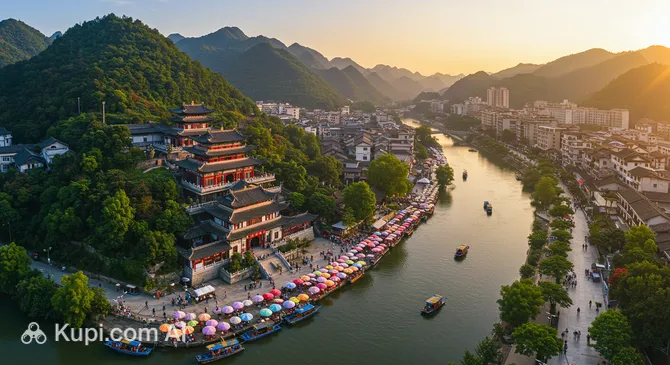
Suining is a picturesque city located in the heart of Sichuan Province in China. With a population of approximately 3.25 million people, it harmoniously combines the dynamics of a regional center with the tranquility of provincial life. The city stretches across a river valley surrounded by emerald hills, creating a unique atmosphere of peace that is quite rare for large Chinese metropolises.
Suining. Illustration.
Source: Kupi.com AI
This region has a deep and rich historical heritage dating back over 1,500 years. Founded in ancient times, Suining carefully preserves the traditions of the Tang Dynasty, which can be seen in its architecture and cultural monuments. Today, the city is known not only for its past but also for its modern commitment to ecology and comfort, often earning it the nickname "green oasis" of the region.
For tourists, Suining is primarily attractive for its Buddhist shrines, scenic riverside parks, and slow pace of life. It is an ideal place for those who want to experience authentic Sichuan culture without the hustle and bustle. We invite you to discover this hospitable city, where ancient mysteries coexist with modern hospitality.
Weather Overview
Suining is located in a subtropical monsoon climate zone, which defines its mild but humid weather character. This region is characterized by warm, rainy summers and cool, mostly dry winters. The average annual temperature is about 17–18°C, making the city comfortable to visit throughout most of the year.
Summer months, especially July and August, can be quite hot—daytime temperatures often rise to +32°C and above. Most of the precipitation falls during this time. Winters here are moderately cool: in January, the average temperature hovers around +7°C, and severe frosts are extremely rare. Spring and autumn are considered the ideal times for walking, when the weather is stable and pleasant.
If you want to check a more detailed weather forecast in Suining before your trip, we recommend aiming for May or October. During these months, the air humidity is optimal, and nature delights with vibrant colors, creating ideal conditions for sightseeing and hiking in the surrounding hills.
Average monthly temperature
Average monthly precipitation
Interesting Facts
Suining officially holds the title of one of the most environmentally friendly and livable cities in Sichuan Province, thanks to its abundance of parks and forest zones.
The city's history dates back more than 1,500 years, making it one of the oldest settlements in the Fujiang River basin.
The city is closely linked to the culture of the Tang Dynasty; unique collections of artifacts from this period, including rare ceramics and jewelry, were discovered here.
Suining is considered an important center of Buddhist culture in the region, attracting pilgrims to its many temples located on scenic hills.
Despite a population of over 3 million people, the city maintains a reputation as a "quiet harbor" of Sichuan, offering a much more relaxed pace of life than neighboring Chengdu or Chongqing.
How to Get There
Suining occupies a strategic position between the two largest metropolises of Western China, making it very accessible for travelers. To better plan your route, it is worth noting that the city is a major transport hub at the intersection of several high-speed highways and railways.
Although the city itself does not have a major international airport, the nearest aviation hub is Chengdu Shuangliu International Airport (CTU). From there, Suining can be reached by high-speed train in just 1–1.5 hours. Travelers also frequently use the airports in Chongqing, which are located at approximately the same distance.
Railway transport is the most convenient way to get around. Suining Railway Station handles dozens of high-speed trains daily. Modern trains connect the city not only with Chengdu and Chongqing but also with Beijing, Shanghai, and Guangzhou. Traveling in a comfortable carriage allows you to enjoy views of Sichuan's hills and rice fields.
One of the city's main gems is undoubtedly the Western Pagoda, built during the legendary Tang Dynasty. This majestic structure is not only impressive for its architectural precision but also houses ancient artifacts that allow visitors to touch the thousand-year-old history of Sichuan. People come here to feel the spirit of antiquity and enjoy the craftsmanship of ancient builders.
For nature lovers and those who enjoy quiet walks, Suining offers magnificent embankments and river parks. The city landscape is designed so that water and greenery are accessible to every resident and guest. Here, you can see locals practicing Tai Chi at dawn or simply relaxing in the shade of trees, watching the river flow by.
In the city's surroundings, there are also numerous temple complexes tucked away among the hills. They attract pilgrims and tourists with their authentic architecture and the opportunity to witness traditional rituals. The cultural heritage of the region is also reflected in local festivals, which turn the streets into vibrant celebrations filled with music and dancing.
Local Cuisine
Suining's cuisine is a vibrant representative of Sichuan gastronomy, famous for its balance of heat, spice, and aroma. The main focus here is the use of Sichuan pepper, which causes a characteristic pleasant numbing sensation, and fresh chili. Must-try dishes include the classic Mapo Tofu and spicy Dan-dan noodles.
A special place in the local diet is held by hot pot (the Chinese "steamboat"). In Suining, it is served with an abundance of vegetables, meat, and local river delicacies. Broths can range from extremely spicy to mild, with added mushrooms or herbs, allowing everyone to find a flavor to their liking.
Regarding drinks, fresh green tea grown on the province's plantations is incredibly popular in the city. In the evening markets, it is worth trying traditional baijiu—a strong spirit—or local beer. Street food in Suining's markets is an adventure of its own: you can find everything from roasted chestnuts to spicy skewers.
Travel Tips
Planning a trip to Suining becomes easier if you follow the advice of experienced travelers. This city is hospitable, but knowing local characteristics will help you feel more confident here.
Clothing and Season: The best time to visit is spring (March-May) and autumn (September-November), when the weather is most comfortable. In summer, bring light clothing and an umbrella as it rains often, and in winter, bring warm items as the climate can be quite damp and cool.
Getting around the city: Install the Didi app for calling taxis. This is the most convenient and price-transparent way to move around. For bus trips, it is handy to have small change or set up payment systems on your smartphone.
Finances: In China, payment via Alipay or WeChat Pay is accepted almost everywhere. Link your card in advance. It's worth having cash (yuan) for visiting small shops or markets. ATMs for withdrawing cash from international cards are available in major bank branches.
Health: Pharmacies are found at every step, but most medicines have Chinese names. It is recommended to have a basic first-aid kit and use translation apps to communicate with the pharmacist.
Communication: English is not widely spoken in Suining. Download an offline translator and save your hotel address in Chinese (characters) to show to a taxi driver.
Etiquette: In Sichuan, politeness and a slow pace are valued. Greet people with a slight nod. Respect for elders is the foundation of local etiquette, so be especially respectful when interacting with older people.
What to avoid: It is best to avoid discussing sensitive political topics. Also, try not to photograph people in temples without their explicit consent.
Internet: To access familiar international services and social networks, you may need a VPN, or purchase a travel SIM card with data roaming included in advance.
Suining will give you many pleasant memories if you are open to new experiences and local traditions. We wish you an unforgettable journey to this amazing corner of China!
Entertainment & Nightlife
Entertainment in Suining is predominantly calm and cultural, reflecting the city's overall atmosphere. Evening life here centers around traditional tea ceremonies, which are an essential part of the Sichuan lifestyle. Visiting a local teahouse is an excellent way to spend an evening, observing the skill of tea masters and enjoying leisurely conversation to the sounds of traditional music.
Those who prefer a stroll after sunset should head to the embankments, which are illuminated by thousands of lights. Along the rivers, there are numerous cafes and small bars with live music where local youth and tourists gather. The atmosphere here is friendly and safe, and the prices remain quite affordable compared to larger cities.
For family vacations and fans of active leisure, amusement parks and modern entertainment centers operate in the suburbs of Suining. Additionally, the city frequently serves as a venue for regional cultural festivals, where you can see performances by folk groups and sample rare local delicacies.
Parks & Museums
Suining is often called a city of parks, and that is no exaggeration. The main recreational zones are the extensive riverside parks along the Fujiang River. Kilometers of pedestrian and bicycle paths are laid out here, along with rest areas and gardens where lotuses or plum blossoms bloom depending on the season. These parks are favorite spots for picnics and morning outdoor exercise.
The city's cultural life is concentrated in its museums. A visit to the local history museum is a must, where artifacts found during excavations in the region are displayed. Special attention is given to the Tang Dynasty era: ancient jewelry, household items, and Buddhist relics are exhibited in the halls, revealing Suining's role as an important center on ancient trade routes.
Another significant point on the map is the complex around the Western Pagoda. This is not just an architectural monument but an entire cultural space combining museum exhibitions and temple grounds. Here, you can not only learn about the history of the structure but also go hiking on the nearby hills, which offer breathtaking views of the city blocks.
Getting Around
The public transport system in Suining is focused on the convenience of residents and guests. The backbone of internal communication consists of bus routes that cover all residential areas, stations, and major attractions. Buses run regularly, and fares remain very low.
Payment for travel is most often made via mobile apps (Alipay or WeChat Pay), which are the standard across China. However, you can usually pay with cash on buses as well. For easy navigation, tourists are recommended to use digital maps that accurately show transport arrival times.
As a quick alternative, you can always use taxis or the popular Didi service. Cars are easy to find on the streets or call via the app. Suining is also actively developing its network of bicycle and electric scooter rentals, which is a great option for short trips along the city's embankments and park areas.
Accommodation
The choice of accommodation in Suining allows you to find a suitable option for almost any budget. Most hotels are concentrated in the central district, near shopping streets and administrative buildings. Mid-range hotels predominate here, offering decent service at very reasonable prices.
For those seeking more picturesque views, it is worth looking at hotels located along the riverbanks. Staying in such places allows you to enjoy beautiful sunrises and the city's evening lights. Also growing in popularity in Suining are rental apartments, which are excellent for families or those planning to stay in the city for several days.
It is recommended to book accommodation in advance, especially during China's national holidays or local festivals, when the demand for rooms increases significantly. Using popular international booking platforms will help you find the best deals and read reviews from other travelers.
Nearby Cities
Thanks to its fortunate location, Suining serves as an excellent starting point for exploring the central part of Sichuan Province. Many interesting places are just an hour or two away, allowing for exciting trips without the need to move to different hotels.
Just 35 kilometers away is the cozy city of Daying, known for its thermal springs and recreational areas. Another popular destination is Nanchong, a major historical and cultural center where you can see ancient temples and picturesque views of the Jialing River. For those interested in the history of Chinese political figures, a visit to the city of Guang'an will be of interest.
In addition, modern high-speed trains allow for quick travel to the region's main metropolises—Chengdu and Chongqing. Each of these directions will give you new impressions of China's multifaceted culture and nature.
Shopping & Souvenirs
Shopping in Suining is primarily about discovering local crafts and traditional goods from Sichuan Province. The city is famous for its silk products and high-quality ceramics, which often replicate the shapes of ancient Tang vessels. As a souvenir, it is also worth bringing back local tea and the famous spice sets, including the legendary Sichuan pepper.
The main shopping activities are concentrated in the city's central blocks, where modern shopping malls stand alongside traditional shops. Here you can find international clothing and electronics brands as well as unique handmade goods from local artisans. Shops usually operate from morning until late evening, and major centers accept international payment system cards.
For those looking for true local color, the local markets are a must-visit. A lively atmosphere of communication reigns here, and the stalls are overflowing with fresh fruit, exotic snacks, and souvenirs. Bargaining is common in the markets—it is not just a way to lower the price, but also a part of the local culture of interaction.