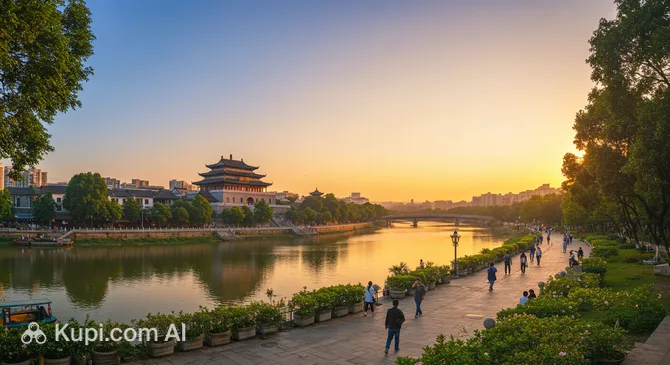
Guang'an is a fascinating city in the eastern part of Sichuan Province, located in China. It boasts a rich history dating back over 2,300 years, having long served as an important trade and cultural hub for the region. Today, it is home to approximately 3.2 million people, and the city harmoniously blends ancient heritage with the tranquility of a provincial center surrounded by picturesque landscapes.
The city's geographical position in the Sichuan Basin provides a unique natural backdrop: majestic mountains, dense forests, and deep rivers. Guang'an is primarily known as the birthplace of prominent historical figures and a guardian of ancient traditions, making it a point of attraction for those who want to see the authentic, non-touristic side of China.
Guang'an. Illustration.
Source: Kupi.com AI
The city's atmosphere is perfect for leisurely walks and contemplation. Among the main magnets for travelers are the scenic Mount Huaying and memorial sites associated with the country's outstanding leaders. A visit to this city is an invitation to travel through the centuries, where every stone and every bend of the river whispers legends of the past.
Weather Overview
Guang'an is located in a typical subtropical climate zone, characterized by mild winters and hot, humid summers. If you are planning a trip, keep in mind that the average annual temperature stays around 17–18°C. The most pleasant periods for a visit are spring and autumn, when the weather is comfortable for long outdoor walks.
Summer in the city is quite hot: in July and August, temperatures often rise to 30–35°C, and humidity increases significantly due to heavy rainfall. Winters, by contrast, are dry and cool, with the average January temperature around 7.5°C, and frost occurring very rarely. It is worth checking detailed information about the city's climate in advance to choose the right wardrobe.
Precipitation is distributed unevenly, with most of it falling between May and September. If your goal is mountain hiking, choose the spring months when nature is in bloom and the rains have not yet become persistent. Expect warm, sunny days in the transitional seasons and be prepared for high humidity during the summer months.
Average monthly temperature
Average monthly precipitation
Interesting Facts
Birthplace of a Great Reformer: Guang'an is the birthplace of Deng Xiaoping. The future leader of China lived here until the age of 15, and today his ancestral home is one of the country's most important cultural heritage sites.
Natural Stone Labyrinth: Mount Huaying is home to one of the most beautiful "stone forests" in Sichuan Province, formed millions of years ago by the erosion of limestone rocks.
Ba People Heritage: The city preserves traces of the ancient Ba people, who were famous for their martial traditions and unique burial rites, including "hanging coffins" on cliffs.
Ancient Strategic Hub: Guang'an stood on the famous "Shu Road"—a complex system of mountain paths that served for centuries as the primary trade and military artery between Sichuan and the rest of China.
Changing Names: Over its long history, the city has changed names and status several times; for instance, under the Yuan Dynasty in 1283, the Guang'an Prefecture was established, highlighting the region's administrative importance.
How to Get There
Guang'an's transport accessibility makes it a convenient destination for travelers exploring Sichuan Province. The main routes to Guang'an run through the region's major transport hubs, ensuring reliable connections with both metropolises and neighboring provinces.
The city does not have its own airport, so most tourists arrive via the nearest major aviation hubs. The most popular options are Chengdu Shuangliu International Airport or Chongqing Jiangbei International Airport. From these cities, Guang'an can be easily reached by high-speed train or regular bus, with the journey taking between 2 and 3 hours.
Rail travel is the most popular way to visit. The city's main station receives trains from Beijing, Shanghai, and other metropolises. High-speed rail lines allow you to cover long distances in comfort, turning the trip into a pleasant observation of the changing landscapes outside the window. For those who prefer road trips, the G42 expressway passes through the city.
One of the most impressive natural attractions is Mount Huaying. This place is famous for its unique "stone forest," where bizarre rock formations rise amidst dense greenery. Travelers are drawn to the deep gorges, ancient temples at the Bao Ding peak, and memorial halls tucked away in the forest. A hike along the trails of Huaying offers not only physical exercise but also stunning panoramic views.
Equally interesting is the Ba People's Stone City (Zuongcheng). This ancient settlement allows you to touch the culture of the Ba tribe, who once inhabited these lands. The city, with its powerful towers and fortifications, served as a strategic point; today, it offers tourists a chance to explore traditional architecture and history while enjoying views of the surrounding hills and valleys.
Of particular cultural significance to the region is the Former Residence of Deng Xiaoping. This memorial complex includes an old estate and an extensive park. The site is steeped in 20th-century history and provides a deeper understanding of the life of the man who changed the face of modern China. The museum exhibits and the carefully preserved interior of the house create a profound and informative atmosphere for all history enthusiasts.
Local Cuisine
The culinary traditions of Guang'an are inextricably linked to legendary Sichuan cuisine. The main focus here is on bold flavors: the spiciness of chili peppers and the specific numbing sensation of Sichuan peppercorns. One of the main gastronomic experiences is Huo Guo (Hot Pot)—the Chinese "steamboat" where you cook meat, vegetables, and mushrooms yourself in a boiling, spicy broth.
Be sure to try the local Dan Dan noodles with spicy meat sauce and dishes made from fresh river fish, which are prepared here with an abundance of aromatic herbs and garlic. Sweet and spicy pork is also a favorite in local restaurants. The city's food scene features everything from cozy family-run spots to lively street stalls where food is prepared right in front of you.
Among drinks, local tea grown on Sichuan plantations holds a place of honor. Guang'an's teahouses are cultural centers where you can spend hours over a bowl of fragrant tea. If you want something stronger, it's worth trying Sichuan beer, which perfectly complements the spicy dishes. The city's simple and honest cuisine will surely be remembered for its bold character.
Travel Tips
A trip to Guang'an will be much more comfortable if you familiarize yourself with useful tips from experienced travelers. These practical recommendations will help you avoid minor inconveniences and focus entirely on the city's beauty.
Clothing and Essentials: Choose clothing according to the season, but be sure to bring comfortable shoes with good grip for mountain walks. In spring and autumn, don't forget a light windbreaker, and in summer, bring sunscreen and an umbrella.
Transport: To get around the city, it is most convenient to use taxis or buses. Install a ride-hailing app, as it will significantly simplify communication with the driver.
Finances: The primary currency is the Chinese Yuan. International payment cards are rarely accepted, so set up Alipay or WeChat Pay before your trip. Cash will be useful for small purchases at markets.
Health and Safety: The city is safe for walking even in the evening. Pharmacies are common, but it's better to bring specific medications with you. Drink only bottled water.
Communication: English is not widely spoken in the city. Be sure to download an offline translator and save the hotel address in Chinese.
Local Etiquette: Chinese people are very hospitable. Greet people with a slight nod, and use both hands when handing over money or business cards—it's a sign of respect.
What to Avoid: It is best not to discuss political topics publicly. Also, try not to take photos of people without their explicit consent, especially in temples.
Additional Tip: Plan your visit to the Deng Xiaoping Memorial for a weekday to avoid the queues that often occur on weekends and holidays.
By following these simple rules, you will make your visit to Guang'an easy and memorable, discovering the true hospitality of Sichuan.
Entertainment & Nightlife
Entertainment in Guang'an is largely centered around nature and contemplation, which is ideal for those seeking a relaxing getaway. Most daytime activity revolves around Mount Huaying, where hiking and eco-tourism are popular. Travelers can spend the entire day exploring stone labyrinths and enjoying the fresh mountain air.
Evening life in the city moves at a measured pace. Instead of noisy nightclubs, it is common to stroll through central squares and along the embankments, where street food stalls come to life as dusk falls. This is a great time to mingle with the locals and try authentic snacks in a relaxed atmosphere.
For those seeking cultural leisure, traditional theaters and small concert venues operate in the city, showcasing performances by local creative groups. Guang'an's nightlife consists of cozy restaurants and teahouses where you can discuss the day's impressions over a cup of local tea. Safety in the city is high, making evening walks through the central districts perfectly comfortable.
Parks & Museums
The region's main natural park is rightfully considered the Mount Huaying National Park. It is not just a forest, but a complex ecosystem with unique geological formations. Here, you can see rare plant species, walk through the "Gorge Valley," and visit a memorial hall dedicated to the guerrilla movement. The park is ideal for photographers and fans of active outdoor recreation.
A cultural program of the city is impossible without a visit to the Deng Xiaoping Memorial Complex. This place combines the functions of a museum and a park, where exhibits telling the story of the life and reforms of one of China's most influential figures are set against a backdrop of picturesque ponds and gardens. The museum possesses an impressive collection of personal items and archival documents presented in modern exhibition halls.
History buffs should check out the Ba People's Stone City area. Fragments of ancient buildings are preserved here in the open air, supplemented by museum displays explaining the daily life and beliefs of this mysterious tribe. The ancient temples at the top of Bao Ding also serve as open-air museums where you can study Buddhist architecture and the art of stone carving.
Getting Around
The public transport system in Guang'an is mainly represented by an extensive network of bus routes. Buses run regularly, connecting residential neighborhoods with the city center, the railway station, and major tourist sites like the Deng Xiaoping Memorial Park. Fares are fixed and very affordable, making buses the most accessible way to get around.
Taxis are an excellent alternative for those who value comfort and time. Cars are easy to flag down on the street or call via mobile apps (such as DiDi). Trips around the city are usually inexpensive, but it's worth having your destination name written in Chinese, as drivers rarely speak English. For trips to remote natural areas like Mount Huaying, a taxi is the most convenient option.
Electric bikes and scooters are popular among locals, allowing for quick maneuvering through city traffic. Tourists can also use bike rentals for leisurely rides along the embankments. An important part of the transport system remains the railway station, which serves high-speed trains, making Guang'an easily accessible from any major city in the province.
Accommodation
Accommodation options in Guang'an cater to both business travelers and tourists visiting for the natural beauty. Most hotels are concentrated in the city center, which is convenient for accessing restaurants and transport hubs. Here, you can find both modern middle-class hotel complexes and budget-friendly options with basic services.
For those who want to be closer to nature, there are hotels and guesthouses located at the foot or on the slopes of Mount Huaying. Staying in these areas allows you to start excursions early in the morning, avoiding the midday heat and the influx of visitors. Many of these establishments offer rooms with panoramic views of the mountain ranges.
It is recommended to book accommodation in advance, especially during China's national holidays when demand for rooms increases significantly. During ordinary times, prices remain affordable. Most hotels accept payment via popular mobile apps, though having cash or international cards at major chain hotels is also an advantage.
Nearby Cities
Guang'an serves as an excellent starting point for exploring the eastern part of Sichuan Province and the neighboring metropolis of Chongqing. Thanks to the developed network of roads and railways, travelers can easily take day trips to nearby cultural and historical centers.
One of the most striking destinations is the majestic Chongqing, which is less than two hours away. This "mountain city" is stunning in its scale, futuristic architecture, and famous night views. It is also worth visiting Nanchong, known for its historical charm, and Diaoyucheng, where you can see ancient fortress structures.
Exploring the surroundings allows you to see the diversity of China: from quiet agricultural landscapes to the glittering lights of megacities. Each of these directions will add new colors to your journey through the region.
Shopping & Souvenirs
Shopping in Guang'an is primarily an opportunity to purchase authentic local products and folk crafts. The city is not overloaded with massive shopping malls, but trade thrives in traditional markets and small shops. The main shopping streets are located in the center, where you can find everything from modern clothing to traditional Chinese housewares.
The most popular souvenirs from Guang'an are the famous Sichuan tea and honey collected on the slopes of Mount Huaying. Local spice sets, including the legendary Sichuan pepper, are popular gifts for culinary enthusiasts. You can also find folk crafts in souvenir shops—textiles with traditional embroidery and souvenirs made from stone quarried in the local mountains.
Shops are usually open from 9 AM until 9 or 10 PM. Payment is most often made through Alipay or WeChat Pay, which are accepted even in the smallest stalls. Cash is still welcome at markets, while bank cards can be used in large supermarkets. Buying at a local market is always a small adventure, offering the chance to haggle and learn more about the products firsthand.