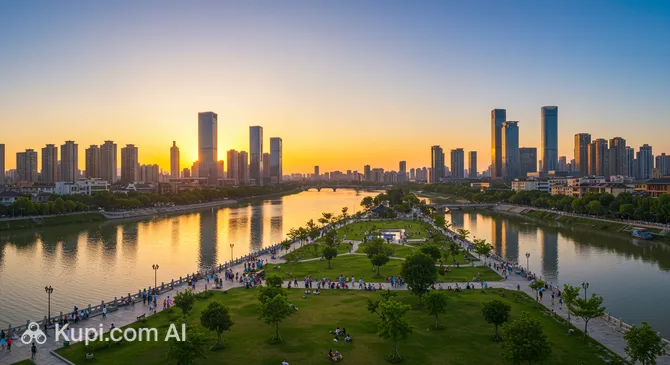
Located in the heart of Henan Province, Luohe is a fascinating blend of ancient cultural heritage and the dynamic rhythm of modern China. Stretching along the banks of the river that shares its name, the city enchants with its peaceful atmosphere and the sincere hospitality of its more than two and a half million residents. Luohe is often called the "pearl of central Henan" for its picturesque riverside landscapes and its vital role in the regional economy.
The city boasts a rich and unusual history of development that reaches deep into the past. Interestingly, the name of the place is linked to the whimsical bends of the local rivers, which reminded ancient inhabitants of the spirals of mollusk shells. Luohe's modern appearance began to take shape rapidly in the early 20th century, when the construction of the railway transformed it into a significant transportation hub.
Luohe. Illustration.
Source: Kupi.com AI
For travelers, Luohe is primarily interesting as the birthplace of the great philologist Xu Shen. Here, you can immerse yourself in the study of the origins of Chinese writing, stroll through magnificent parks, or enjoy the evening lights on the embankments. Visiting this city is an excellent opportunity to see authentic China, which has preserved its identity far from the well-trodden tourist paths.
Weather Overview
The climate in Luohe is moderately continental with a clearly defined change of seasons. Summer here is usually hot and humid: the average temperature in July and August stays around +28°C, and during daytime hours, it can rise above +32°C. Winters, by contrast, are dry and cool—in January, the thermometer often drops to slightly negative values at night, although weak positive temperatures usually persist during the day.
The greatest amount of precipitation falls in the summer months, especially in July, when intense but short-lived rains are possible. Spring and autumn are considered the most comfortable periods to visit, as this is when mild and pleasant weather in Luohe sets in, perfect for long walks in the Xu Shen Cultural Park and along the embankments.
When planning a trip, keep in mind that sharp temperature fluctuations between day and night are possible during the transition seasons. It is recommended to bring clothing that can be layered depending on the current conditions and to always check the latest forecast before heading out for a walk.
Average monthly temperature
Average monthly precipitation
Interesting Facts
Luohe is the birthplace of Xu Shen, the great scholar known as the "Sage of Chinese Characters" for creating the world's first systematic dictionary.
The local Shuowen Museum houses a unique collection of more than 5,000 dictionaries published during various dynasties.
The city's original name during the Yuan Empire was associated with sea mollusks due to the spiral bends of the river, but the character was later replaced with a homophonous one more suitable for an inland city.
The modern name "Luohe" was officially established in 1906 thanks to the opening of a major railway station on the Beijing–Wuhan line.
In front of the entrance to the Xu Shen Cultural Park, you can see stelae with calligraphy by great masters, which are considered the standard of elegant writing in China.
How to Get There
Luohe occupies a strategic position in the central part of Henan Province, making it easily accessible for travelers. The main transport hub of the region is the railway, which historically contributed to the city's development. To plan your visit as comfortably as possible, we recommend studying the sections on how to get to Luohe by various means of transport in advance.
The nearest major aviation hubs are located in neighboring metropolises, from where you can quickly reach the city by high-speed train or bus. A developed network of expressways also connects Luohe with key cities in the province, providing convenient road links.
Railway communication has played a key role in the city's life since 1906. Luohe's modern stations receive trains from various directions, connecting the city with Beijing, Wuhan, and other important centers of the country. Traveling by train is not only fast but also a very scenic way to reach this cultural hub.
The Xu Shen Cultural Park is rightfully considered the city's main pride and its spiritual center. This grand architectural complex, built in the classical Han Dynasty style, is dedicated to the life and works of the author of the first dictionary of Chinese characters in history. Walking through the park grounds is like turning the pages of history: every stela and pavilion tells the secrets of ancient writing.
The Alley of Chinese Characters is of particular interest to tourists, where the multi-century evolution of signs—from archaic oracle bones to modern simplified forms—is engraved right on the ground. In the central Hall of the Sage of Characters, a solemn statue of Xu Shen stands surrounded by exhibits chronicling the painstaking process of creating his fundamental work, "Shuowen Jiezi."
Beyond its historical components, the park delights visitors with its natural zones. In April and May, the lush Peony Garden bursts into bloom, and from June to September, the air is filled with the fragrance of the Rose Garden. You can conclude your walk at the tomb of Xu Shen, which is recognized as a national treasure and serves as a place of pilgrimage for students seeking inspiration before important exams.
Local Cuisine
Luohe's gastronomic scene is a reflection of the rich traditions of Henan cuisine, which is famous for its hearty soups and a variety of noodle dishes. Locals value the balance of flavors and the freshness of ingredients, so you will often see seasonal vegetables and fish caught in local rivers on the table. A characteristic feature of local dining is the use of aromatic spices that give dishes a recognizable character.
Exploring street food is a special pleasure for tourists. In the busy streets near the Xu Shen Cultural Park, you can find stalls with traditional snacks prepared right before your eyes. Try the local filled flatbreads or hot soups, which are especially popular during the cooler months.
As for drinks, tea culture thrives in Luohe, as it does throughout the region. Local establishments will offer you both classic green teas and herbal blends. An evening at one of the restaurants on the embankment is a great way to get acquainted with local culinary traditions in a relaxed and friendly atmosphere.
Travel Tips
Preparing for your trip to Luohe will be easier with our practical recommendations, which will help you feel confident in this hospitable city.
Clothing by season: Summer in Luohe is hot and humid, so choose clothing made from natural fabrics. It can be quite frosty in winter, so a warm jacket will be necessary. Be sure to bring comfortable shoes for long walks in the parks.
Transport nuances: To get around the city, it is best to use buses or taxis. Install offline maps and a translator on your phone, as English is not very common here.
Finance and payment: The primary currency is the Chinese yuan. Although cards are accepted in large hotels, it is better to have cash or set up Alipay or WeChat Pay apps for everyday expenses.
Cultural interaction: Be sure to visit the Rubbing Hall in Xu Shen Park. For just 30 yuan, you can make a souvenir with your own hands—this is a unique experience rarely found in other cities.
Health: Always carry bottled water with you. Pharmacies are easy to find in the city, but medicine names may only be in Chinese, so carry a basic first-aid kit.
Etiquette: When entering temples or historical pavilions, try to be quiet and do not use a flash when taking photos if it is prohibited. Politeness and a smile are the best keys to communicating with locals.
Timing for parks: To catch the peony bloom, plan your visit for April–May. If you prefer roses, choose the period from June to September.
Luohe will reveal its secrets to you if you show a little curiosity and respect for its ancient traditions. Enjoy your trip!
Entertainment & Nightlife
Luohe in the evening offers guests a peaceful and aesthetic leisure experience. The main centers of attraction after dark are the river embankment and the historic Luohe Old Street. Here, bright lights reflect in the water, creating an atmosphere of comfort and romance. Locals and tourists alike enjoy leisurely strolls through these areas, taking in the cool air and beautiful views of the illuminated bridges.
For those seeking more active experiences, the Xu Shen Cultural Park offers a unique form of entertainment—the chance to try on traditional hanfu clothing. A photoshoot in a historical setting among ancient pavilions allows you to literally feel like part of a great era and capture unique memories of your trip.
Daytime entertainment in the city is closely intertwined with education and creativity. For example, you can attend calligraphy workshops or try your hand at creating traditional rubbings. Overall, Luohe's nightlife is free from the excessive noise of megacities, offering instead the soulfulness and traditional charm of provincial China.
Parks & Museums
The city's main cultural site is the Shuowen Jiezi Museum, located within the Xu Shen Cultural Park. This unique place houses more than five thousand rare dictionaries and manuscripts. Visitors can trace the entire history of Chinese writing and understand how graphic symbols have transformed over millennia. Nearby is the Print Museum, whose exhibitions introduce the delicate techniques of traditional printing.
The park area of the complex is a true oasis of peace and beauty. A walk along the Alley of Chinese Characters leads guests to the Kuixing Pavilion, where people have long prayed for success in studies and careers. From an aesthetic point of view, the park is particularly attractive during the flowering seasons, when the Rose and Peony gardens turn into a vibrant sea of petals, creating a perfect backdrop for relaxation.
For those interested in history, the Stela Culture Corridor is a must-visit. Here, under the open sky, works by outstanding calligraphers whose mastery is recognized as exemplary are on display. The combination of austere Han-style architecture and well-maintained landscape zones makes this museum and park complex the most memorable place in Luohe.
Getting Around
The public transport system in Luohe is organized practically and conveniently for moving between the main attractions. The basis of internal communication consists of bus routes that cover all key areas of the city. Buses run regularly, and the fare remains very low, making them the most affordable way for tourists to get around.
The city also has an extensive taxi network. You can call a car through popular Chinese apps or simply hail one on the street. Taxis are a great option for evening travel or when you need to get to the railway station quickly. Additionally, bicycle rental services are popular on the city streets, allowing you to explore the embankments and park areas at your own pace.
Given Luohe's historical significance as a railway hub, trains remain a vital element of the transport infrastructure. Railway links connect the city not only with neighboring provinces but also with the country's largest metropolises. For convenience in planning trips, we recommend using mobile apps to track public transport routes in real time.
Accommodation
In Luohe, travelers can find accommodation for every taste: from modern hotels of major chains to cozy guesthouses. The main concentration of hotels is found in the central part of the city and in areas adjacent to major transport hubs, which significantly simplifies travel between attractions.
Accommodation options in the Luohe Old Street area are particularly popular. Staying here allows you to fully experience the city's historical charm while being within walking distance of colorful shops and local restaurants. Hotels in this zone often combine traditional decor with modern levels of comfort.
When planning a trip, especially during national holidays or during the peony bloom (April–May), it is worth booking rooms in advance through international services. Accommodation prices in Luohe remain very affordable, allowing you to find a high-quality option even on a limited budget.
Nearby Cities
Luohe serves as an excellent starting point for exploring the culturally rich surroundings of central China. Convenient transport links make it easy to take day trips to neighboring cities, each of which has a unique historical character.
Just 63 kilometers away is the ancient city of Zhoukou, located at the confluence of three rivers. It is famous for the Taihao Mausoleum, dedicated to the ancestor Fuxi, and the magnificent Guandi Temple with its unique wood carvings. You should also look into Xiping and Zhumadian, which offer tourists a chance to experience the authentic life of Henan province.
Such trips allow you to significantly expand your travel impressions, seeing not only Luohe but also other facets of this amazing historical region. Each destination promises new discoveries and encounters with monuments of global significance.
Shopping & Souvenirs
Shopping in Luohe is primarily about finding unique items related to the history of Chinese writing. The main shopping opportunities are concentrated in the Luohe Old Street area, where numerous shops selling souvenirs, antiques, and local handicrafts are nestled among old buildings. Here you can find high-quality calligraphy sets: brushes, ink, and handmade paper.
The most original souvenir from Luohe is a rubbing of a character on an oracle bone. In a special hall of the Xu Shen Cultural Park, you can not only buy a finished work but also, under the guidance of a master, independently reproduce ancient signs that are thousands of years old. Such a gift will be not only a beautiful reminder of the trip but also a true symbol of ancient wisdom.
For more conventional shopping, there are modern shopping centers in the city offering products from well-known brands and electronics. Most stores are open from early morning until late evening, and it is convenient to use popular mobile apps for payment, though cash may still be required in small souvenir shops.