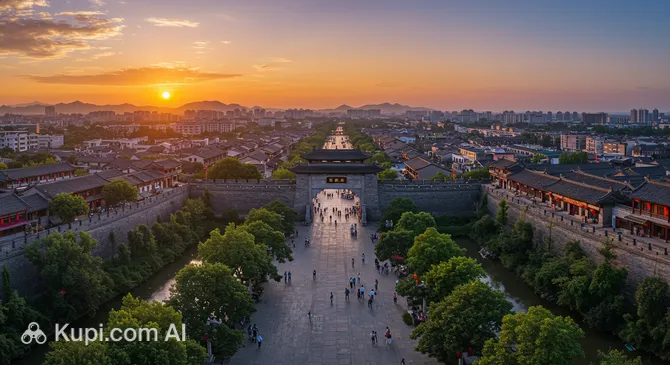
Shangqiu is not just another metropolis in China; it is a place with deep historical roots, often called the "hidden primordial universe of Chinese civilization." Located in the eastern part of Henan Province, this prefecture-level city is steeped in an ancient atmosphere: it is believed that the Shang people, who founded one of the first great dynasties of the Middle Kingdom, originated here.
Geographically, the city occupies an important strategic position in the east of the Central Plain. Today, the population of Shangqiu exceeds 7.8 million people, making it a significant regional center where modern industrial districts and priceless archaeological sites harmoniously coexist. The city's name translates as "Shang Hill," referring to the legends of Yu the Great, who tamed the Great Flood.
Shangqiu. Illustration.
Source: Kupi.com AI
Shangqiu attracts tourists primarily with the opportunity to touch the origins of history. Exploring the city's heritage, you can find traces of ancient capitals, temples, and artifacts that are thousands of years old. A visit to this place is an invitation to travel through time, allowing for a new perspective on the development of Eastern culture.
Weather Overview
The climate in Shangqiu is distinctly continental, typical of the temperate zone of Central China. There are four distinct seasons, each bringing its own character to the city's appearance. Winters are usually relatively mild and dry, although January temperatures can drop to -3°C. Snow falls rarely but adds a special charm to the ancient temples.
Summer in the region is hot and humid. Temperatures peak in June and July, when the thermometer often rises above 32°C. July sees the highest amount of precipitation, so when planning a trip, be prepared for tropical downpours. Spring and autumn are considered the most favorable seasons for visiting: during these times, comfortably warm weather sets in, ideal for long excursions to historical sites.
Current data on the weather in Shangqiu will help you pack your suitcase correctly. Expect a sunny and warm start to autumn with gradual cooling towards November. Winds in the city are usually moderate, making walks pleasant throughout most of the year.
Average monthly temperature
Average monthly precipitation
Interesting Facts
Cradle of the Shang Dynasty: The city is officially recognized as the homeland of the Shang people, who laid the foundations of Chinese statehood after the legendary taming of the flood by Yu the Great.
Temporary Capital: In 1014, due to an external threat from the north, Shangqiu became the temporary capital of the Song Empire and proudly bore the name Nanjing (Southern Capital) at that time.
Imperial Refuge: In 1232, during the decline of the Jurchen Jin Empire, Emperor Aizong also chose this city (then known as Guidefu) to relocate his residence.
Administrative Division: The prefecture-level city is divided into two key districts—Liangyuan and Suiyang—each of which is home to nearly a million people.
Unique Status: Historians and archaeologists call Shangqiu the "original universe of Chinese civilization" due to the incredible concentration of ancient cultural layers.
How to Get There
Thanks to its location at the intersection of important transport routes, getting to Shangqiu is quite simple. The city is a significant railway hub connecting the country's eastern and central regions. The best way to plan your trip is to study information about transport links.
While the city itself does not have a large international airport, tourists often use domestic flights to nearby aviation hubs or arrive by high-speed trains from Beijing, Shanghai, or Zhengzhou. Shangqiu Railway Station is conveniently located and serves trains from most major cities in Henan Province and neighboring regions.
In addition to trains, there is a well-developed intercity bus service. For international tourists, high-speed railways remain the most comfortable and straightforward travel option. Private transport is convenient for traveling on modern expressways, but inside historical districts, it is better to use public transport or taxi services.
Station
Passenger traffic
Distance
Bozhou Railway Station
4
64 km
Heze Railway Station
3
92 km
Jining Railway Station
3
138 km
Xuzhou railway station
9
143 km
Fuyang Railway Station
6
167 km
Main Attractions
The primary value of Shangqiu lies in its archaeological and historical heritage. The city is famous for monuments inseparably linked to the Shang Dynasty. Visitors can discover ruins of ancient capitals and temple complexes that evoke the power of China's first states. Of particular interest are areas belonging to the Song State and the Han-era Liang Fiefdom, where an authentic atmosphere of the past is preserved.
Strolling through the historical districts, you can encounter remnants of ancient city walls and religious structures that locals have carefully protected for centuries. These sites make the city a true gem of Henan Province for those who prefer thoughtful cultural tourism and exploring the origins of civilization away from overcrowded popular routes.
Local Cuisine
The gastronomic scene in Shangqiu is a classic embodiment of Henan cuisine traditions. Wheat flour dishes form the basis of the diet here. Be sure to try the local noodles and dumplings, which are prepared with an emphasis on preserving the natural taste of fresh ingredients. Huitong dishes, which masterfully combine meat and seasonal vegetables, are especially popular.
Food culture in the city is closely linked to street markets and small family-run restaurants. It is in such places that you can experience the true taste of the region. Locals value simple but hearty food served hot. In the Liangyuan and Suiyang districts, you will find many establishments offering authentic dinners in a warm atmosphere.
Regarding drinks, in Shangqiu, as in all of Central China, people enjoy local tea varieties. It is also worth noting traditional rice wine, which is often served at festive meals. A gastronomic journey through the city would not be complete without visiting a traditional teahouse, where time seems to slow down during a leisurely ceremony.
Travel Tips
Preparing for a trip to Shangqiu will be easier and more pleasant if you consider a few practical nuances characteristic of this ancient region of China.
Seasonality and Clothing: The optimal time for a visit is spring or autumn, when the weather is most comfortable for long walks. It can be quite chilly in winter and hot and humid in summer, so bring seasonal clothing and be sure to wear comfortable shoes for exploring archaeological zones.
Domestic Transport: It is better to buy train tickets in advance through the Trip.com app, as the route is popular among locals.
Finances: The main currency is the Chinese Yuan. International payment cards are rarely accepted, so have a reserve of cash or set up Alipay/WeChat Pay.
Language Barrier: English is not widely spoken in the city. Download an offline translator in advance and carry a card with your hotel's name in Chinese.
Connectivity: For stable internet, it is worth purchasing a local SIM card at the arrival airport or in large communication stores in the city.
Etiquette: Chinese people value politeness. Greet people with a slight nod, and offer business cards or money with both hands—it is a sign of respect.
Safety: The city is generally very safe, but always keep an eye on your personal belongings in crowded places and at markets.
Local Food: Don't be afraid to try street food, but choose places where many locals dine—this is the best indicator of quality.
May your journey to the cradle of Chinese civilization be filled with amazing discoveries and pleasant impressions!
Entertainment & Nightlife
Entertainment in Shangqiu is primarily cultural and contemplative. Life flows at a measured pace, and the main focus is on preserving traditions. Locals and visitors alike prefer to spend their evening hours in traditional teahouses, where they can not only sample rare teas but also enjoy quiet conversation in an authentic setting.
For those seeking more active leisure, the city hosts numerous historical festivals and fairs timed to coincide with significant dates. In the evening, it is worth strolling through the illuminated ancient streets of the Liangyuan and Suiyang districts—it is there that you can find cozy restaurants with local flavor. Nightlife in the classic sense (with noisy clubs) is not very developed here, making the city ideal for families and those who appreciate peace and quiet.
During the day, walking through city parks or attending seasonal cultural events are excellent options. To call a taxi in the evening, it is recommended to use mobile apps like Didi, as this guarantees safety and a fixed price for the trip to any part of the city.
Parks & Museums
For a deep dive into the city's history, a visit to local archaeological museums is a must. These museums house unique Shang Dynasty artifacts found during excavations of ancient settlements. The collections vividly demonstrate the greatness of the "original universe of Chinese civilization," presenting bronze items, ceramics, and everyday objects created thousands of years ago.
If you want to take a break from the city bustle, head to the park zones of the Liangyuan and Suiyang districts. Local parks are designed in the best traditions of Chinese landscape design: they feature plenty of greenery, neat walking paths, and traditional pavilions. These are excellent places to observe the daily life of citizens, who often gather in parks for gymnastics or chess games.
Although Shangqiu is not as widely known for its museums as Beijing or Xi'an, its intimate exhibitions allow for a more detailed study of history without unnecessary haste. The combination of fresh-air walks and viewing ancient relics makes the city's cultural program balanced and educational.
Getting Around
The public transport system in Shangqiu primarily relies on an extensive network of bus routes. Buses run regularly and cover all key areas of the city, including the Liangyuan and Suiyang districts. This is the most economical way to get around, allowing you to easily reach major attractions and shopping centers.
For faster and more comfortable travel, tourists actively use taxis. You can hail a car directly on the street or through the popular mobile app Didi, which significantly simplifies the process of communicating with the driver. Taxi prices in the city are quite reasonable and accessible even for budget travelers.
In recent years, eco-friendly modes of transport have been gaining popularity in Shangqiu: you can find many electric scooters and rental bicycles on the streets. This is a great option for short trips through central blocks or leisurely rides through historical zones. Although the metro is still under development, the current transport infrastructure fully handles the needs of tourists.
Accommodation
The Liangyuan and Suiyang districts are the most convenient areas for staying in Shangqiu. The main tourist infrastructure is concentrated here, and most historical sites are located in these areas. Accommodation options range from modest budget hotels to mid-range hotels catering to business travelers and tourists.
Chain hotels located in the immediate vicinity of the main railway station are particularly popular. This is a strategically convenient location that allows for easy movement around the city and ensures you catch trains to other regions on time. The quality of service in such establishments usually meets international mid-range standards.
When planning a trip, especially during Chinese national holidays, it is strongly recommended to book a room in advance. For this purpose, it is convenient to use international booking services like Trip.com, which provide the most complete list of available options with current prices and reviews.
Nearby Cities
Shangqiu serves as an excellent starting point for exploring the surroundings and immersing yourself in the history of Central China. The developed railway network makes it easy to plan day trips to neighboring cities, each possessing its own unique character.
For example, you can head to Bozhou, which is located just 64 kilometers away and is famous for its traditional medicine markets. Minquan is also of interest to travelers, and the journey there takes very little time. For those ready for slightly longer trips, high-speed trains will take you to the provincial capital, Zhengzhou, or the ancient city of Kaifeng in a short time.
Exploring the surrounding counties and small towns will help you gain a more complete picture of life in Henan Province. The region is rich not only in historical monuments but also in picturesque rural landscapes, which are especially beautiful during the spring and autumn periods.
Shopping & Souvenirs
Shopping in Shangqiu is primarily about searching for unique souvenirs with historical subtext. The city's commercial life is concentrated in the Liangyuan and Suiyang districts, where colorful street markets operate alongside modern shops. It is in the markets that you can find the most interesting items that will serve as a great reminder of your trip.
As souvenirs, tourists most often choose high-quality replicas of ancient Shang Dynasty artifacts, local silk products, and traditional handicrafts. It is also worth paying attention to local tea and spices, which are famous for their aroma. Strolling through the market stalls provides an opportunity not only to make purchases but also to observe the city's authentic life.
Shops in the city usually operate from early morning until late evening. For payments, it is most convenient to use mobile payment systems like Alipay or WeChat Pay, which are accepted everywhere—from large retail outlets to small market stalls. Cash Yuan will also come in handy, especially when visiting remote areas or small street vendors.