Support

Golden Lane

About

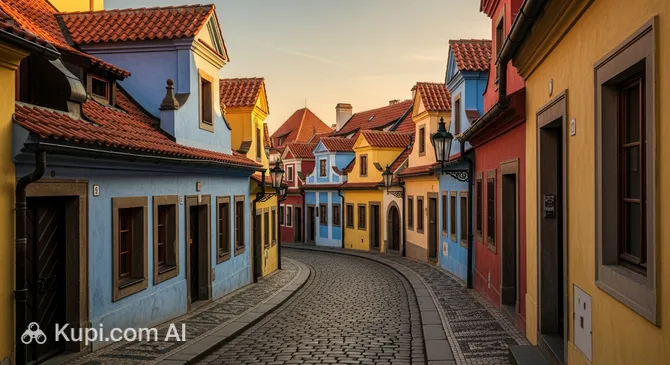
Imagine a tiny cobblestone path squeezed between ancient fortress walls, where houses look like toys and doors seem almost doll-sized. This is the legendary Golden Lane, one of the most recognizable symbols Prague is proud of. Located in the northern part of Prague Castle, this narrow strip of land is a unique monument of architecture and daily life, included in the UNESCO World Heritage list.
\n\n

Golden Lane
Golden Lane. Иллюстрация. Источник: Kupi.com AI

\n\n

The place owes its name to the goldsmiths who once lived here in close proximity to the Royal Guard marksmen. Today, Golden Lane in the Czech Republic is considered a true portal to the past. It consists of twelve preserved houses built directly into the arches of the defensive wall. The facades are painted in vibrant colors based on sketches by the famous artist Jiří Trnka, giving the place an incredibly fairytale and photogenic look.

\n\n

Visitors can not only admire the exterior of the buildings but also step inside many of them. Beyond the low thresholds, interiors of different eras have been recreated — from an alchemist's workshop and a guard's modest dwelling to the apartment of a famous fortune teller. This is a place dense with legends, where every stone is steeped in the city's history and the secrets of medieval craftsmen.

Contacts

To plan your visit to this popular attraction, it is helpful to check the official contact information in advance. The site is managed by the Prague Castle administration.

How to contactContact
AddressPražský hrad Hrad III, nádvoří, 119 00 Praha 1-Hradčany, Чехия
Phone+420 224 372 423
Websitewww.hrad.cz

What to Do

A walk along Golden Lane is an interactive immersion into history. First, visit House No. 22, painted in a soft blue: this is where the great writer Franz Kafka rented a room in the early 20th century. Today, it houses a cozy bookstore where you can feel the very atmosphere in which his mystical works were created.

\n\n

Be sure to go up to the upper level, where the long Defensive Corridor runs. This is a covered gallery above the houses where guards used to patrol. Now, it features an impressive collection of medieval weapons and knights' armor. For those seeking a thrill, the corridor leads to the Daliborka Tower, whose dungeons still hold sinister torture instruments, such as the "iron maiden" and the rack.

\n\n

Don't forget to look into the museum houses, where daily life from past centuries is recreated behind glass displays. You will see a marksman's Renaissance dwelling, an alchemist's laboratory, and even an old cinema. If you want to take a piece of this place home with you, the ground floors of the houses host souvenir shops selling unique items made of ceramics, glass, and traditional Czech jewelry that are hard to find in other parts of the city.

Getting There

Finding this fairytale corner is easy: it is nestled in the northern part of the Prague Castle complex. The most popular way to get here is to take the famous Tram No. 22 (or routes No. 20 and No. 23). You should get off at the "Prašný most" or "Královský letohrádek" stop, from where the walk to the castle gates takes about 10–15 minutes. If you prefer the metro, the nearest station is "Malostranská" (Line A), from which you can walk up the picturesque Old Castle Stairs.

\n\n

For those who enjoy walking, the ideal route starts from the very center of the city. Prague is perfect for long strolls: from Old Town Square, you can reach the lane in 20–30 minutes by crossing Charles Bridge and walking up the historical Nerudova Street. If you value comfort, you can always call a taxi through popular apps; however, remember that entry to the fortress grounds is restricted, and the car will drop you off at one of the entrances.

\n\n

Keep in mind that parking in the Hradčany district is very limited and intended mainly for local residents. Visitors are encouraged to use public transport, which works flawlessly here. Upon entering the castle, you must pass through a security check, so during the high season, it is worth allowing extra time for potential queues at the main gates.

Ближайший город: Prague

History & Facts

This site owes its existence to extensive defensive works in the late 16th century. When the new northern fortifications were built under Emperor Rudolf II, free space was created in the deep niches of the fortress wall. In 1597, by royal decree, 24 tiny houses were allowed to be built here for the castle marksmen and their families. Initially, the place was called "Marksmen's Lane," and the dwellings were so cramped that they were literally built into the castle's stonework.

\n\n

Over time, the profile of the inhabitants changed: craftsmen replaced the military. According to legend, Emperor Rudolf II, who was fascinated by the occult, settled alchemists here who attempted to turn lead into gold and create the elixir of eternal youth. It is to these legends that the lane owes its current "precious" name, although historians believe the name is more likely associated with the goldsmiths who lived and worked in these houses in later periods.

\n\n

In the 19th century, the area gradually became a refuge for the city's poor, yet it retained its unique atmosphere, which attracted the creative intelligentsia. The most famous resident was the writer Franz Kafka, who worked on his writings in House No. 22 between 1916 and 1917. The lane finally acquired its modern appearance with fairytale-like colorful facades in the 1950s after a restoration led by the artist Jiří Trnka.

\n\n

The walk along the lane ends at the stern Daliborka Tower, which served as a prison from the end of the 15th century. It was named after its first prisoner, the knight Dalibor of Kozojedy. His story formed the basis of Bedřich Smetana's famous opera, becoming an integral part of Czech cultural heritage. The last permanent residents left these tiny houses only in 1953, after which the lane became exclusively a museum site.

Time Needed

To stroll leisurely along the cobblestone street, peek into every open house, and carefully study the exhibitions, most tourists need about 1 to 1.5 hours. This time is quite sufficient to feel the medieval atmosphere and take memorable photos against the bright facades.

\n\n

If you plan to examine the knight's armor exhibition in detail, visit the souvenir shops, and descend into the dungeons of the Daliborka Tower, your walk may take longer. It is recommended to plan your visit as part of a general tour of Prague Castle, dedicating at least half a day to the entire complex.

Working Hours

The attraction is open to visitors daily. Usually, the doors to the houses and exhibitions are open to tourists from 09:00 to 17:00 during the summer season, while in winter, the operating hours may be shortened by one hour.

\n\n

Since the schedule may change depending on public holidays or official events held within Prague Castle, it is highly recommended to check current information on the official website of the castle complex before your visit.

09:00–17:00

Nearby

A visit to Golden Lane is just one part of a grand journey through the city's historical heart. Since it is located within Prague Castle, you are automatically in the center of a concentration of the most important architectural monuments. Exploring the surroundings will allow you to dive deeper into the atmosphere of the Czech capital and see how classical history sits alongside modern entertainment.

\n\n
NameDistance
Lobkowicz Palace0.1 km
Prague Castle0.2 km
Pork's0.5 km
Vrtba Garden0.6 km
Church of Our Lady Victorious and Infant Jesus of Prague0.7 km
Old Town Bridge Tower0.9 km
Four Seasons Hotel Prague0.9 km

Reached the end of the page?

That means the route is fully explored