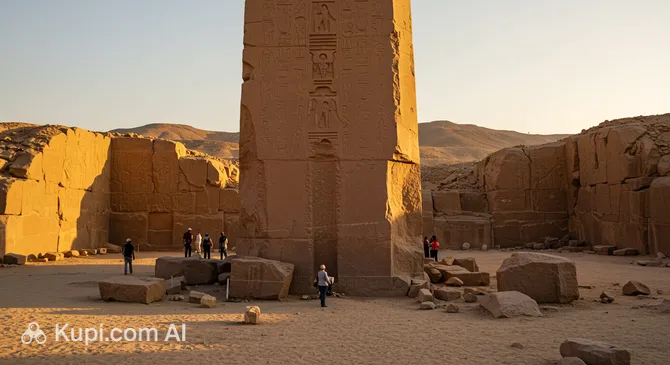
Imagine a giant monument frozen in stone thousands of years ago. The Unfinished Obelisk is not just a monument, but a unique archaeological site that serves as a living testament to the grand engineering visions of Ancient Egypt. It is located directly in an ancient granite quarry in the city of Aswan, still attached to its bedrock.
Unfinished Obelisk. Illustration.
Source: Kupi.com AI
Traveler photos:
This monolith is recognized as the largest known ancient Egyptian obelisk. Its dimensions are mind-boggling even for modern builders: if the work had been completed, the stele's height would have been about 42 meters, and its weight would have reached an incredible 1,200 tons. For comparison, that is roughly the weight of several modern airliners.
Today, the area surrounding the obelisk has been transformed into a fascinating open-air museum. The significance of this site lies not only in the scale of the monument itself but also in how it reveals the secrets of ancient construction technologies, showing us the stone extraction process that is usually hidden behind the finished forms of pyramids and temples.
Contacts
To plan your visit to this unique location in Aswan, it is helpful to review the official details in advance. Below is the essential contact information to help you find the site and locate it using navigation systems.
Please note that the site is managed by the Ministry of Tourism and Antiquities, so you can find the latest updates and ticket prices on their official portal.
The highlight of a visit is the opportunity to stand next to a true giant and literally touch history. While walking through the ancient granite quarry, you can see not only the obelisk itself but also the traces of the workers' titanic labor. Be sure to notice the dolerite balls scattered around—ancient craftsmen used these heavy stones to methodically hammer out channels in the granite to separate the monolith from the rock.
The site is equipped with special paths and viewing bridges that offer excellent views of the cracks and cuts in the stone. This is the best place to take scale photos where a person looks tiny against the backdrop of this stone colossus. The tour provides a clear idea of how complex the process of transporting such objects was in antiquity.
For history enthusiasts, it will be interesting to study the structure of the granite itself and understand why the project was abandoned. Clear layout lines and spots where craftsmen tried to work around defects in the rock are visible. The atmosphere of this place allows you to feel the rhythm of the work that was buzzing here three and a half thousand years ago.
Getting There
Finding the Unfinished Obelisk is easy, as it is located right within the city limits of Aswan, at the northern granite quarry. The most convenient and popular way to get here is by local taxi, which can quickly take you from the Nile Corniche or the city center in just 10–15 minutes.
If you prefer organized travel, almost any local tour operator includes a visit to this quarry in their city sightseeing tours. A group transfer eliminates the need to navigate city streets, although there are clear road signs leading to the site.
For independent travelers, the Sheyakhah Oula residential area, which directly borders the archaeological zone, can serve as a landmark. Although there is no metro in the city, the quarry's proximity to the center makes it easily accessible even for those who prefer local public transport—the microbuses that run along the main streets.
Nearest city: Aswan
History & Facts
The history of the Unfinished Obelisk is inextricably linked to the New Kingdom era and the ambitions of Queen Hatshepsut. Scholars believe that work on this giant began in the 15th century BC. The obelisk was intended to be a pair to the so-called Lateran Obelisk, which originally stood in Karnak and was moved to Rome centuries later.
The fate of this monument was decided by a sudden crack in the granite. Ancient craftsmen discovered the defect when the main shape had already been carved out of the rock. Continuing the work was pointless—the monolith could have simply shattered while being separated from its base. As a result, work was halted, and the obelisk was left lying in its stone cradle for over three thousand years.
For historians, this event was a true gift. Because the monument was never finished, researchers have had the opportunity to study stone-working technologies that the Egyptians kept secret in great detail. Tool marks and channels cut by workers are still visible on the rock surface, allowing for a step-by-step reconstruction of the process of creating the great monuments of antiquity.
Time Needed
To leisurely explore the Unfinished Obelisk and walk through the ancient quarry, most tourists need about 1 to 1.5 hours. This is plenty of time to head up to the viewing platforms, examine the ancient tool marks, and take commemorative photos.
If you have a deep interest in archaeology and plan to study the granite-cutting techniques in detail, or if you simply want to enjoy the views of Aswan from the rocky heights without rushing, you might want to set aside a bit more time. However, given the exposed nature of the site and the scorching sun, a long stay can be tiring.
Working Hours
The Unfinished Obelisk is open to visitors daily. The site operates on a consistent schedule, making it easy to include in a morning or afternoon sightseeing itinerary.
Operating hours every day of the week, including weekends, are from 7:00 AM to 4:00 PM. We recommend arriving at opening time to avoid the midday heat and to explore the quarry before the large tour groups arrive.
7:00 – 16:00
Nearby
A visit to the granite quarry can be easily combined with exploring other iconic Aswan sites. The city is steeped in history, and many interesting locations are in the immediate vicinity or just a few minutes' drive away.
The variety of attractions in this area allows you to see ancient temples, picturesque islands, and even modern cultural centers all in one day. Below is a list of places worth visiting to make your trip as fulfilling as possible.