Support

Deir el-Medina

About

Imagine a place where the everyday history of the greatest masters of antiquity comes to life. Deir el-Medina is a unique ancient Egyptian craftsmen's village located on the West Bank of the Nile, across from the city of Luxor. Unlike the grand temples and royal palaces for which Egypt is famous, this monument offers a glimpse into the private lives of the people whose hands created the masterpieces in the Valley of the Kings and the Valley of the Queens.
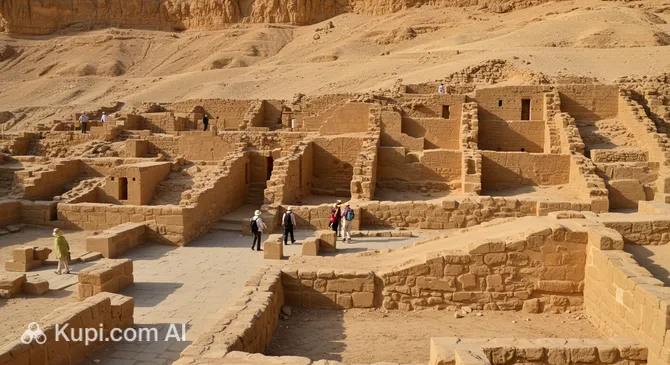
Deir el-Medina
Deir el-Medina. Иллюстрация. Источник: Kupi.com AI

This settlement was a true "city of masters," isolated from the rest of the world to keep the secrets of the royal tombs' layouts hidden. At its peak, the village consisted of 68 mud-brick houses, painted white to protect them from the scorching sun. Today, Deir el-Medina is recognized as a UNESCO World Heritage site and is considered one of the most studied ancient settlements in the world, thanks to thousands of written records—ostraca and papyri—found here.

Walking through the preserved foundations and narrow streets, you can clearly see the layout of the houses, which covered about 70 square meters. Although time has spared only parts of the walls, this place possesses an incredible energy, revealing to tourists the human side of the great civilization that stood behind the creation of eternal monuments.

Contacts

To plan your visit to this unique archaeological site, you can use the following contact details. Although the monument does not have an official website or a direct information phone line, its location is easily found on maps.

How to contactContact
AddressPJH2+37, Al Qarna, Luxor Governorate 1340412, Egypt

What to Do

The main highlight of visiting this site is the opportunity to explore the ruins of residential houses where life once bustled. You can see the clear structure of ancient streets and understand how the dwellings of stonemasons and artists were arranged. This is a rare chance to see the "domestic" side of Ancient Egypt, far from the grandiosity of formal monuments.

Special attention should be paid to the tombs of the workers themselves. Ironically, the burial chambers of simple craftsmen have often survived better than some royal tombs and are striking in their vivid colors. The craftsmen built them for themselves in their spare time, pouring in all their talent; thus, the paintings here are distinguished by an amazing warmth and attention to detail. The most popular tombs to visit are those of Sennedjem and Inherkha.

In the northern part of the complex, you will find the small but elegant Temple of Hathor, built during the Ptolemaic era. Interestingly, during the early Christian period, it was converted into a church, which gave the site its modern name ("Deir el-Medina" translates as "the City Monastery"). Since this location is less popular with mass tours, you can enjoy the silence and examine the monuments without the usual crowds.

Getting There

This archaeological complex is located on the West Bank of the Nile, roughly halfway between Medinet Habu and the Ramesseum. The journey usually begins from the city center, from where you need to cross to the other side of the river.

The most popular and scenic way to get there is to use a local ferry or boat, which run regularly between the banks. After crossing, it is most convenient to hire a taxi or arrange a ride with a tour bus driver. For active tourists, renting a bicycle is an option, though the region's hot climate should be taken into account.

The site is in close proximity to other iconic locations, such as the Valley of the Kings, so it is often included in a comprehensive itinerary of the West Bank's attractions. If you plan to get there on your own, use the address: PJH2+37, Al Qarna, Luxor Governorate.

Ближайший город: Luxor

History & Facts

The history of this site began during the reign of Thutmose I (early 18th Dynasty), when it was decided to create an isolated settlement for the construction elite. The villagers were officially known as the "Servants in the Place of Truth." They were highly skilled stonemasons, painters, and sculptors who, for four centuries, created magnificent tombs for the pharaohs.

Deir el-Medina entered world history not only through the art of its inhabitants but also as the site of the first recorded strike in history. In 1159 BC, due to delays in food supplies and payment, the workers stopped fulfilling orders, providing unique evidence of social struggle in Ancient Egypt.

By the 11th century BC, life in the village became unsafe due to frequent raids and necropolis looting, and the settlement was abandoned. It remained hidden under the sands until the early 20th century. Serious scientific research began here in 1905 under the leadership of Ernesto Schiaparelli, and later Egyptologists Bernard Bruyère and Jaroslav Černý reconstructed a detailed picture of the daily life of ancient masters based on the papyri and ostraca found here.

Time Needed

To leisurely explore the ruins of the ancient settlement, peek into several preserved tombs, and study the details of the Temple of Hathor, most travelers need 2 to 3 hours. This is enough time to soak up the atmosphere, take photos without rushing, and study the information boards.

If you are a passionate archaeology enthusiast and want to closely examine the paintings in the craftsmen's tombs, which are known for their striking detail, it is worth setting aside a bit more time. Given its proximity to other major sites, a visit to Deir el-Medina fits perfectly into a full-day tour of the West Bank.

Working Hours

The attraction welcomes visitors daily, following a consistent schedule throughout the week. This makes it convenient to plan your visit on both weekdays and weekends.

Deir el-Medina Opening Hours:

  • Monday – Sunday: 6:00 AM – 5:00 PM

6:00 – 17:00

Nearby

The West Bank of ancient Thebes is literally steeped in history, and a visit to Deir el-Medina is just one part of a deep dive into the world of Ancient Egypt. Exploring the surroundings will allow you to see the contrast between the modest daily life of the workers and the colossal grandeur of their rulers' mortuary temples.

Key monuments located within a few kilometers that are worth including in your travel plan:

NameDistance
Valley of the Queens0.8 km
Tombs of the Nobles0.8 km
Temple of Amun at Medinet Habu0.9 km
Ramesseum0.9 km
Tomb of Nefertari0.9 km
Mortuary Temple of Hatshepsut1.2 km
Colossi of Memnon1.2 km

Reached the end of the page?

That means the route is fully explored