Support

Luxor Temple Ticket Office

About

On the east bank of the majestic Nile, in the heart of the modern city of Luxor, stands one of the most impressive structures of antiquity—Luxor Temple. This grand architectural monument in Egypt was built in honor of the divine Theban Triad and remained the center of the Ancient World's most important religious ceremonies for centuries.
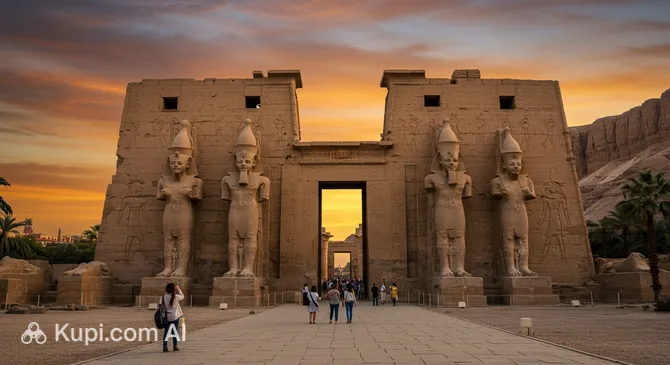
Luxor Temple
Luxor Temple. Иллюстрация. Источник: Kupi.com AI

The temple represents a unique historical synthesis, combining the architectural ambitions of several pharaohs within its walls. One of its most striking features is the continuity of traditions: here, on the site of ancient sanctuaries, the Abu el-Haggag Mosque still stands today. This makes Luxor Temple a rare place on the planet where spiritual life has continued uninterrupted for over 4,000 years.

Strolling among the massive columns and towering pylons, visitors can feel the true scale of Egyptian architecture. The temple is famous for its monumentality, elegant reliefs, and statues that have remained beautifully preserved despite the passing millennia and changing eras.

Contacts

For your convenience, we have gathered the essential contact information to help you plan your visit. Luxor Temple is located in the heart of the city and is easily recognizable.

How to contactContact
AddressMabad Al Oksor, Luxor City, Luxor, Luxor Governorate 1362501, Египет
Websiteru.egy.guide

What to Do

Upon entering the complex, your attention will immediately be drawn to the colossal statues of Ramses II and the majestic 24-meter pylon. Here, you should also take a look at the slender pink granite obelisk—its twin "brother" now adorns the Place de la Concorde in Paris. Be sure to walk along the preserved section of the Avenue of Sphinxes, which once stretched for three kilometers, connecting this site with Karnak.

Inside the complex, it is worth spending time in the Great Colonnade Hall of Amenhotep III. Its 14 columns, with capitals shaped like blooming papyrus, create the feeling of an endless stone forest. No less impressive is the courtyard surrounded by a double row of papyrus-bud columns, where the play of light and shadow highlights the skill of ancient stone carvers.

History enthusiasts will find it interesting to study the wall reliefs. They provide detailed depictions of festival processions, the Opet rites, and scenes of pharaonic military triumphs. Every image is a story frozen in stone, which can be read like an open book of an ancient civilization.

Getting There

The sanctuary is located in the central part of the city on the east bank of the Nile, making it extremely easy to reach. If you are staying in one of the central hotels, you can reach the entrance on foot while enjoying views of the river and the city's Corniche promenade.

For those staying in more distant areas, the most convenient way to get around is by taxi or traditional Egyptian horse-drawn carriages. Numerous minibuses also run throughout the city. You can use the following address for navigation: Mabad Al Oksor, Luxor City, Luxor Governorate 1362501, Egypt.

Ближайший город: Luxor

History & Facts

The history of this sacred site began during the New Kingdom era, around 1400 BC. The main architectural ensemble was established under Pharaoh Amenhotep III. Under the guidance of the prominent architects of that time, the building was transformed into a masterpiece symbolizing the greatness of the gods and the power of the ruler.

Later, Ramses II significantly expanded the complex by adding a huge courtyard and a monumental northern pylon. It is on its walls today that you can see the famous "Poem of Pentaur"—a heroic description of the Battle of Kadesh. Tutankhamun and Horemheb also contributed to the decoration of the halls, adding exquisite reliefs to the walls.

A surprising fact is that at the end of the 3rd century, the temple was integrated into a Roman military fortress. Under the orders of Emperor Diocletian, powerful defensive walls were built around the sanctuary. Over the centuries, religions within the complex changed: ancient Egyptian cults gave way to Christianity and later to Islam, as evidenced by the Abu el-Haggag Mosque, which stands directly upon the ancient foundations.

Time Needed

To fully explore all the architectural details, read the wall inscriptions, and experience the monumentality of the halls, it is recommended to set aside about 2–3 hours for your visit. This is the optimal amount of time for a thoughtful introduction to the site without rushing.

Many tourists prefer to visit the complex at sunset or in the evening. At dusk, the artistic lighting is turned on, transforming the forest of columns into something truly magical, allowing for stunning photos and a chance to enjoy the cool air after a hot day.

Working Hours

The doors of the ancient sanctuary are open to guests daily from 06:00 to 20:00. The site is open every day of the week, allowing tourists to choose the most convenient day for an excursion during their trip.

Since operating hours may change due to public holidays or the season, it is recommended to check for updated information on the official tourism portal or with the museum administration on-site before your visit.

06:00–20:00

Nearby

Exploring the surroundings of this great monument can significantly enrich your experience of the trip. Many interesting locations are *within walking distance* or just a few minutes' drive away, allowing you to see the city from different perspectives.

NameDistance
Abu Haggag Mosque0.1 km
Mummification Museum0.2 km
Luxor Temple0.2 km
Thebes Restaurant0.8 km
Luxor Museum0.9 km
Snobs Restaurant1.6 km
The King's Head Pub1.7 km

Reached the end of the page?

That means the route is fully explored